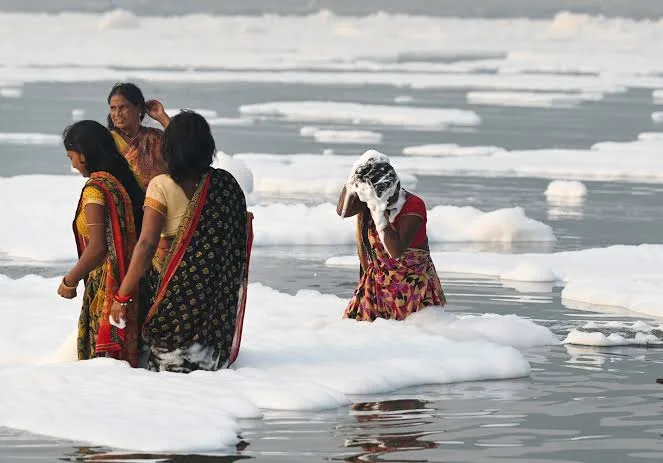
As thousands of devotees prepare to offer arghya to the Sun God during Chhath Puja on November 15 and 16, concerns over the quality of Yamuna water in Delhi have resurfaced. An analysis of Delhi Pollution Control Committee (DPCC) data and satellite imagery by NDTV Datafy has found that none of the seven major riverbank ghats examined meets the government’s prescribed bathing water standards.
However, three locations upstream of Wazirabad, namely Shyam Ghat, Sonia Vihar and Sur Ghat, have comparatively lower pollution levels than the four major ghats downstream. The findings highlight the sharp deterioration in water quality as the river passes through the city.
For devotees observing Chhath Puja in Delhi, the findings are particularly significant because the rituals involve standing in the river during evening and morning prayers. Although the upstream locations are relatively less polluted, the analysis does not establish any of the seven ghats as safe for bathing.

What bathing water standards say about Yamuna pollution
The Centre’s bathing water standards prescribe a biochemical oxygen demand (BOD) level of 3 milligrams per litre (mg/L) or less. BOD measures the amount of oxygen required by microorganisms to break down organic matter in water. Higher readings generally indicate greater organic pollution, much of which in the Yamuna is linked to sewage.
The standards also specify limits for faecal coliform, bacteria associated with human and animal waste. The desirable level is below 500, while the count must not exceed 2,500. Elevated faecal coliform levels indicate possible contamination by disease-causing organisms and increase the risk of gastrointestinal, skin and eye infections if devotees bathe in this water during Chhath Puja.
These parameters are important for assessing the risks faced by devotees entering the river during Chhath Puja in Delhi. Even where the water appears relatively clear, bacterial contamination may remain a concern.
At the Wazirabad monitoring station, BOD levels are around one-third higher than the prescribed limit, while faecal coliform counts are more than twice the desirable level. This indicates that even the comparatively cleaner upstream stretch does not fully meet bathing water requirements.
Also Read | IIT Roorkee student death puts campus mental health support under scrutiny as exams are postponed
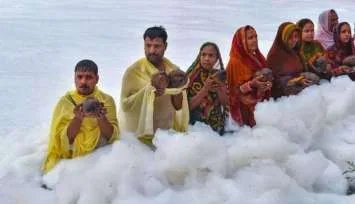
3 Yamuna ghats have comparatively lower pollution levels
Shyam Ghat, Sonia Vihar and Sur Ghat are situated between Palla, where the Yamuna enters Delhi, and Wazirabad. According to the analysis, BOD levels across this stretch range between 2 and 4 mg/L, while faecal coliform readings remain within the maximum permissible limit.
Sur Ghat is located a few hundred metres downstream of the DPCC’s Wazirabad monitoring station. The pollution control body does not collect samples directly near Shyam Ghat or Sonia Vihar. However, both locations fall between its Palla and Wazirabad monitoring points.
Satellite images analysed by NDTV Datafy also indicate that the water near Shyam Ghat and Sonia Vihar is comparatively clear, with lower algae levels similar to those observed at Sur Ghat.
The three locations therefore emerge as relatively better options for devotees seeking to offer prayers near the Yamuna during Chhath Puja in Delhi. However, lower pollution does not mean that the water is completely safe. The Wazirabad readings show that even this stretch falls short of at least some prescribed bathing water standards.
Also Read | PM Modi outlines 5 priorities for agriculture to achieve Viksit Bharat goal
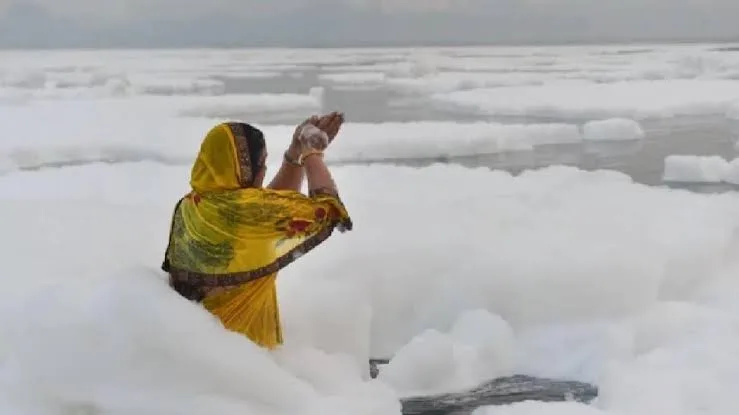
Pollution rises sharply downstream of Wazirabad
The situation changes considerably after the river passes Wazirabad. At the ISBT Bridge monitoring station, BOD levels rise from around 4 mg/L to 30 mg/L. Faecal coliform counts also increase sharply, from approximately 1,300 to 35,000.
Vasudev Ghat and Nigambodh Ghat near Kashmere Gate, which are situated close to the ISBT Bridge monitoring station, record particularly high pollution levels. Their faecal coliform count is around 14 times the maximum permissible limit.
ITO Chhath Ghat and Kalindi Kunj show comparatively lower readings than the two locations near ISBT Bridge. However, faecal coliform levels at these locations remain around seven to eight times the permissible limit, making them unsuitable for bathing under the prescribed standards.
The analysis also points to a substantial increase in phosphate levels between Wazirabad and ISBT Bridge. The concentration rises approximately eightfold, providing nutrients that encourage algae growth.
Satellite imagery from October, based on Sentinel-2 observations, reinforces the findings. The three upstream ghats have clearer water and weaker algae signals. Downstream of Wazirabad, the river appears murkier, while the algae signal is around three times stronger.
Kalindi Kunj records the highest readings on both indicators, partly because relatively stagnant water and aquatic weeds behind the Okhla barrage can influence the measurements. The stretch has also been reported to have white toxic foam floating on the water’s surface.
As Chhath Puja in Delhi approaches, the findings underline the continuing challenge of Yamuna pollution. While some upstream locations are relatively less contaminated, none of the seven major ghats assessed meets all the government’s bathing water requirements.
Leave a Reply