Blog

  • 5 things to know about the Congress’s Rs 81.45 lakh payment to The Indian Express during the Bengal polls

    5 things to know about the Congress’s Rs 81.45 lakh payment to The Indian Express during the Bengal polls

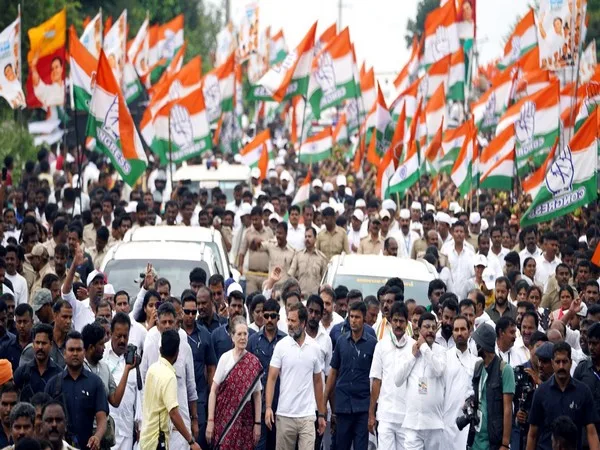
    A Rs 81.45 lakh expenditure entry involving The Indian Express has triggered a political controversy over Congress’s election spending and its relationship with media organisations during the West Bengal Assembly elections. The payment, cited from Congress expenditure records, has been highlighted by critics amid a separate dispute over the newspaper’s recent reports concerning the Election Commission, electoral-roll revision and changes related to Form 6.

    The controversy gained momentum after Supreme Court senior advocate Mahesh Jethmalani claimed on social media that the payment was evidence of a connection between Congress and The Indian Express. His allegation has been reported by the Navbharat Times. However, the existence of an expenditure entry and an allegation of editorial influence are two different things. The available expenditure record establishes a payment but does not by itself establish that Congress influenced the newspaper’s editorial decisions.
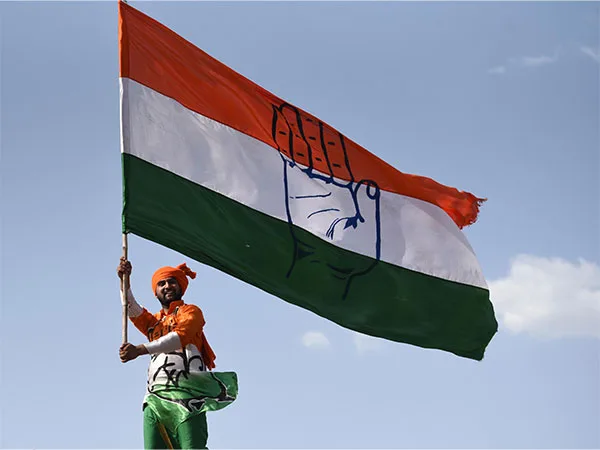
    A Rs 81.45 lakh expenditure entry involving The Indian Express has triggered a political controversy over Congress's election spending and its relationship with media organisations during the West Bengal Assembly elections. (ANI)
    A Rs 81.45 lakh expenditure entry involving The Indian Express has triggered a political controversy over Congress’s election spending and its relationship with media organisations during the West Bengal Assembly elections. (ANI)

    Congress’s payment to The Indian Express recorded during Bengal polls

    The central figure in the controversy is Rs 81,45,780, which the cited Congress expenditure material records as a payment to The Indian Express during the West Bengal election period.

    The timing has attracted particular attention because The Indian Express has recently been involved in a political dispute over its reporting on the Election Commission’s handling of the Special Intensive Revision of electoral rolls. Critics of the newspaper have questioned its coverage, while the Election Commission has rejected several interpretations surrounding its internal decision-making and Form 6.

    The Congress’s payment to The Indian Express therefore became a talking point in the wider political debate. The organiser reported that the expenditure document establishes the payment but does not establish an editorial quid pro quo.

    Congress, like other political parties, incurs substantial election expenditure on advertising, publicity and campaign-related activities. Recent expenditure reporting has also shown the scale of spending by other parties. For instance, The Indian Express reported that the BJP spent Rs 529.38 crore across the latest round of Assembly elections, including Rs 286 crore in West Bengal.

    Also Read | LPU violence: Rape claim, student death and hostel demands explained

    The central figure in the controversy is Rs 81,45,780, which the cited Congress expenditure material records as a payment to The Indian Express during the West Bengal election period. (ANI)
    The central figure in the controversy is Rs 81,45,780, which the cited Congress expenditure material records as a payment to The Indian Express during the West Bengal election period. (ANI)

    Congress’s payment to The Indian Express is part of wider media spending

    The Bengal payment was not the only media-related expenditure cited in the material under discussion. The records also contain substantial payments involving other media organisations.

    For Kerala, the entries cited include Rs 76.47 lakh to Veekshanam, Rs 42.48 lakh to Jaihind TV and Rs 28.37 lakh to The New Indian Express. The cited material puts these payments together at more than Rs 1.47 crore.

    The records also point to expenditure involving Udayavani and India Express during the 2023 Karnataka Assembly election. The entries cited in the controversy amount to more than Rs 2.32 crore.

    These figures provide context for the Congress’s payment to The Indian Express in Bengal. Political parties routinely use newspapers, television channels and digital platforms for election publicity. Consequently, a payment to a media organisation cannot automatically be treated as proof that its editorial coverage was purchased or directed.

    That distinction is particularly important in the present controversy because the allegation of editorial influence goes beyond what the expenditure record itself demonstrates.

    Also Read | What actually is the ‘virtue of higher seeding’? Here is how it helped India reach the semis of Asian Games
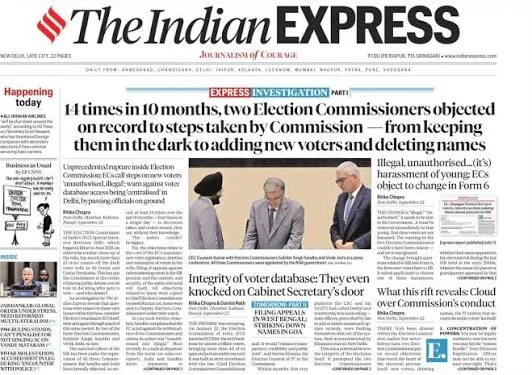
    The political controversy has intensified because of the timing of the payment and The Indian Express's recent reporting on the Election Commission. (The Indian Express Newspaper)
    The political controversy has intensified because of the timing of the payment and The Indian Express’s recent reporting on the Election Commission. (The Indian Express Newspaper)

    What the Rs 81 lakh record proves and does not prove

    The political controversy has intensified because of the timing of the payment and The Indian Express’s recent reporting on the Election Commission.

    The newspaper has published reports concerning disagreements or concerns raised during discussions within the poll panel over aspects of the Special Intensive Revision and Form 6. The Election Commission, however, has maintained that its final decisions were unanimous and has rejected suggestions that its internal discussions represented a breakdown in institutional functioning.

    The BJP has also challenged aspects of the newspaper’s reporting, particularly claims concerning the authority of Electoral Registration Officers and the SIR-related material accompanying Form 6.

    Against this backdrop, the Congress’s payment to The Indian Express has been cited by critics as a reason to question the newspaper’s relationship with the Congress party. Mahesh Jethmalani has gone further, describing the payment as evidence of a deeper connection. His claim is an allegation, rather than an established finding.

    The available expenditure record establishes that money was paid. It does not establish that the payment was made in return for favourable coverage, that Congress dictated editorial decisions, or that a particular report was commissioned by the party.

    Establishing such a link would require additional evidence beyond an election expenditure entry.

    The episode nevertheless highlights a broader question about transparency in political advertising. Readers can reasonably distinguish between paid election publicity and independent editorial content, particularly when a media organisation is reporting on institutions and political issues that directly affect the parties funding election campaigns.

    For now, the Rs 81.45 lakh figure remains a documented expenditure entry at the centre of a political dispute, while claims about its impact on editorial coverage remain allegations that require separate evidence.

  • Want a protein-rich chicken recipe? Try dahi tadka chicken at home

    Want a protein-rich chicken recipe? Try dahi tadka chicken at home

    If regular chicken curry has started feeling repetitive, this dahi tadka chicken recipe offers a creamy and flavourful alternative. Shared by chef Saloni Kukreja as part of her ‘AirFryerMaxxing’ series, the recipe combines air-fried chicken breast with Greek yoghurt and a tempering of mustard seeds, curry leaves and green chillies.

    The chicken is air-fried instead of deep-fried, while Greek yoghurt forms the creamy base of the dish. The recipe can be served with roti or paratha.

    Also Read | Depression Is Not Just a Lifestyle Problem. Here’s Why

    Why try this dahi tadka chicken recipe?

    The recipe uses 400g chicken breast and Greek yoghurt, both of which are sources of protein. The chicken is air-fried with a drizzle of oil, reducing the need for deep-frying.

    The yoghurt mixture gets its flavour from a tadka made with ghee, mustard seeds, curry leaves, green chillies, red chilli powder and turmeric. Lime juice, ginger-garlic paste and spices add flavour to the chicken marinade.

    How to make dahi tadka chicken at home?


    Ingredients


    400g chicken breast, cut into pieces
    1 tbsp lime juice
    ½ tsp salt
    ½ tsp pepper
    ½ tsp chilli powder
    ¼ tsp coriander powder
    1 tbsp ginger-garlic paste
    1 small onion, sliced
    Coriander, for garnish
    ¾ cup Greek yoghurt
    1 tbsp ghee
    ¼ tsp red chilli powder
    Salt and pepper, to taste
    A pinch of turmeric powder
    2 tsp mustard seeds
    1 sprig curry leaves
    2 green chillies, slit


    Method

    1. Marinate the chicken:
      Add lime juice, salt, pepper, chilli powder, coriander powder and ginger-garlic paste to the chicken. Mix well and leave it to marinate.
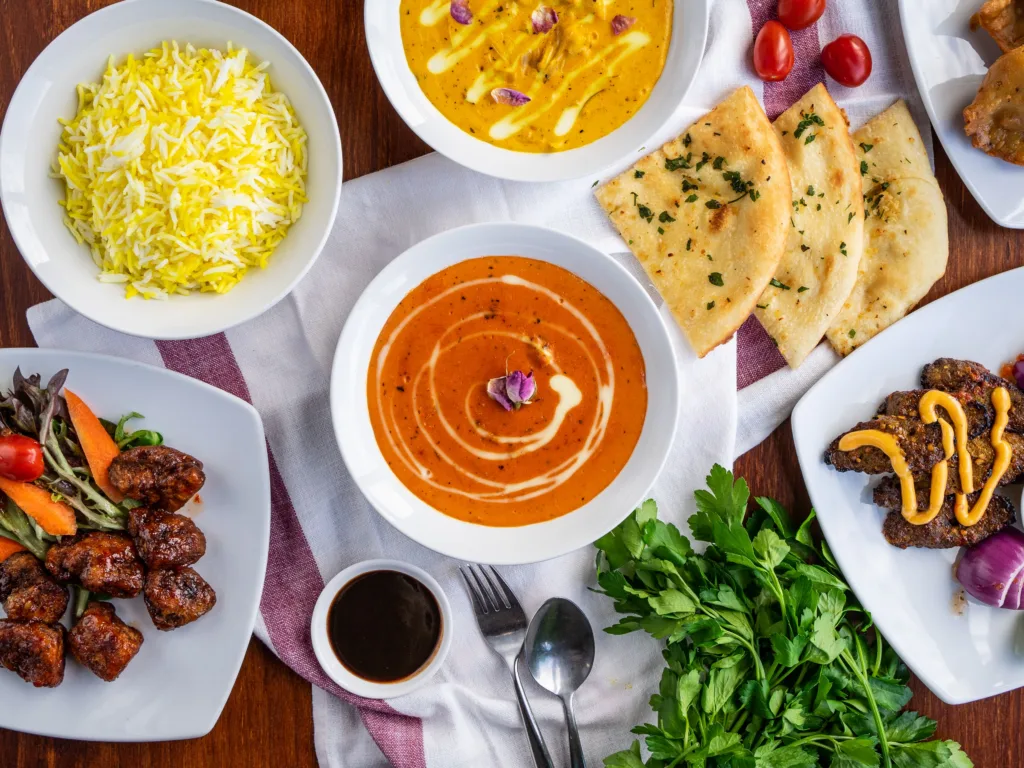
    Bored of regular chicken curry? This creamy dahi tadka chicken adds a protein-rich twist to your meal.
    Bored of regular chicken curry? This creamy dahi tadka chicken adds a protein-rich twist to your meal / Pexels
    1. Air-fry the chicken:
      Place the marinated chicken pieces on a parchment-lined tray and drizzle with oil. Air fry at 230°C for around 15 minutes, or until the chicken is cooked and crispy.
    2. Prepare the tadka:
      Heat ghee in a pan. Add mustard seeds, slit green chillies, curry leaves, red chilli powder and turmeric powder. Let the mixture crackle.

    Also Read | Instagram’s AI Feature Makes Soft Launching Your Relationship Easier

    1. Add the tadka to the yoghurt:
      Pour the hot tadka into the Greek yoghurt and stir well.
    2. Assemble:
      Add the air-fried chicken to the yoghurt mixture and combine. Garnish with chopped coriander and sliced onions.

    Serve with roti or paratha.

    Source note: This recipe is based on user-generated social media content shared by chef Saloni Kukreja.

  • TMC rebel MLAs: Supreme Court sets October 8 timeline from Bengal Speaker

    TMC rebel MLAs: Supreme Court sets October 8 timeline from Bengal Speaker

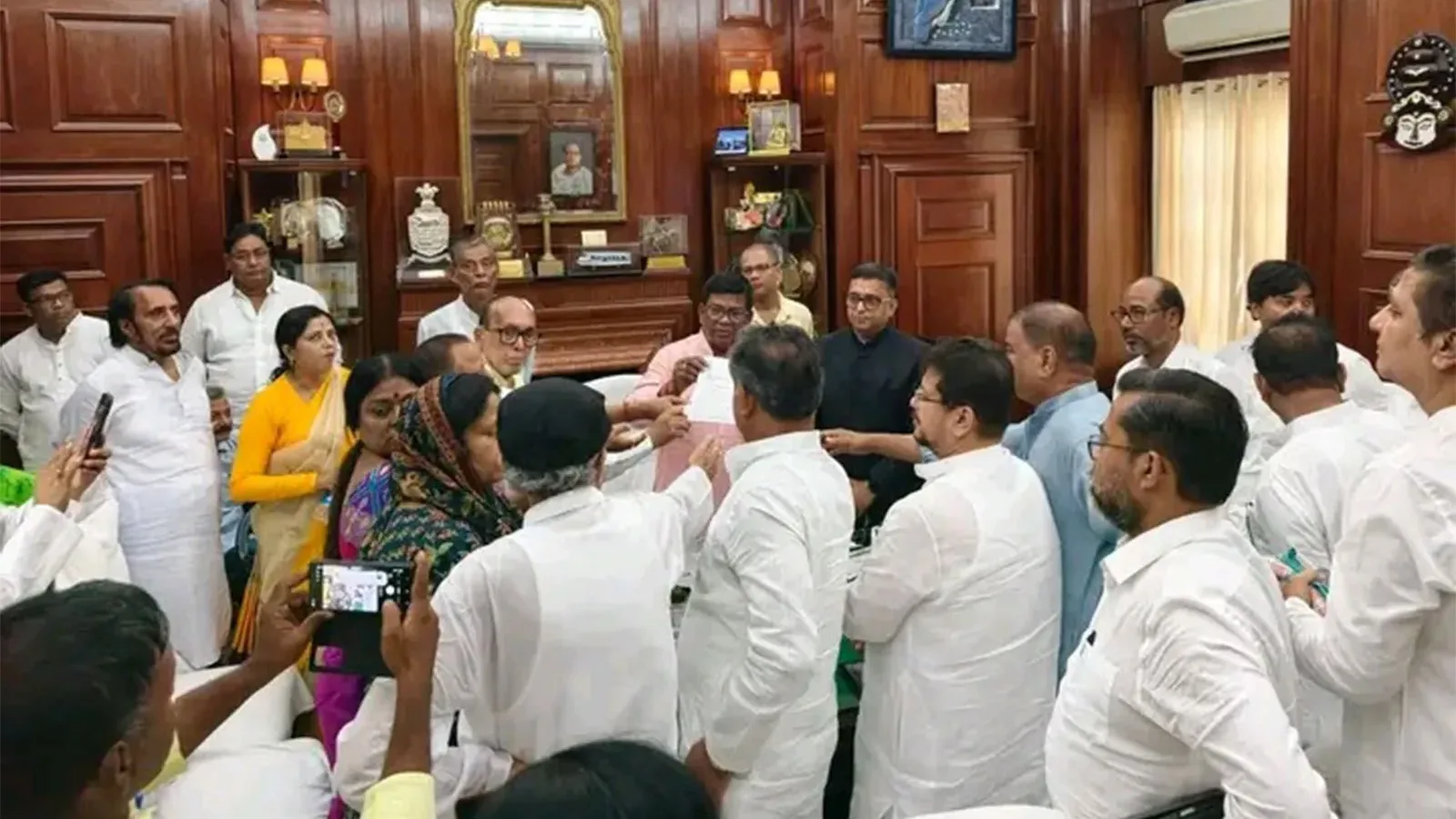
    The Supreme Court on Monday said West Bengal Assembly Speaker Rathindra Nath Bose has time until October 8 to decide disqualification petitions filed against 10 rebel Trinamool Congress (TMC) MLAs.

    The petitions were filed on July 8 by TMC leader Sohandeb Chattopadhyay.

    A three-judge bench headed by Chief Justice of India Surya Kant and comprising Justices Joymalya Bagchi and V Mohana referred to the Supreme Court’s 2020 ruling on disqualification proceedings while dealing with the matter.

    Also Read | BJP’s Bengal poll bill exceeds Congress’ spend across five polls

    The court said the Speaker, while deciding such petitions, acts as a tribunal and is expected to take a decision within a reasonable period.

    What the Supreme Court said on TMC rebel MLAs

    The bench relied on its earlier judgment in Keisham Meghachandra Singh v Speaker, Manipur Legislative Assembly, decided in 2020. In that case, the Supreme Court had held that a Speaker exercising powers over disqualification petitions acts as a tribunal.

    The court noted that the 2020 judgment had prescribed a three-month period for the Manipur Speaker to decide the pending disqualification petitions.

    Applying that principle to the West Bengal case, the bench said the Speaker should follow the same timeline.

    The bench stated, “We have every reason to believe that the Speaker is fully cognisant” of the principles laid down by the court and would make efforts to take an appropriate decision within the prescribed period.

    The Supreme Court ultimately disposed of the petition after taking the earlier ruling into account. It did not keep the matter pending despite a request from the petitioner’s side.

    Who filed the disqualification petitions?

    The petition before the Supreme Court was filed by senior TMC leader Sohandeb Chattopadhyay. He had also filed the disqualification petitions against the 10 rebel MLAs in the West Bengal Assembly.

    The legislators named in the proceedings include Ritabrata Banerjee, Arup Roy, Firhad Hakim, Sandipan Saha, Akhuruzzaman Ansari, Shiuli Saha, Sabina Yasmin, Biplab Mitra, Javed Khan and Rathin Ghosh.

    Senior advocate Kapil Sibal appeared for Chattopadhyay. He asked the Supreme Court to keep the matter pending, pointing out that similar issues were arising in several proceedings.

    The bench, however, declined that request. During the hearing, the court remarked that there were several proceedings in which judicial timelines had not been followed, saying it was “gloriously in breach” of such timelines.

    What is the TMC rebel MLAs dispute?

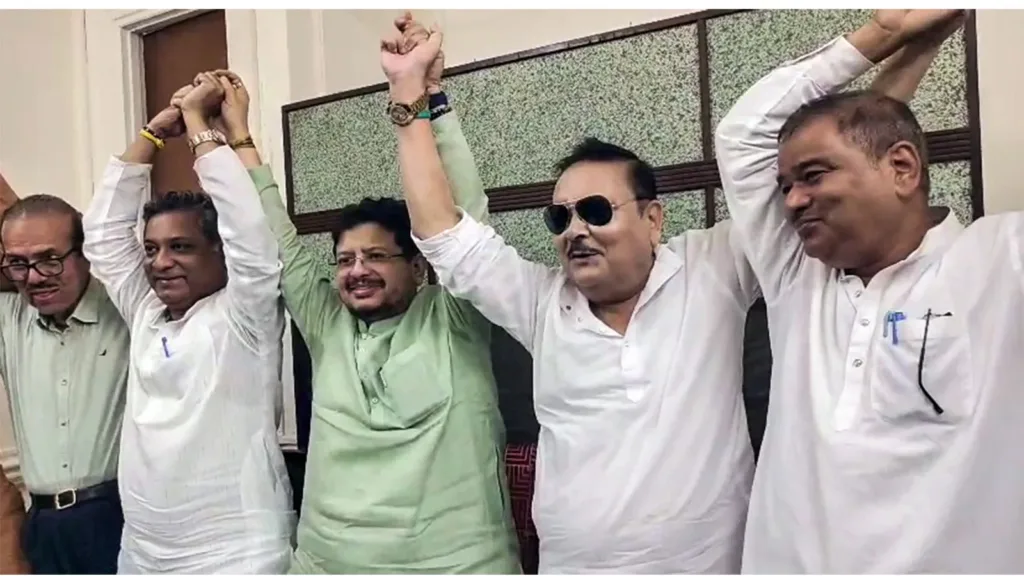
    The dispute follows the political developments after the 2026 West Bengal Assembly election. According to the Hindustan Times report, around 58 newly elected TMC MLAs broke away from the party and backed Ritabrata Banerjee as Leader of the Opposition. The group described itself as the “real TMC”.

    SC sets October 8 timeline for rebel MLAs’ pleas.
    SC sets October 8 timeline for rebel MLAs’ pleas.(ANI)

    The TMC subsequently expelled Ritabrata Banerjee and Sandipan Saha, citing “anti-party” activities. The disqualification proceedings against the 10 MLAs form part of the wider dispute involving the rival TMC factions.

    The Supreme Court’s order does not itself decide whether any of the 10 MLAs should be disqualified. That decision remains with the West Bengal Assembly Speaker under the applicable proceedings.

    Separate case involving 20 rebel TMC MPs

    The West Bengal Assembly case is separate from another disqualification matter involving 20 rebel TMC Members of Parliament.

    TMC general secretary Abhishek Banerjee has filed a separate petition in the Supreme Court seeking an expedited decision on disqualification petitions against the 20 rebel MPs pending before the Lok Sabha Speaker.

    Also Read | Chief Minister Suvendu Adhikari promises major investments in Bengal; Adani hospital project set to begin 

    The October 8 timeline discussed in Monday’s order concerns the 10 rebel MLAs in the West Bengal Assembly. It should not be confused with the separate proceedings involving the 20 rebel MPs in the Lok Sabha.

    Reports on the latter indicate that October 8 is the deadline given to the MPs to submit their replies, rather than a court-imposed deadline for the Lok Sabha Speaker to deliver a final decision.

    The Supreme Court’s latest order therefore places the focus on the West Bengal Assembly Speaker’s handling of the 10 disqualification petitions, with October 8 now marking the timeline referred to by the court.

  • Calm restored at SRFTI campus after clash between students and ABGP

    Calm restored at SRFTI campus after clash between students and ABGP

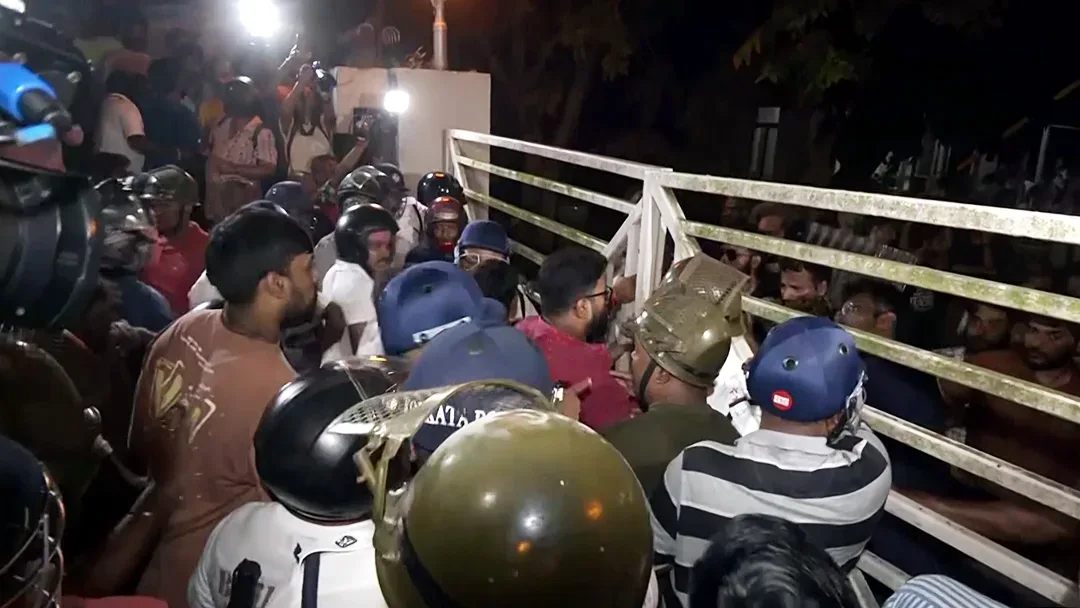
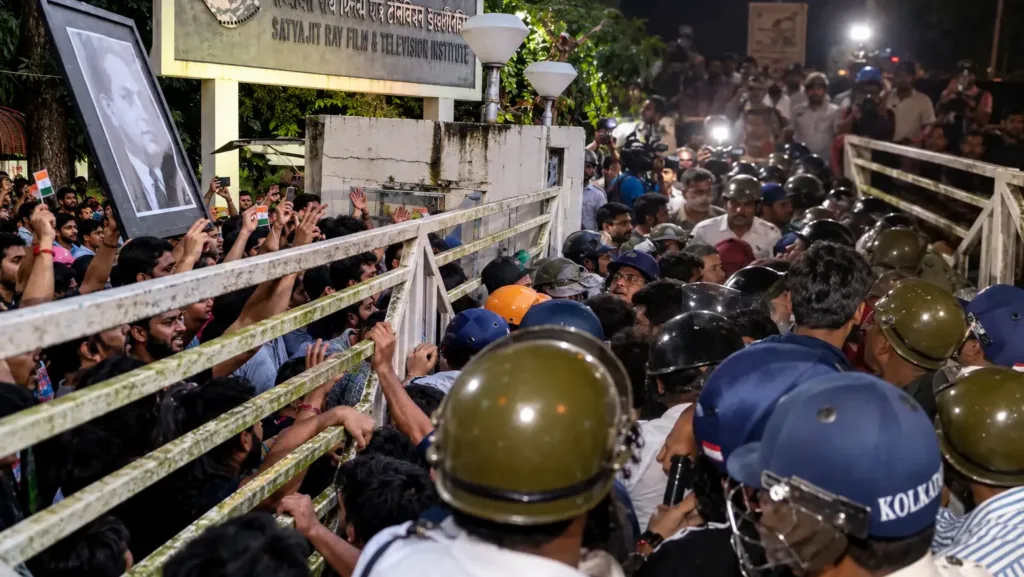
    Police maintained a presence outside the main gate of the Satyajit Ray Film and Television Institute (SRFTI) in Kolkata on Monday, a day after a clash between a section of students and members of the Akhil Bharatiya Grahak Panchayat (ABGP) left several people injured.

    The situation remained calm on Monday as students returned to their classes and no gathering of outsiders was seen outside the institute. A senior police officer was present near the main gate as authorities continued to look into the violence reported on Sunday. An SRFTI official said, “Today the situation is normal. Outsiders have dispersed, while students have resumed classes.”

    Cases Filed Over SRFTI Campus Clash

    A senior police officer said cases had been registered by both sides, along with a suo motu case, at the nearby Panchasayar police station in connection with Sunday’s incident. The clash involved students and members of ABGP, with both sides accusing each other of assault.

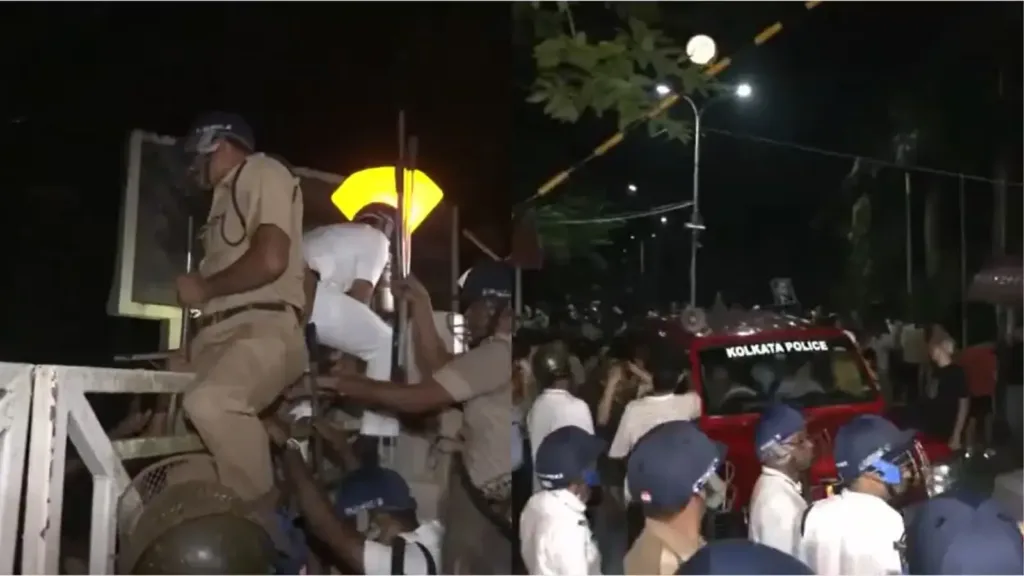
    A clash broke out between members of the SFI and the Akhil Bharatiya Grahak Panchayat during an event organised by the Akhil Bharatiya Grahak Panchayat at the SRFTI auditorium, in Kolkata on Sunday.
    A clash broke out between members of the SFI and the Akhil Bharatiya Grahak Panchayat during an event organised by the Akhil Bharatiya Grahak Panchayat at the SRFTI auditorium, in Kolkata on Sunday. Credit: X/ANI

    The dispute began during an ABGP programme that was being held at the institute’s auditorium. According to ABGP state leaders, the organisation had obtained permission from the authorities and paid to use the venue for the event. The programme started at around 10 am on Sunday.

    Students Object To Outside Programme

    According to the accounts provided by the students, the trouble began after some students noticed people from outside the institute attending the programme.

    A section of students questioned the authorities about allowing a private organisation with right-wing links to hold an event on the SRFTI campus. The students then put up posters near the auditorium to register their protest.

    The situation reportedly escalated when students and members of the organising group entered into a heated exchange.

    The students’ association later alleged that speakers at the event delivered “highly provocative speeches”. It further claimed that members of the organisation used terms such as “anti-national”, “urban Naxals” and “terrorists” while referring to students.

    The students’ body also alleged that female students were manhandled during the confrontation.

    Students Allege Assault With Knives

    The confrontation later turned violent, according to the students’ account. The students’ association alleged that some ABGP members assaulted students with knives.

    The students claimed four students suffered serious injuries, while several others were also hurt.

    A student, speaking to a news channel on Sunday, described how the confrontation unfolded.

    “We were having our practical classes in the auditorium. When we saw people from outside holding a programme there, some of us protested and put up posters on the wall. The members of the organisation then came towards us and started beating us up. We somehow managed to escape towards the hostel,” the student said. An institute teacher also alleged that he and some of his colleagues were assaulted after they intervened in the confrontation.

    Following the clash, protests took place inside the campus. Students subsequently locked the main gate and staged a sit-in, demanding action against those they alleged had attacked them.

    The students’ body claimed that around 150 students remained inside the campus and alleged that they had been “surrounded by goons”.

    It also claimed that six policemen had detained the main accused inside a police vehicle, while a crowd outside the campus was demanding their release.

    ABGP Rejects Allegations

    ABGP rejected the students’ allegations and presented a different account of the incident.

    Also Read | BJP Bengal poll spend: Influencers named in ECI filings

    The organisation claimed that its programme had been disrupted after students objected to the event and tore posters and banners, including images of Bharat Mata and Swami Vivekananda.

    An ABGP member told reporters, “We had paid ₹15,000 to hire the auditorium and had obtained permission from the authorities. Our organisation works mainly for consumer protection and awareness. But an attempt was made to disrupt our programme, and posters were torn.”

    The ABGP member also alleged that several members of the organisation were injured during the confrontation and said four of them had been admitted to hospital.

    SRFTI campus unrest continues as outsiders gather at the gate at night; students and professors remain inside.
    SRFTI campus unrest continues as outsiders gather at the gate at night; students and professors remain inside. Credit: X/ANI

    ABGP Calls Event A Consumer Rights Programme

    ABGP state president Pankaj Roy described the programme as an event focused on consumer rights with a “nationalist vision”.

    He alleged that some students objected to a picture of Bharat Mata displayed at the venue. Roy also claimed that people attending the programme, including women, were harassed.

    Also Read | Kolkata Police cracks down on civic volunteers with new SOP

    With cases filed by both sides, the incident is now being examined by the police. On Monday, however, the situation at SRFTI remained normal, with students attending classes and no fresh disturbance reported outside the institute.

  • LPU violence: Rape claim, student death and hostel demands explained

    LPU violence: Rape claim, student death and hostel demands explained

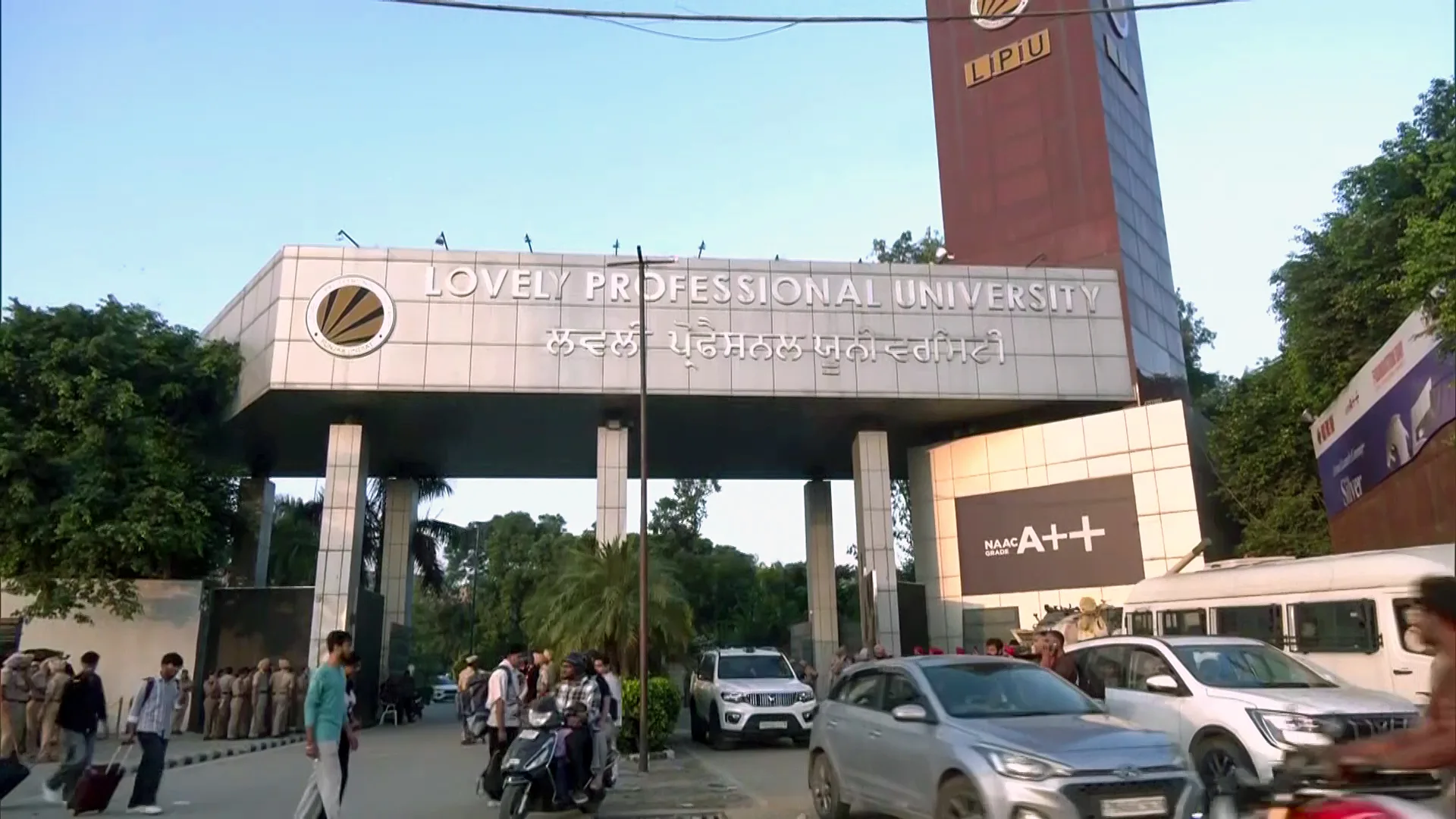
    Violent protests at Lovely Professional University (LPU) in Phagwara, Punjab, escalated into vandalism, arson, clashes with police and a blockade of NH-44 after students raised allegations of sexual assault involving a female student and questions over the death of another student.

    The allegations surrounding the reported sexual assault have not been established. Police have registered a rape case against an unidentified person and formed a seven-member Special Investigation Team (SIT) to investigate the matter. LPU, meanwhile, has denied that a rape took place on campus and described the reports as false and fabricated.

    Also Read | 4 injured as chutney dispute sparks street brawl in Hapur market

    The unrest began around the girls’ hostel early Sunday and later spread across the campus and the adjoining highway. Police said the situation returned to normal by Monday, while NH-44, which had remained blocked for more than 15 hours, was restored.

    What triggered the LPU protest?

    The immediate trigger was a series of claims circulating among students and on social media that a female student had allegedly been sexually assaulted by a construction worker or plumber at a girls’ hostel.

    Students also alleged that the hostel warden had been informed but had not taken the matter to the police. These claims formed the basis of a complaint by protesting students, according to police.

    Violence erupted at Lovely Professional University in Punjab’s Phagwara
    Students block the national highway, followed by a protest outside Lovely Professional University (LPU), in Phagwara on Sunday. (ANI Video Grab)

    Jalandhar Range DIG Naveen Singla said investigators would examine forensic evidence, CCTV footage and call records before reaching a conclusion. Police subsequently registered a case against an unknown person and constituted a seven-member SIT. Five representatives of the protesting students were also included in the probe, according to Singla.

    The police investigation is therefore still ongoing, and the allegation should not be treated as established fact.

    How did the Telangana student’s death become part of the protests?

    Students also raised the case of 21-year-old Laxmi Chandra, a BTech Agriculture student from Telangana, who died after allegedly jumping from the seventh floor of a girls’ hostel on September 10.

    Police said the circumstances surrounding her death were being investigated. Singla said Laxmi’s parents had visited the university and that her mobile phone had been sent for forensic examination.

    Police have said that if evidence suggests foul play, appropriate action will follow. The available material does not establish a connection between her death and the separate sexual assault allegation.

    What did LPU say about the rape allegation?

    LPU has denied that a rape occurred on its campus and described the reports circulating on social media as “false”, “baseless” and “fabricated”.

    Registrar Monica Gulati said certain people were spreading allegations through social media and creating confusion among students. Vice-Chancellor Jaspal Singh Sandhu said the university would cooperate with the investigation.

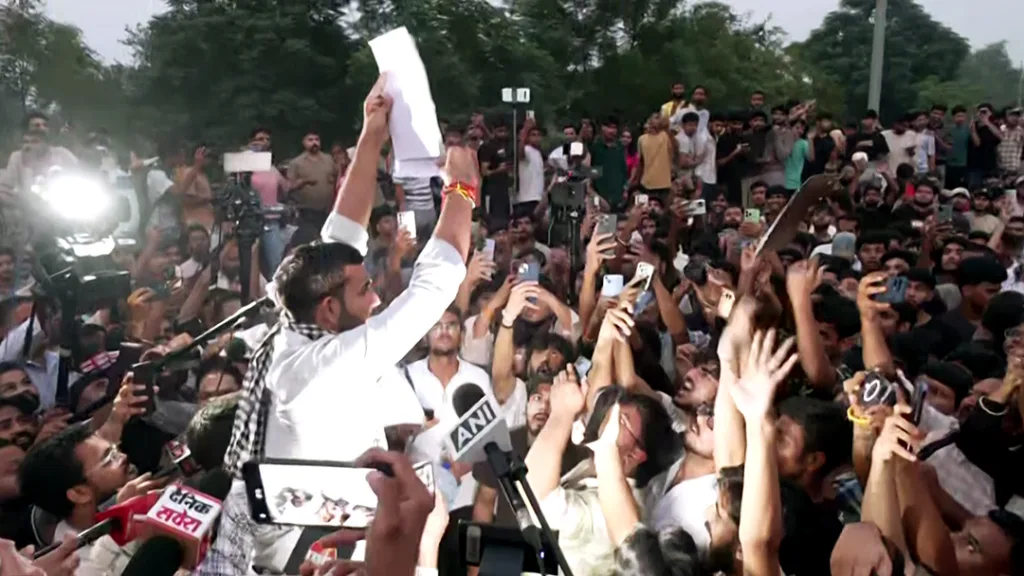
    LPU protests turn violent over an unverified rape allegation.
    Students hold a protest at Lovely Professional University (LPU), in Phagwara on Sunday. (ANI Video Grab)

    LPU also released a video featuring three female students who said they were staying in the hostel room identified in the allegations and denied that a rape had taken place there.

    How did the LPU protest turn violent?

    The protest began near the girls’ hostel around 1 am on Sunday before escalating as the number of protesters grew.

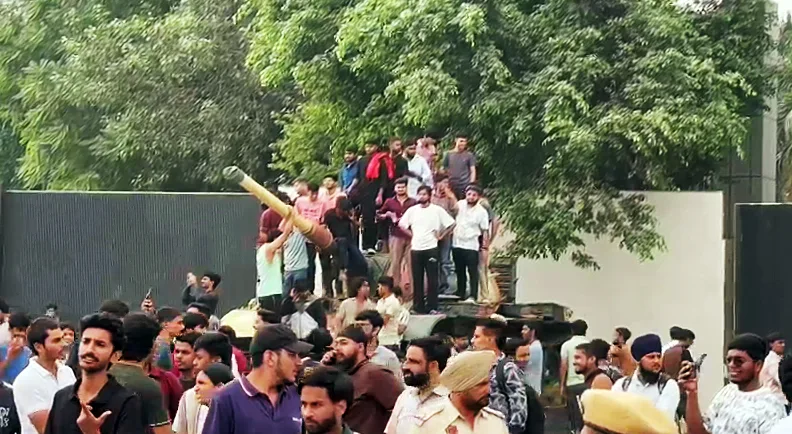
    Protesters damaged administrative buildings and other campus property, while videos showed broken windows, burning objects and damage to shops. Some protesters also climbed onto a decommissioned MiG-23 aircraft and a military tank installed on the campus.

    The protesters later blocked NH-44, disrupting traffic between Jalandhar and Phagwara for more than 15 hours.

    The confrontation with police intensified on Sunday evening. Police said protesters threw stones at personnel and attacked police vehicles, after which a lathi charge was carried out. Several police personnel were injured, while vehicles were damaged and some were set on fire.

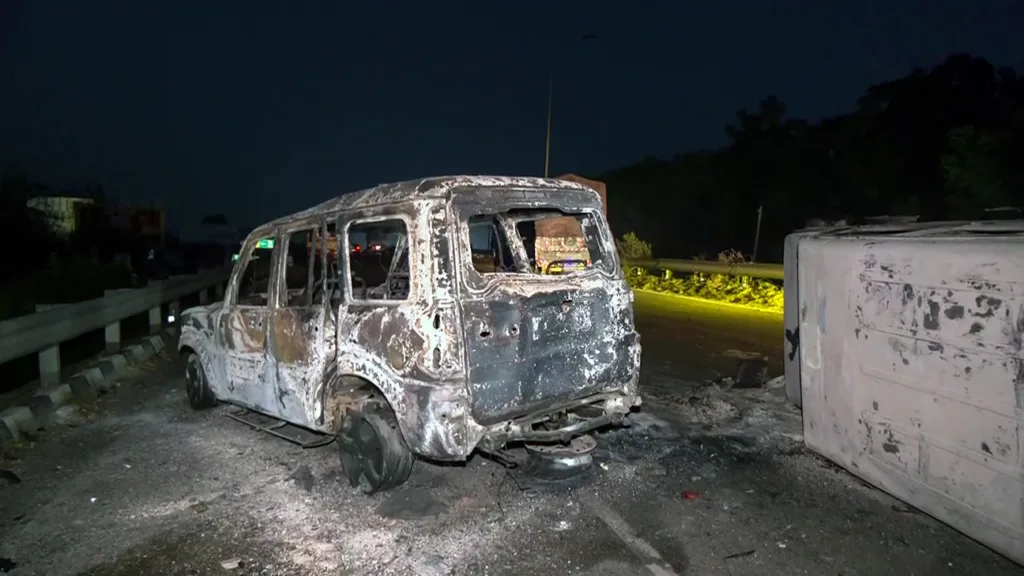
    A view of the completely gutted vehicle(s) following the protests by the students of Lovely Professional University (LPU) that turned violent over the alleged rape of a female student and inaction by the authorities in Phagwara, Kapurthala, on Monday. (ANI Video Grab)
    A view of the completely gutted vehicle(s) following the protests by the students of Lovely Professional University (LPU) in Phagwara, Kapurthala, on Monday. (ANI Video Grab)

    Punjab Police subsequently deployed more than 2,000 personnel and conducted a flag march on the campus, according to officials cited in the source material.

    What were students demanding?

    Apart from the sexual assault allegation, students raised concerns about hostel safety and security.

    Punjab DGP Gaurav Yadav said one of the demands was that only women staff should be present in girls’ hostels. DIG Singla also said female students had sought an all-women hostel staff.

    Authorities said discussions were held with students and the university administration to address these concerns.

    Police have also said they found indications that outsiders may have entered the campus during the unrest. Kapurthala SSP Gaurav Toora said four or five people were detained late Saturday night, including one person carrying a walkie-talkie. Police said they were investigating the circumstances of their presence.

    What is the situation at LPU now?

    By Monday, police said the situation on campus had returned to normal, with heavy deployment at the university gates. NH-44 was also reopened.

    Also Read | 3-day bank strike deferred as panel takes up 5-day week demand

    LPU has suspended regular classes for 10 days from September 28 and postponed its mid-term examinations until further notice. Students have been allowed to travel home in consultation with their parents or guardians, while those staying on campus have been advised to remain inside their hostels or residences and avoid unnecessary movement.

    Police said the investigation into the sexual assault allegation remains underway. The SIT is expected to examine CCTV footage, forensic material, call records and other evidence before drawing conclusions.

  • What actually is the ‘virtue of higher seeding’? Here is how it helped India reach the semis of Asian Games

    What actually is the ‘virtue of higher seeding’? Here is how it helped India reach the semis of Asian Games

    India secured a place in the men’s cricket semi-finals at the 2026 Asian Games after their quarter-final against Afghanistan was abandoned due to rain in Nisshin, Japan. No ball was bowled in the match, but the washout did not prevent India from progressing to the next stage.

    The Asian Games cricket rules provide an advantage to the higher-seeded team when a knockout fixture cannot produce a result. Since India entered the quarter-finals as a higher seed, they advanced to the semi-finals after the match was called off.

    What Is The ‘Virtue Of Higher Seeding’?

    The phrase “virtue of higher seeding” refers to the advantage given to a team that has been placed higher in the tournament’s seeding system.

    Also Read | 4 injured as chutney dispute sparks street brawl in Hapur market

    In a knockout match, both teams normally need a result to determine who moves forward. However, when weather conditions make a game impossible, the competition regulations can provide a route for the higher-seeded side to progress.

    That is what happened in the India vs Afghanistan quarter-final. Persistent rain meant the fixture could not begin, with no toss or delivery taking place. As there was no result on the field, India’s higher seeding became decisive.

    The progression was therefore not based on runs scored, wickets taken or a Duckworth-Lewis-Stern calculation. Instead, the tournament’s no-result provision allowed the higher-seeded team to move into the semi-finals.

    Why Did India Have Higher Seeding?

    India’s position in the knockout stage was linked to the format of the Asian Games men’s cricket competition. As the defending champions, India were among the four teams that received direct entry into the quarter-finals.

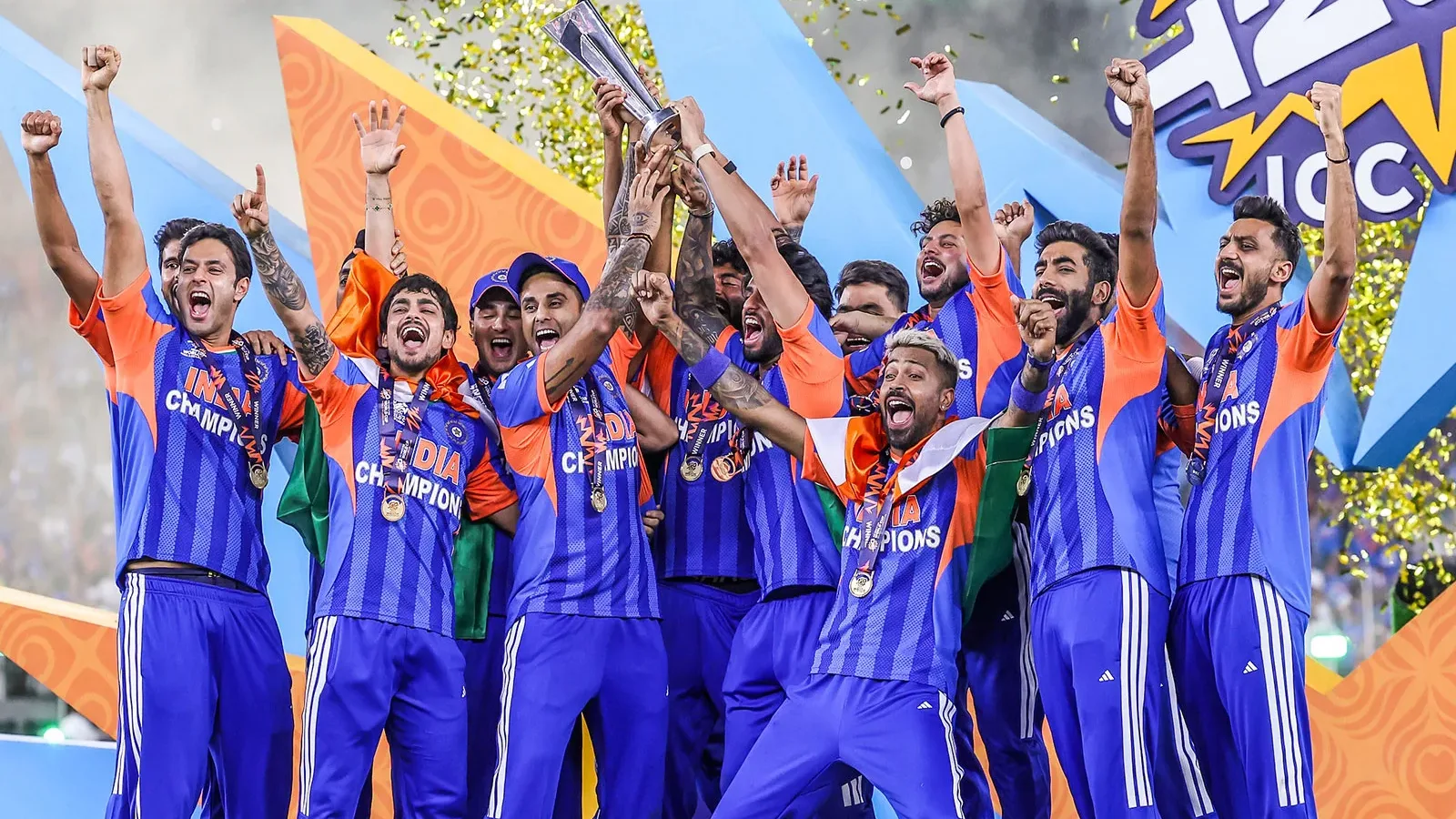
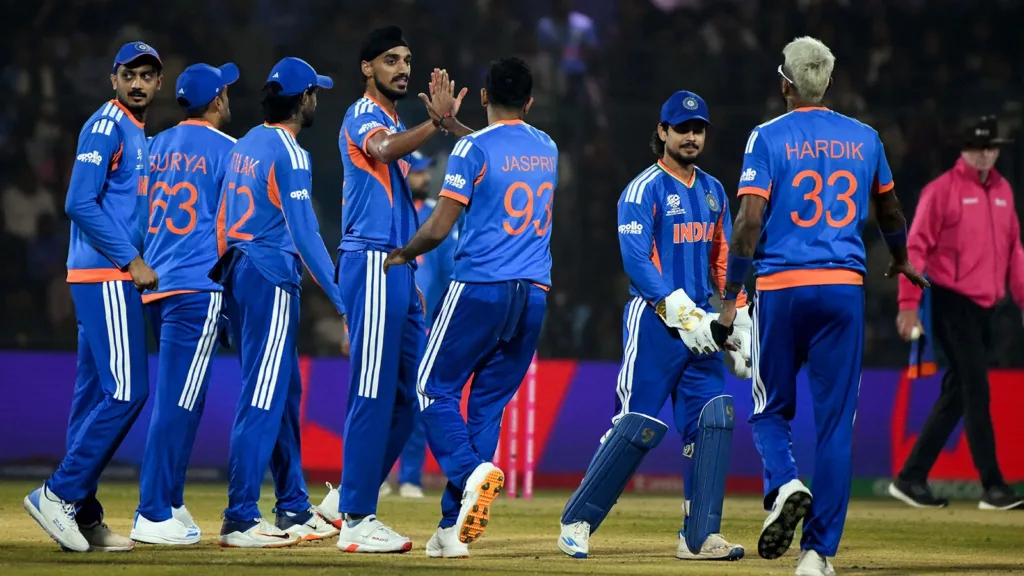
    India men cricket team
    India men cricket team. Credit: X/ANI

    India, Pakistan, Sri Lanka and Bangladesh were given byes into the last eight. Afghanistan, Japan and Nepal, meanwhile, had to compete in the preliminary stage for their places in the quarter-finals. This meant Afghanistan had to play their way into the knockout round, while India entered directly at the quarter-final stage.

    Also Read | 3-day bank strike deferred as panel takes up 5-day week demand

    India vs Afghanistan T20 Rankings

    India’s position at the top of the ICC Men’s T20I rankings also underlines the difference in the teams’ international standing.

    India are ranked No. 1 in men’s T20Is with a rating of 269, while Afghanistan are ranked No. 10 with a rating of 218.

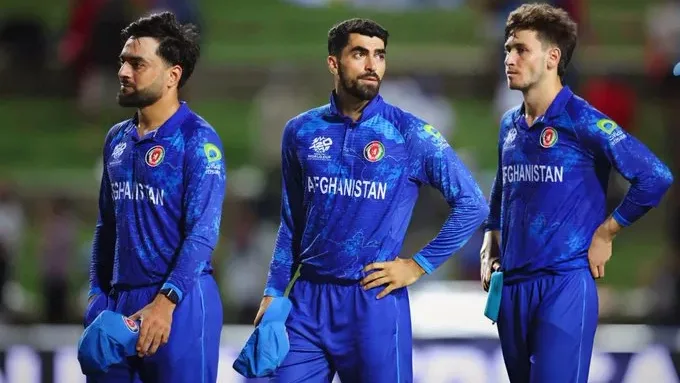
    Afghanistan T20I players
    Afghanistan T20I players. Credit: X/ANI

    However, the quarter-final was decided by the Asian Games’ competition regulations rather than simply by the ICC rankings. The tournament’s seeding and format determined India’s advantage when the match was washed out.

    India also arrived at the Asian Games as the reigning T20 World Cup champions and defending Asian Games men’s cricket champions.

    Rain Ends Afghanistan’s Campaign

    The India-Afghanistan quarter-final was eventually abandoned without a ball being bowled after rain made play impossible.

    The outcome allowed India to continue their campaign without taking the field, while Afghanistan’s hopes of winning the men’s cricket gold medal came to an end.

    The situation also echoed the previous Asian Games. India’s gold-medal match against Afghanistan at the 2022 Asian Games was affected by rain, with India winning the title by virtue of their higher seeding.

    This time, the same tournament principle again came into play, sending India into the semi-finals despite the quarter-final never getting underway.

  • UPI MDR charges: Supreme Court questions Centre over ₹2,000 payments

    UPI MDR charges: Supreme Court questions Centre over ₹2,000 payments

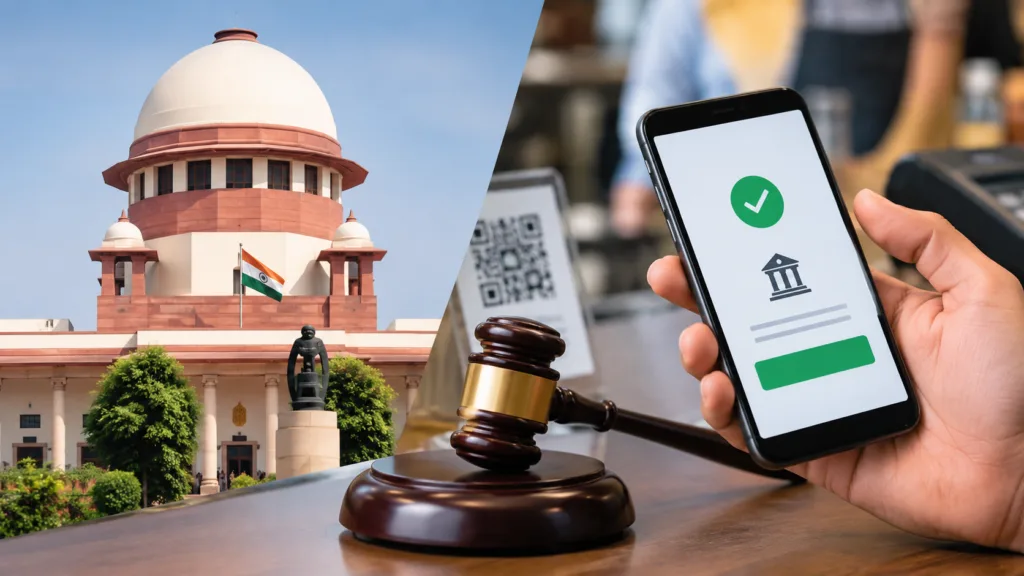
    On Monday, the apex court asked the government to file its reply to a petition against the imposition of the Merchant Discount Rate (MDR) for certain UPI transactions above ₹2,000.

    The arguments centered around the legality of the newly imposed fee, which is set to be effective from October 15.

    Justice Surya Kant, sitting in a three-judge bench with Justices Joymalya Bagchi and V Mohana, heard a public interest litigation case filed by advocate Anjan Datta, seeking quashing of the decision of the Centre to impose MDR on certain UPI transactions.

    SC raises doubts over legality of UPI MDR

    The bench said that during the hearing, it wanted the Centre to clarify the source of law behind this charge.

    The bench headed by Chief Justice Surya Kant said, “It is more of a technical matter and less of a legal one. You need to give us the facts through a brief affidavit.”

    Also Read | 3-day bank strike deferred as panel takes up 5-day week demand

    Bagchi, Justice asked, “What is the executive power to impose this charge? If it is a fee, then it cannot be imposed as per executive fiat. Then what does it become?”

    All India Mobile Retailers Association have announced a protest against UPI MDR charges on October 2.
    All India Mobile Retailers Association has announced a protest against UPI MDR charges on October 2. Credit: X/ANI

    The questions were raised as part of the hearing into the petition filed against the notification issued on September 14 by the Ministry of Finance. The notification is related to the new MDR structure that will come into effect from October 15.

    What is the new UPI MDR framework?

    As per the new framework, an MDR of 0.4 per cent will be levied on the specified UPI payments exceeding ₹2,000 for merchants. However, for transactions that exceed ₹75,000, the maximum cap for the MDR will remain ₹300.

    The new framework does not affect all UPI users in the same way. The Central Government informed the Supreme Court that 96 per cent of the individuals who use payment gateways will be exempted from the MDR of UPI payments exceeding ₹2,000.

    (Representational Image) Supreme Court seeks Centre’s response on new MDR
    (Representational Image) Supreme Court seeks Centre’s response on new MDR

    Additional Solicitor General N Venkataraman, representing the Centre, stated, “The decision is yet to come into effect on October 15. To begin with, I would like to say that 96 per cent of persons using the UPI payment gateway are exempted. Even for the remaining four per cent, essential services are capped.”

    Centre tells the court how it will use MDR money

    In addition to this, the Supreme Court inquired about the nature of the proposed charge and where exactly the money collected via MDR would be used.

    To this, Venkataraman responded, “Not even a single rupee will go to the government. It is a settlement fee between the two parties, the bank and the service.

    Also Read | 4 injured as chutney dispute sparks street brawl in Hapur market

    It is said that the Supreme Court will use the Centre’s reply in order to find out which party the amount would form an “income” in the end.

    Supreme Court does not stay UPI MDR decision

    Though the Supreme Court sought replies from the Centre and others regarding the matter, it has not stayed the decision for imposing the MDR on specified UPI transactions above ₹2,000. The charges will continue to be imposed from October 15.

    The case was filed against the Union of India, Reserve Bank of India, NPCI and the UPI & Services Steering Committee.

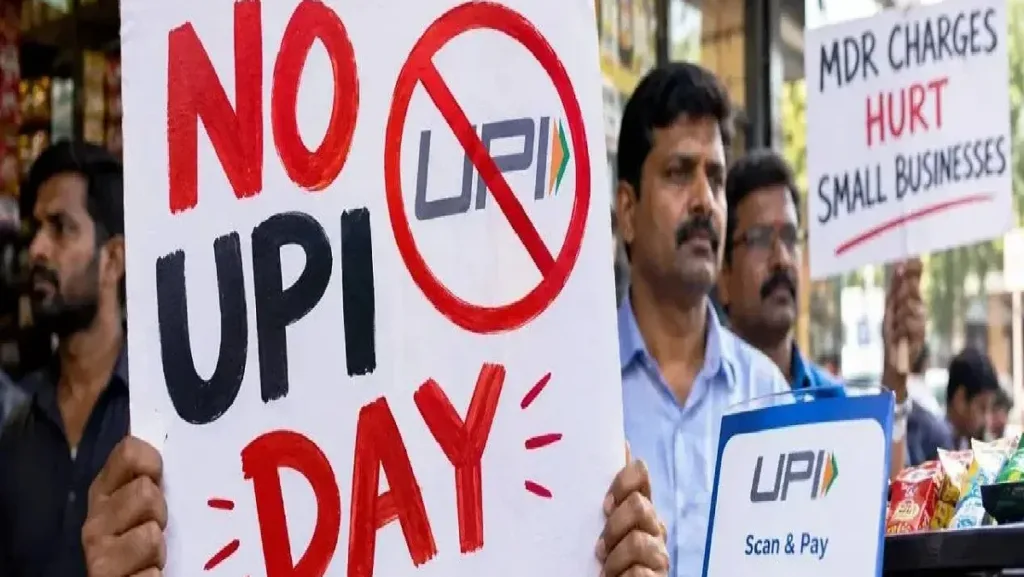
    Retailers hold a placard of "No UPI Day" to protest the proposed 0.4 per cent MDR on eligible UPI merchant transactions
    Retailers hold a placard of “No UPI Day” to protest the proposed 0.4 per cent MDR on eligible UPI merchant transactions. Credit: X/ANI

    This legal challenge arises in advance of the scheduled implementation date of October 15. This petition has brought the new charges of the UPI to the Supreme Court, where the court is now seeking the response of the Centre on the legal and technical issues relating to the system.

  • ‘Possibly [be] needed in 90-120 days’: Why is the US checking Cuba readiness?

    ‘Possibly [be] needed in 90-120 days’: Why is the US checking Cuba readiness?

    The United States is assessing whether key Army Reserve units could be made available for missions under US Southern Command within the next four months.

    The message itself does not mention Cuba. Multiple US officials, however, told CBS that the request is part of continued military planning focused on the island.

    There is no indication that any unit has been ordered to deploy. The document also does not say how many troops could be involved, where they might go, or what operation they would support.

    Also Read | 800,000 gather for Pope Leo XIV in Paris as France confronts its Catholic roots

    Military preparedness

    The Army Reserve is checking the possible availability of six types of formations. They include logistics and sustainment units, an engineer battalion, a medical brigade, a forward surgical and resuscitative detachment, and a military police brigade.

    Their roles are largely about keeping a military operation supplied, treating casualties, providing engineering support, and maintaining security.

    The message says these units could be “possibly [be] needed in 90-120 days.” Commands were asked to report their availability to Army Reserve headquarters by September 25.

    A diplomatic squeeze

    From logistics and engineers to medics and military police, the readiness check covers the support structure needed for a possible military mission | X (@TheCalvinCooli1)
    From logistics and engineers to medics and military police, the readiness check covers the support structure needed for a possible military mission | X (@TheCalvinCooli1)

    The timing matters because Washington and Havana have been under growing pressure for months. The Trump administration has increased economic pressure on Cuba and has pushed for political changes on the island.

    Earlier this year, US forces carried out reconnaissance operations around Cuba’s seabed and maritime approaches.

    Some US airpower components were also placed on heightened readiness, and personnel were prepared for possible deployment, although those plans did not move forward.

    At the same time, US Southern Command has refused to discuss specific operational movements, citing security concerns.

    A spokesperson said the command “continuously coordinates with the Joint Force” to assess military requirements across its area.

    Door ajar

    Army Reserve units are being assessed for possible logistical, medical, and security support as the Trump administration weighs military options involving Cuba | X (@RealTruth)
    Army Reserve units are being assessed for possible logistical, medical, and security support as the Trump administration weighs military options involving Cuba | X (@RealTruth)

    There is also an important second signal from Washington. On September 26, President Donald Trump said he did not believe the US would need military force and that “Cuba and we will make a deal.”

    Trump made the remarks at the White House after months of escalating pressure on Havana.

    Cuban Foreign Minister Bruno Rodriguez, speaking at the United Nations, said Cuba remained open to dialogue and to business relations with US companies while condemning the US trade embargo.

    The latest Army Reserve message therefore points to contingency planning, not a confirmed military operation.

    What happens next will depend on how the broader US-Cuba confrontation develops and whether the two sides move towards an agreement.

    Also Read | At 18, Christa Pike took a life; now age and trauma shape her appeal

  • At 18, Christa Pike took a life; now age and trauma shape her appeal

    At 18, Christa Pike took a life; now age and trauma shape her appeal

    Christa Pike, the only woman on Tennessee’s death row, is scheduled to be executed by lethal injection on September 30 at Riverbend Maximum Security Institution in Nashville.

    Pike, now 50, was sentenced to death for the 1995 murder of 19-year-old Colleen Slemmer, whom prosecutors said she and two other teenagers lured to a secluded area and attacked.

    Pike was 18 when the crime took place. If the execution goes ahead, she would be the first woman executed in Tennessee since 1819 and the first person in the state’s modern death penalty era to be executed for a crime committed at exactly age 18.

    Also Read | Europe’s seas are getting warmer. Its fishermen are seeing the consequences

    A firm verdict

    Pike’s execution remains scheduled for September 30 after the court denied her latest request for a stay | X (@TheLinzerShow)
    Pike’s execution remains scheduled for September 30 after the court denied her latest request for a stay | X (@TheLinzerShow)

    The central issue now is not whether Pike was convicted. She was convicted in 1996 of murder and conspiracy to commit murder and sentenced to death.

    The dispute is about whether factors surrounding her life and the execution itself should change that outcome.

    Her lawyers have presented evidence of severe childhood abuse, sexual violence and neglect. Court records say Pike was sexually assaulted as a child and later diagnosed with PTSD and bipolar disorder.

    Her defence also argues that important mitigating evidence was not properly presented to the original jury. Pike has since expressed remorse for Slemmer’s death.

    “I feel remarkably remorseful for what I did,” she said in a documentary about her case.

    The line at 18

    Age adds another layer to the case. In 2005, the US Supreme Court ruled in Roper v. Simmons that the death penalty cannot be imposed for crimes committed by people who were under 18.

    The court pointed to differences in maturity, judgment and vulnerability between juveniles and adults.

    Pike cannot invoke the Supreme Court's juvenile death penalty ban because she was 18 | X (@XAmericanValues)
    Pike cannot invoke the Supreme Court’s juvenile death penalty ban because she was 18 | X (@XAmericanValues)

    Pike, however, was 18 at the time of Slemmer’s murder, so that categorical constitutional protection does not apply to her. Her lawyers instead argue that modern understanding of adolescent brain development and the long-term effects of childhood trauma should be considered as mitigating factors.

    That argument has also featured in recent expert and legal appeals seeking to prevent her execution.

    Trauma

    Could the circumstances of an 18-year-old still matter decades later? | X (@901Lulu)
    Could the circumstances of an 18-year-old still matter decades later? | X (@901Lulu)

    There is also a separate challenge over how the execution could affect Pike. Her lawyers argued that being restrained, observed by male staff and undergoing IV procedures could trigger memories of the sexual assaults she experienced as a child.

    Experts and advocates have raised concerns about possible re-traumatisation.

    Pike has asked for an all-female execution team. Tennessee officials have agreed to several accommodations, including female officers for her transfer where possible, privacy protections and access to her spiritual adviser before the execution.

    The Tennessee Supreme Court rejected her request for a stay on September 23, finding that she had not shown the lethal-injection procedure would cause unconstitutional suffering.

    Her lawyers subsequently filed an emergency application with the US Supreme Court on September 25.

    The execution date remains set for September 30, subject to any further court or executive action.

    Also Read | 800,000 gather for Pope Leo XIV in Paris as France confronts its Catholic roots

  • 3-day bank strike deferred as panel takes up 5-day week demand

    3-day bank strike deferred as panel takes up 5-day week demand

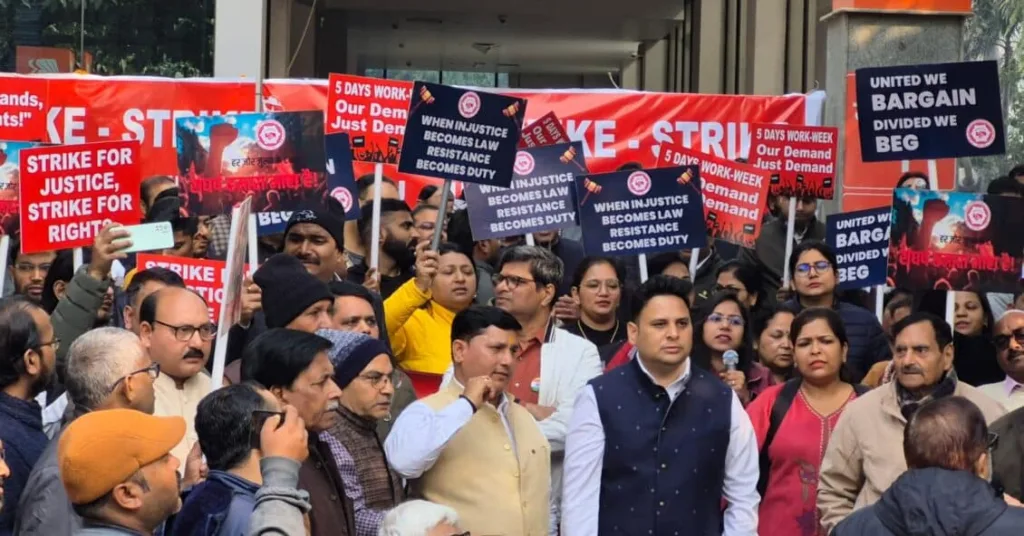
    The proposed three-day bank strike from September 28 to 30 has been deferred after the United Forum of Bank Unions (UFBU) reached an agreement with the Indian Banks’ Association (IBA) following talks on Sunday night. As a result, bank branches are expected to function normally on Monday, avoiding a disruption that could have coincided with the half-yearly closing of accounts.

    The bank strike was called by unions primarily over their demand for a five-day banking week, with all Saturdays declared holidays. The IBA has now agreed to set up a high-level joint committee to examine the demand and consider possible alternatives. The committee will also consult stakeholders, including customers, before arriving at its recommendations.

    The development means customers will not face the widespread branch closures that had been expected during the three-day bank strike. However, the broader dispute over working days and Saturday holidays remains unresolved.

    The proposed three-day bank strike from September 28 to 30 has been deferred after the United Forum of Bank Unions (UFBU) reached an agreement with the Indian Banks’ Association (IBA) following talks on Sunday night. (ANI)
    The proposed three-day bank strike from September 28 to 30 has been deferred after the United Forum of Bank Unions (UFBU) reached an agreement with the Indian Banks’ Association (IBA) following talks on Sunday night. (ANI)

    Bank strike deferred after agreement with IBA

    The bank strike was withdrawn after the IBA agreed to immediately constitute a high-level committee to examine the unions’ demand. The UFBU subsequently announced that its other planned agitation would also be deferred.

    At present, banks remain closed on the second and fourth Saturdays of every month, while branches operate on the remaining Saturdays. The unions have been seeking a change to this arrangement as part of their demand for a five-day banking week.

    The committee will examine the possibility of declaring the remaining Saturdays as holidays and will also look at alternative arrangements. Its discussions are expected to include consultations with customers and other stakeholders who could be affected by any change in banking schedules.

    However, the agreement does not mean that banks will immediately move to a five-day working week. No deadline has been set for the committee to complete its examination or make a recommendation.

    The decision to defer the bank strike therefore provides temporary relief for customers while leaving the central demand open for further negotiations between the unions and the banking industry.

    Also Read | 4 injured as chutney dispute sparks street brawl in Hapur market

    The bank strike was withdrawn after the IBA agreed to immediately constitute a high-level committee to examine the unions’ demand. (ANI)
    The bank strike was withdrawn after the IBA agreed to immediately constitute a high-level committee to examine the unions’ demand. (ANI)

    Why was the bank strike called by the unions?

    The UFBU had announced the bank strike after previous rounds of discussions failed to resolve the issue of working Saturdays. The unions have argued that employees face long working hours and that a five-day banking week would bring banking schedules in line with those followed by several other sectors.

    The demand for five-day banking has been under discussion for more than two years, according to the unions. Their proposed agitation had included the September 28 to 30 bank strike, followed by a possible indefinite strike from October 26 if their demands remained unresolved.

    Government sources, however, have maintained that a five-day banking week was neither agreed upon nor included in earlier wage negotiations. This has been one of the key points of disagreement between the government and bank employee organisations.

    Sunday’s agreement does not set a fresh date for the deferred bank strike. Instead, both sides will continue discussions through the newly proposed committee.

    The two sides have also agreed to discuss a performance-linked incentive scheme for officers in Scale IV and above. The IBA will propose changes to the existing government scheme in an attempt to address objections raised by the unions.

    Also Read | What happens if Gyanesh Kumar resigns as Chief Election Commissioner?

    The demand for five-day banking has been under discussion for more than two years, according to the unions. (ANI)
    The demand for five-day banking has been under discussion for more than two years, according to the unions. (ANI)

    What does a bank strike deferment mean for customers?

    For bank customers, the immediate impact of the decision is that branches are expected to remain open as usual on Monday, September 28. The proposed bank strike would otherwise have affected services for three consecutive days.

    The timing had raised particular concerns because September marks the half-yearly closing period for banks. The Finance Ministry had warned that a three-day bank strike could affect several customer services and financial transactions.

    Public sector banks and Regional Rural Banks were also asked to open on Sunday, September 27, providing customers with an additional opportunity to complete branch-related transactions before the planned strike.

    With the bank strike now deferred, customers are not expected to face the disruption that had been anticipated for September 28 to 30. However, digital banking services, ATMs and other electronic facilities would have continued to operate subject to normal technical availability even during a branch strike.

    The immediate disruption has therefore been avoided, but the question of whether all Saturdays should become bank holidays remains open. The committee will examine the proposal and possible alternatives before further decisions are taken.

    For now, the deferred bank strike marks a pause in the unions’ agitation rather than a final settlement. The five-day banking week demand, Saturday holidays and the proposed changes to performance-linked incentives will remain part of the discussions between the UFBU and the IBA.