A relationship may feel serious, yet the future can tell a very different story. In situations where your partner appreciates your presence but continuously avoids discussing anything related to commitment and the future of the relationship, you may begin to question where you stand with him/her.
The concept of a “placeholder partner” will become apparent at that point. It refers to a situation where one person gives company and comfort to another who may not actually plan on staying in the relationship for the long run.
What is a placeholder partner?
Placeholder partner refers to a temporary romance choice and not an enduring one. The relationship might be quite serious, yet one partner does not take efforts to invest emotions in order to build a future together.
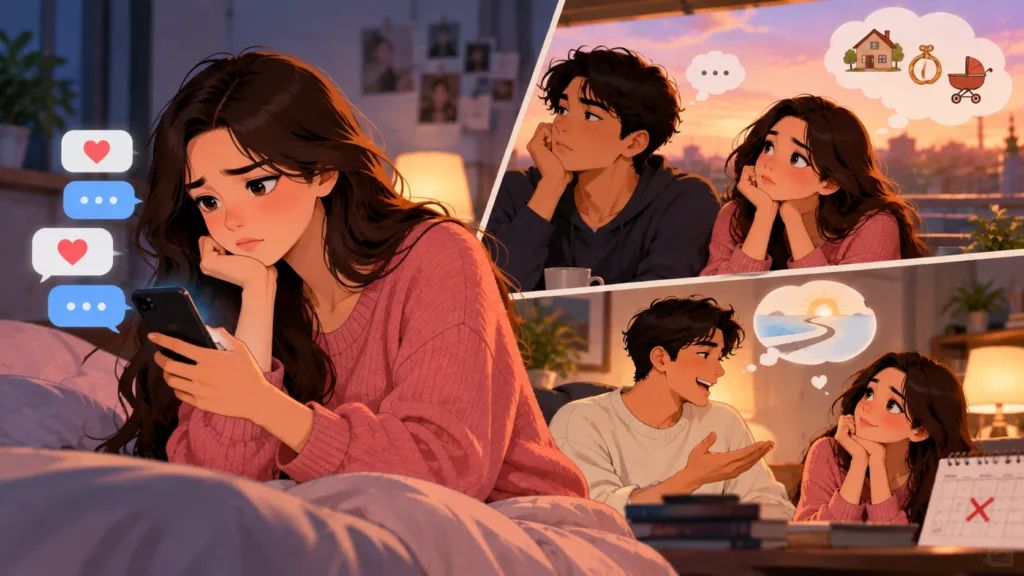
(Representational Image) Avoiding future plans can be a sign of limited relationship commitment | AI Generated
The term “placeholder partner” is widely used on social media and defines relationships where one person appreciates the company but secretly treats the relationship as temporary and not a permanent one.
Indicators of being a placeholder partner
One of the potential signs is frequent communication with mixed messages. Your partner may occasionally speak of the relationship with seriousness, yet becomes distant and avoids the conversation about the future.
(Representational Image) Promises without action may signal that the relationship is temporary | AI Generated
Lack of discussion about future may serve as another indicator. If the discussions of marriage, cohabitation and having kids do not become more detailed with time, it is hard to say whether these plans are real.
Finally, promises that are not accompanied with any actions should not be considered seriously. There are people who promise a future together yet make no moves towards it, leaving the other partner emotionally invested.
Why do people stay in temporary relationships?
Every relationship that fails is not necessarily a placeholder relationship. Some people end up in a relationship due to loneliness, after experiencing heartbreak or being uncomfortable with being alone.
(Representational Image) A lack of shared goals can raise questions about long-term commitment | AI Generated
Some relationships can also help people heal, learn and grow, even when they do not ultimately become permanent. The key issue is whether both people understand what they want from the relationship.
The relationship will be healthy if there is honesty, efforts by both individuals and common goals. However, if an individual continues putting off making commitments, avoids discussions about the future or makes empty promises, then it might be good to consider if the relationship is living up to each individual’s needs.
(Representational Image) Honesty and mutual effort are key signs of a healthy lasting relationship | AI Generated
When two people have entirely different needs, it might be better if each individual moves ahead independently.
The traditional big wedding is no longer the only way couples want to celebrate getting married. In 2026, micro-weddings are increasingly appearing in conversations around modern wedding planning, with couples choosing smaller guest lists and more intimate celebrations.
A micro-wedding typically has 50 guests or fewer, compared with an average wedding size of around 117 guests.
Social media has helped popularise the format, with couples highlighting smaller celebrations as less stressful and more personal. But there is another factor behind the trend which is money.
For younger couples dealing with an uncertain job market, student debt and ambitions such as buying a home, spending heavily on one day may not always feel worthwhile. That makes micro-weddings an interesting intersection of romance, personal choice and financial practicality.
Why are micro-weddings becoming a trend in 2026?
While there is probably no exact data about how many couples choose micro-weddings, they definitely attract attention on social media.
Clinical psychologist and marital counsellor Brandy Dunn, PsyD, says that people are becoming more thoughtful about choosing the type of wedding and asking themselves what wedding will represent who they really are, rather than what was expected of them.
Micro-weddings are becoming increasingly popular as couples rethink traditional big-day expectations / Pexels
Gen Z grew up in economically uncertain times and during the pandemic, which might influence their attitude towards finances.
In addition, couples who are working hard to buy an apartment and pay off student debts do not have much extra money for weddings.
However, it does not mean that all micro-weddings are just budget weddings.
Are micro-weddings actually cheaper?
One of the biggest attractions of a smaller wedding is obvious — fewer guests can potentially mean lower expenses.
Micro-weddings can reduce some of the costs and pressures associated with large-scale wedding planning while allowing couples to focus on meaningful experiences with the people closest to them.
A smaller guest list can also change the experience of the wedding itself. Dunn points out that large weddings can become a blur for couples who spend much of the day greeting guests and managing logistics.
Micro-weddings are everywhere / Pexels
With fewer people around, couples may have more time for conversations, meals and actually experiencing their ceremony.
But smaller does not automatically mean cheaper.
Charnas cautions that micro-weddings can come with unexpected expenses, and some costs may not shrink simply because the guest list does. Couples therefore need to look at the entire budget rather than assuming that fewer invitations will automatically translate into major savings.
What are the downsides of having a micro-wedding?
The biggest challenge may not be financial at all. It can be deciding who gets invited.
When a couple limits attendance to a small group, friends and relatives who do not make the cut may feel hurt or disappointed. Charnas says couples choosing this route should be prepared for some backlash, particularly when family members have their own expectations about the wedding.
Micro-weddings are having a moment in 2026 / Pexels
The situation can become even more complicated when relatives are contributing financially to the celebration. Financial support may come with expectations about the guest list, venue or overall scale of the event.
That means couples may need to establish their priorities early and communicate them clearly.
How do you know if a micro-wedding is right for you?
Rather than begin by trying to decide how many guests to invite, the advice is to focus first on your own personal values as a couple.
DeFife advises that determining the top three values and priorities in advance of wedding plans is important to ensure good decisions. Examples may be excellent food, photo-taking, or just an intimate atmosphere.
The priorities will guide other decision-making. If any particular decision seems too stressful, couples can determine if it contributes to the desired experience.
Budget is definitely one of those priorities. Fewer guests can be helpful for budgeting, but the process of cost evaluation needs to go on.
In the end, there may not be a single best approach to marriage.
A micro-wedding can be a romantic choice, a financial necessity, or even both. What counts is if the wedding represents the couple’s style and preferences rather than expectations.
The word narcissist is everywhere in dating conversations, but being selfish, arrogant or bad at taking criticism does not automatically make someone a narcissist. Narcissistic traits exist on a spectrum, and only a qualified mental health professional can diagnose narcissistic personality disorder.
What can be useful, however, is looking at patterns of behaviour. Love bombing, a constant need for validation, difficulty taking accountability, blame-shifting and problems with boundaries can all affect a relationship when they occur consistently.
The key is not to diagnose your partner based on one argument or unpleasant interaction. Instead, look at whether a repeated pattern is leaving you feeling dismissed, controlled or increasingly unsure of yourself.
What does being a narcissist actually mean?
Narcissism involves more than self-centred behaviour. Psychologist Golee Abrishami describes it as being linked to a fragile sense of self that may be protected through grandiosity, control and a persistent need for admiration.
Signs you may be dating someone with narcissistic traits / Pexels
Having narcissistic traits is also not the same as having narcissistic personality disorder (NPD). The distinction depends on factors including how severe, consistent and rigid the behaviour is and how significantly it affects a person’s relationships and everyday life.
That means one bad argument, an insensitive comment or even several problematic behaviours do not automatically mean someone has NPD.
11 signs you may be dating someone with narcissistic traits
They come on extremely strong at first
The relationship can initially feel almost too good to be true. Constant messages, excessive compliments, elaborate dates and declarations about how special the connection is may appear romantic.
This can sometimes be love bombing, particularly when intense affection forms part of a larger pattern of manipulation or control. However, enthusiasm early in a relationship by itself is not proof of narcissistic behaviour.
Conversations always come back to them
You might start by talking about your stressful day, an achievement or something important to you, only for the conversation to quickly become about their experiences.
The issue is not simply that someone likes talking about themselves. The concern is when your feelings and experiences are repeatedly minimised while their achievements, problems or emotions consistently take centre stage.
They treat people differently based on what they can offer
Pay attention to how your partner treats people they do not need to impress.
Their behaviour towards waiters, service workers, strangers or people they consider less important can reveal patterns that may not be obvious during the honeymoon phase. Frequent name-dropping or attempts to establish their own importance can also be worth noticing.
They are highly concerned with appearances
For someone displaying narcissistic traits, how they are perceived by others can become extremely important.
This may extend to the relationship itself. Your partner could become more concerned about how you make them look publicly than about resolving the actual issue between you.
Representational Image / Pexels
Their affection becomes conditional
The intense affection at the beginning may eventually feel dependent on whether you are meeting their expectations.
Warmth and praise can appear when you make them feel good about themselves, while affection may disappear when you disagree, assert your independence or fail to play the role they expect from you.
They struggle to apologise or take responsibility
Everyone becomes defensive occasionally. The difference can lie in what happens repeatedly.
An apology may come with a justification or quickly turn into an explanation of why you were supposedly responsible. Instead of taking accountability, your partner may redirect the conversation towards your mistakes.
Arguments somehow become your fault
You may begin a conversation about something they did and end up defending yourself instead.
Repeated blame-shifting can leave you questioning whether you were wrong to raise the issue in the first place. Over time, this dynamic can make conflict feel one-sided, with you repeatedly doing the emotional work of repairing the relationship.
They react badly when you set boundaries
Healthy relationships allow both people to have boundaries. But someone displaying narcissistic traits may interpret a boundary as rejection.
A simple request for space or a decision to end a conversation when someone starts yelling could trigger guilt, anger or another argument. The important factor is whether your limits are repeatedly challenged rather than respected.
Representational image / Pexels
Everyone else is always the problem
If every former partner was supposedly terrible, every friend betrayed them and every colleague is incompetent, pay attention to the pattern.
Someone who consistently portrays themselves as the victim while refusing to acknowledge their own role in failed relationships may be displaying a concerning behaviour pattern.
They threaten the relationship when they feel rejected
A partner who repeatedly threatens to leave, flirts with others to provoke a reaction or reminds you that they have other options may be attempting to regain control when they feel insecure.
Breakup threats and harsh ultimatums can turn ordinary disagreements into emotionally destabilising situations.
You no longer feel like yourself
Perhaps the biggest warning sign is how the relationship affects you.
If you constantly second-guess yourself, feel like you are walking on eggshells or find yourself questioning whether you are being too sensitive, the impact deserves attention.
You may also notice that your confidence has gradually declined or that you have started accepting criticism you would once have recognised as unfair.
What should you do if you recognise these signs?
You do not need to determine whether your partner is a narcissist before deciding that a relationship dynamic is unhealthy for you.
Representational Image / Pexels
Instead, look at the pattern over time. Be clear about your needs and establish boundaries around what you will do rather than trying to control your partner’s actions. For example, you can decide to leave a conversation when it becomes hostile rather than demanding that the other person never raise their voice.
It can also help to speak with someone outside the relationship, whether that is a trusted friend or a therapist. Unhealthy dynamics can become harder to recognise when you are experiencing them every day.
Most importantly, you do not need a clinical diagnosis to take your own wellbeing seriously. If a relationship repeatedly leaves you feeling small, anxious, controlled or unlike yourself, that experience matters regardless of what label applies to your partner.
For many students, the memory of a teacher with a powerful voice is hard to forget. A single shout could often bring a noisy classroom back under control. But repeatedly speaking over classroom chatter, teaching for hours and dealing with dusty environments can put considerable pressure on the voice.
For teachers, vocal health is especially important because speaking is central to their daily work. Long teaching hours, loud classrooms and limited opportunities to rest the voice can gradually lead to strain.
Dr Murarji Ghadge, Senior Consultant ENT Surgeon & Sleep Disorder Specialist, Ruby Hall Clinic, Pune, told News 18 that signs of an overused voice in teachers can include hoarseness, throat pain, frequent throat clearing, a tired voice or trouble speaking at the end of the day.
Here are five everyday habits teachers should avoid to protect their voices.
Constantly raising your voice
Trying to speak louder than classroom noise can place unnecessary pressure on the voice. Teachers can reduce this effort by improving classroom acoustics, using a microphone when possible and getting students’ attention before beginning to speak. Maintaining a comfortable pitch and volume is preferable to repeatedly forcing the voice louder.
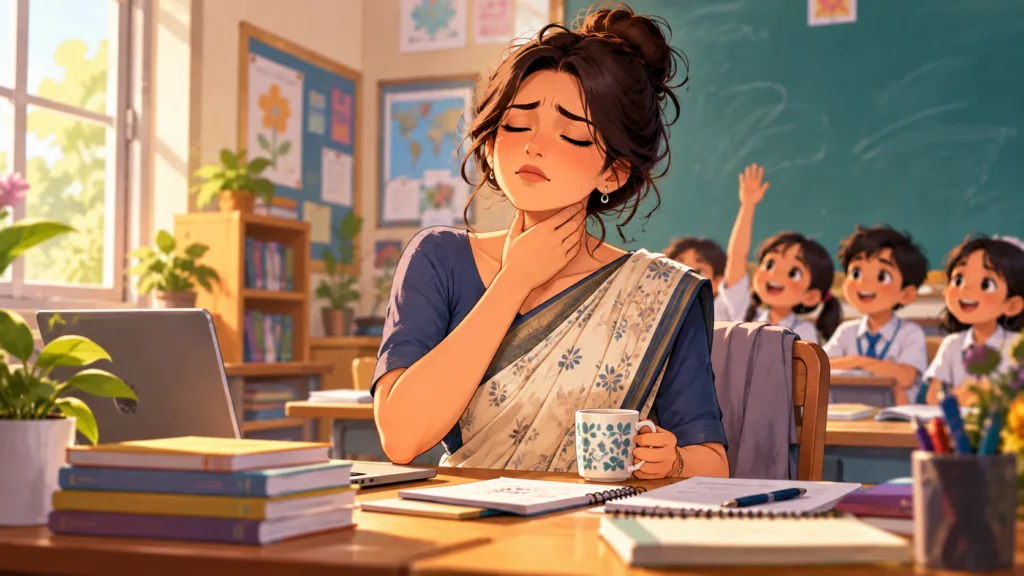
(Representational Image) Raising your voice over classroom noise can increase vocal stress | AI Generated
Not drinking enough water
Teachers often spend hours speaking without taking regular breaks. Staying hydrated can help keep the vocal cords moist and allow them to vibrate more easily. Sipping water throughout the day is better than waiting until the throat becomes dry. Water should remain the preferred drink, particularly when excessive coffee or sugary beverages leave some people feeling dehydrated.
Repeated throat clearing
Frequent, forceful throat clearing may provide temporary relief but can increase irritation because it causes the vocal cords to collide forcefully. Teachers can instead take a sip of water or swallow gently when the urge to clear the throat arises.
Continuing to speak without rest
The voice also needs recovery time after a long teaching day. Giving it periods of rest can help it recover from the demands of classroom teaching.
(Representational Image) Regular hydration helps teachers manage vocal strain through the day | AI Generated
Whispering when the voice feels strained
Whispering may seem like an easy way to rest a tired voice, but it can sometimes require more effort. When the voice is strained, proper rest is a better approach than continuing to speak in a whisper.
Persistent voice problems should not simply be considered part of teaching. If a voice change continues for more than two or three weeks, or is accompanied by pain, difficulty swallowing or breathing, an ENT specialist should examine the voice. Early evaluation can help identify vocal-cord problems and prevent temporary strain from becoming a longer-term issue.
For years, popular ideas about romance have centred on becoming one with your partner. Phrases such as “You complete me” and “I can’t live without you” have often presented love as something that requires complete emotional and personal involvement. But relationship expectations are shifting, particularly among Gen Z, who are increasingly placing value on individuality alongside emotional closeness.
In an interview with Hindustan Times, Chandni Gaglani, EVP and Head of Aisle, explained how younger people are approaching love, commitment and personal freedom differently.
Gen Z wants love without losing individuality
According to Chandni, traditional ideas of relationships often placed togetherness at the centre. Couples were expected to spend much of their time together, share friends and social circles, make decisions jointly and allow the relationship to become a major part of their identity.
Gen Z, however, appears more comfortable maintaining the life they had before entering a relationship.
(Representational Image) Personal space is becoming an important part of Gen Z relationships | AI Generated
“For Gen Z, finding a meaningful relationship does not necessarily mean giving up the life that existed before it. They want love, companionship and emotional intimacy, but increasingly, they also want the freedom to remain individuals within the relationship,” highlighted Chandni.
“Their careers, friendships, interests, ambitions and personal space continue to matter. This isn’t necessarily a rejection of commitment. Instead, it reflects a changing understanding of what commitment can look like: choosing someone without having to lose yourself in the process,” added Chandni.
Why personal space matters in modern relationships
Chandni noted that having separate friendships, individual interests, solo travel plans, personal routines or time alone does not necessarily signal emotional distance for Gen Z.
(Representational Image) Gen Z is choosing commitment without giving up personal identity | AI Generated
“Compatibility is no longer just about enjoying the same things or wanting the same future. It can also mean being comfortable with each other’s differences and giving each other the room to explore them,” said Chandni.
Love can complement identity, not replace it
The idea of a partner “completing” someone is also giving way to a more individual-centred understanding of love.
“The idea of a partner completing you is gradually giving way to something more balanced: finding someone who complements the life you are already building. This doesn’t make the relationship less meaningful,” explained Chandni.
For Gen Z, commitment can mean sharing a life while continuing to nurture personal ambitions, friendships, hobbies and interests.
Commitment without losing yourself
At the heart of this changing approach is the possibility of staying emotionally connected while retaining a sense of self. Separate interests, shared values and time apart can coexist with a committed relationship.
(Representational Image) Young couples are balancing emotional intimacy with individual lives | AI Generated
Gen Z may not be seeking less commitment, but a different form of it: companionship without confinement, intimacy without dependence and love that leaves room for individuality.
“Because perhaps the healthiest version of love isn’t you. It is I know who I am, you know who you are, and we still choose each other,” concluded Chandni.
Few foods can turn an ordinary meal into an instant comfort ritual quite like pizza. A crisp or chewy crust, tangy tomato sauce and bubbling melted cheese are enough to make even the simplest slice feel special.
Cheese Pizza Day is observed every year on September 5, with 2026 marking another occasion to celebrate the classic cheese pizza. Unlike an official public holiday, the observance is an unofficial food day, and its precise origins are not clearly documented.
But the history of pizza itself is far more fascinating. Its modern form is closely associated with Naples, Italy, before the dish travelled across continents and evolved into countless regional versions.
Modern pizza is closely linked to Naples
Flatbreads existed in several ancient cultures, but the pizza that resembles the dish we know today developed in Naples.
Pizza chef in a Napoli restaurant kitchen / Pexels
The combination of baked dough, tomato, cheese and other ingredients eventually evolved into modern pizza, making Naples central to its culinary history.
Mozzarella is the classic pizza cheese
Ask for a classic cheese pizza and mozzarella is probably the first cheese that comes to mind.
There is a reason for that. Mozzarella melts beautifully, develops an appealing golden surface and delivers the stretchy texture associated with a cheesy slice. Modern pizzerias also use provolone, Parmesan, cheddar and cheese blends depending on the style.
Margherita pizza comes with a famous story
Margherita pizza is among the world’s best-known cheese-led pizzas. Its classic combination of tomato, mozzarella and basil creates the red, white and green colours associated with the Italian flag.
Margherita pizza/ Pexels
The popular story says the pizza was created in 1889 for Queen Margherita of Savoy. However, food historians debate that account, while the broader history of pizza in Naples clearly predates the famous tale.
Pizza was once working-class food
Pizza was not always the global restaurant staple it is today.
In Naples, inexpensive flatbreads topped with simple ingredients provided an accessible meal for working people. Their affordability, portability and satisfying flavours helped the food spread beyond its original setting.
How did pizza become a global food?
Italian immigrants played an important role in taking pizza abroad, particularly to the United States.
American cities subsequently developed their own distinctive styles. New York became associated with thin, foldable slices, while Chicago developed its famous deep-dish pizza. Over time, these adaptations created new regional pizza cultures rather than simply reproducing the Italian original.
The fascinating story behind pizza / Pexels
A simple cheese pizza can test a pizzeria
For pizza enthusiasts, a plain cheese pizza can be one of the best ways to judge a pizzeria.
With no elaborate toppings competing for attention, the quality of the dough, tomato sauce, cheese, seasoning and cooking technique becomes much more noticeable. A good cheese pizza is essentially the dish stripped back to its essentials.
Pizza does not have just one style
Pizza can look dramatically different depending on where it is made.
Some of the best-known styles include Neapolitan, New York-style, Chicago deep-dish, Detroit-style, Sicilian and Roman-style pizza. Crust thickness, cooking temperature, cheese distribution, sauce and shape can all change while the basic combination of dough, toppings and heat remains recognisable.
Cheese Pizza Day 2026 falls on September 5. / Pexels
The famous cheese pull is all about heat
That satisfying cheese pull is not just made for photographs.
When cheese is heated, its fat and moisture change its texture, while the surface can brown and develop deeper flavours. Mozzarella is particularly popular because it melts well and provides the stretchy texture many pizza lovers associate with a perfect slice.
9. Why does cheese pizza remain so irresistible?
Cheese brings several elements together in one bite, including fat, saltiness, texture, aroma and richness.
When melted, it creates a contrast between the crisp crust and soft topping. Mozzarella’s relatively mild flavour also allows the tomato sauce and crust to remain part of the overall experience. That balance helps explain why a classic cheese pizza can work perfectly well without a mountain of toppings.
Cheese Pizza Day vs National Pizza Day
The two observances are easy to mix up.
National Pizza Day is usually observed on February 9, while Cheese Pizza Day takes place on September 5. However, this one deals solely with the most basic type of pizza – crust, tomato sauce, and cheese.
Cheese Pizza Day vs National Pizza Day / Pexels
Cheese Pizza Day is not an official holiday sanctioned by the US government. Its exact origins have not been reliably documented, and it is generally treated as an unofficial food observance.
How to celebrate Cheese Pizza Day 2026
A ceremony is not required to celebrate Cheese Pizza Day in 2026. People who love pizza may celebrate the day by ordering their beloved cheese pizza, baking dough themselves, testing various melting cheeses or experimenting with different types of pizza.
One may organize an event for friends with several cheese pizzas to taste or prepare mini pizzas with their family members. One can even combine Italian and Indian flavours on a traditional cheese pizza.
The beauty of cheese pizza is in its simplicity. From the Italian city of Naples to various places around the world, cheese pizza has come a long way without losing its original magic.
Remember icy blue eyeshadow, frosted lips and ultra-thin brows? The Y2K makeup trends that defined the early 2000s are making a comeback, but this time they are getting a more polished and wearable update.
Instead of recreating the heavily frosted, sharply defined looks of the era, makeup artists are giving the nostalgic trends a softer finish. Think diffused blue shadow instead of stark colour, natural-looking skin instead of heavy foundation, pearlescent lips instead of intense glitter and slimmer-looking brows without necessarily reaching for the tweezers.
The revival is part of beauty’s natural cycle, but the latest version is not simply a repeat of the past.
Which Y2K makeup trends are making a comeback?
Icy blue eyeshadow
Blue eyeshadow is once again having a moment. The early-2000s version was often intensely shimmery and almost white, but the modern take is softer and more diffused.
Makeup artists recommend blending the edges rather than creating a sharply defined block of colour. Keeping the rest of the makeup understated can also allow the blue shade to become the focus of the look.
Icy blue eyeshadow / Pexels
A matte or creamy blue shadow topped with a subtle shimmer can give the eyes that unmistakable Y2K feel without looking dated.
Natural, breathable skin
The current obsession with lightweight base makeup has more in common with early-2000s beauty than it might seem.
The period’s emphasis on enhancing natural features rather than creating an overly perfected complexion. The updated version means letting real skin remain visible, using concealer selectively or choosing sheer coverage instead of masking the entire face.
Natural, breathable skin / Pexels
The result is a complexion that looks fresh rather than heavily sculpted.
Frosted lips
Frosted lips are another unmistakable early-2000s trend returning to the beauty conversation.
But today’s version is less about an intensely metallic finish and more about a subtle, pearlescent sheen. Adding shimmer to the centre of the lips can also enhance their natural shape and create the appearance of added fullness.
Frosted lips / Pexels
For an easy take, start with a lip liner close to your natural lip colour and layer a shimmery lipstick or balm over it.
Skinny brows
Ultra-thin brows were one of the defining beauty choices of the early 2000s, and they are gradually returning.
Skinny brows / Pexels
But you don’t necessarily have to pick up a pair of tweezers to try the trend. Whitfield suggests using brow gel to reshape the tail of the brow so that it appears slimmer.
Why are Y2K makeup trends back now?
The comeback goes beyond simple nostalgia. Beauty has been moving away from highly sculpted and perfected looks towards individuality and experimentation.
That shift makes early-2000s makeup particularly relevant again. The era’s beauty trends were often playful, colourful and personality-driven Sand those elements can be adapted without copying the original looks exactly.
The key to wearing Y2K makeup trends in 2026 is restraint: blend the blue shadow, keep the skin light, make the frost subtle and reshape brows rather than immediately committing to extreme plucking.
In other words, the Y2K revival is less about recreating the past and more about borrowing its most fun beauty ideas.
Arunachal Pradesh travel destinations are getting a fresh push as more remote parts of the northeastern state begin appearing on the tourism map. The recently concluded Trans Arunachal Drive (TAD) covered nearly 2,000 km, travelling through the state’s valleys and mountains and highlighting places that remain largely unexplored by tourists.
The drive showcased Rima, Lishu, Bomjir, Geku, Maryang, Kambu and Gori as potential new driving destinations, according to the Times of India report on the event.
The larger idea behind the drive was to position Arunachal Pradesh not only as a scenic holiday destination but also as a self-drive and road-trip destination.
Which new Arunachal Pradesh destinations are in focus?
The TAD brought attention to several remote locations that have so far remained outside the mainstream tourism circuit.
Places such as Rima, Lishu, Bomjir, Geku, Maryang, Kambu and Gori offer travellers a different side of Arunachal Pradesh, away from the state’s better-known tourist routes.
Much of the state remains relatively unexplored, particularly in remote areas. Upper Subansiri and Dibang Valley, for instance, have not yet become established parts of the wider tourism circuit because of connectivity challenges.
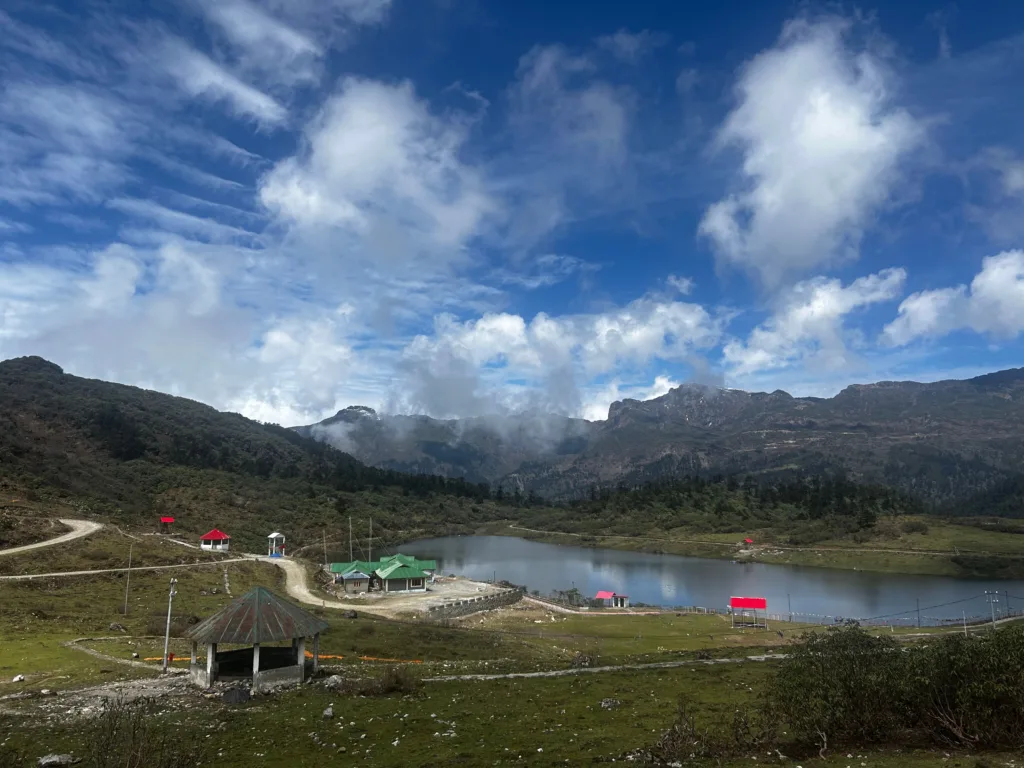
Arunachal Pradesh opens up new destinations for self-drive trips / Pexels
Improving access to such areas is therefore likely to be important if Arunachal Pradesh wants to turn these emerging destinations into viable tourism hubs.
Why could road trips change tourism in Arunachal Pradesh?
Arunachal Pradesh’s geography makes road travel particularly significant. The state’s appeal lies not only in individual tourist attractions but also in the journey through its mountains, valleys, villages and remote landscapes.
The TAD was designed to highlight precisely this experience and promote the state as a destination where the road itself becomes part of the holiday.
the road itself becomes part of the holiday in Arunachal / Pexels
Better connectivity could bring more visitors into areas that currently see relatively few tourists from outside the state. At the same time, expanding tourism beyond established destinations could spread its economic benefits to smaller communities.
The push is also particularly relevant for travellers looking for less commercialised experiences. Remote destinations are unlikely to immediately have large hotels and extensive tourist infrastructure, making smaller-scale accommodation an important part of the experience.
How can rural tourism benefit?
The emergence of new destinations could give homestays and local tourism businesses a significant role.
With fewer large hotels in far-flung areas, travellers may rely on locally run homestays for accommodation, food and guidance. That creates an opportunity for tourism income to reach communities that may otherwise remain outside the state’s mainstream tourism economy.
The Trans Arunachal Drive covered nearly 2,000 km across the state / Pexels
Arunachal Pradesh’s attraction is also closely tied to its local cultures, traditions, cuisine and communities, alongside its natural landscapes.
If connectivity improves and responsible tourism grows alongside it, these lesser-known destinations could become part of a broader tourism network without losing the local character that makes them attractive in the first place.
Arunachal Pradesh’s road-trip appeal
The state has long been known for its mountains and natural beauty, but the Trans Arunachal Drive places a different emphasis on how visitors experience the region.
Rather than simply travelling to a famous viewpoint or established tourist town, the road-trip model encourages travellers to explore the state’s lesser-known corners.
For travellers seeking an offbeat Northeast India itinerary, destinations such as Rima, Lishu, Geku, Maryang, Kambu, Gori and Bomjir could eventually offer a new route through Arunachal Pradesh.
The challenge now is to match that growing interest with better connectivity and tourism infrastructure while ensuring that development remains sustainable for the remote communities that call these places home.
Political view may not be the most obvious topic for a first date, but for many people, it is becoming harder to keep it out of the dating conversation.
The usual questions about work, hometowns, hobbies and relationship goals are still there. But as conversations around feminism, climate change, inequality, identity, education and mental health become more prominent, political opinions can reveal something deeper about how a potential partner sees the world.
That raises an uncomfortable question for modern dating: can two people with completely different political views build a healthy relationship?
The answer may have less to do with which party someone supports and more to do with what their beliefs say about their values.
When did politics become a dating question?
Nobody expects a first date to begin with a political questionnaire. Yet political beliefs can naturally enter conversations when people discuss current events, social issues or the kind of future they want.
For younger daters in particular, political opinions can feel personal because they often overlap with issues that directly affect everyday life. A person’s views on equality, women’s rights, climate change or social justice may tell you more about their worldview than their favourite film ever could.
From dating-app filters to first-date conversations, political views are becoming part of the modern compatibility check. / AI Generated
Two people can disagree about an election, a political party or a particular policy and still have plenty in common. They may argue about politics over dinner and still happily order dessert afterwards.
The bigger concern is what happens when the disagreement involves fundamental values.
If two partners have completely different ideas about equality, individual freedom or whether certain groups deserve the same rights, the disagreement can become much harder to compartmentalise.
Is political disagreement really a relationship dealbreaker?
Not necessarily.
A healthy relationship does not require two people to agree on everything. In fact, having different opinions can work when both partners are capable of listening, explaining their position and accepting that disagreement does not automatically make the other person stupid or immoral.
Your next dating dealbreaker may have nothing to do with looks / Pexels
The more important compatibility question may therefore be: How do you behave when you disagree?
Someone’s political label only tells you part of the story. The way they speak about people with opposing views can reveal far more about their personality and relationship style.
Can they listen? Can they disagree without becoming dismissive? Can they respect a partner’s right to hold a different opinion?
Those qualities can matter when political disagreements eventually spill into conversations about money, family, careers, children and everyday decisions.
What should you look for beyond someone’s political view?
Dating apps already allow people to filter potential partners according to preferences ranging from location and lifestyle to relationship goals. Political beliefs can feel like another compatibility marker, particularly for people for whom certain values are non-negotiable.
But instead of immediately asking someone to declare their political identity, it may be more useful to understand why they believe what they believe.
Would you date someone with completely different political views? / Pexels
Pay attention to how they talk about people they disagree with. Notice how they discuss their friends, colleagues, former partners or social issues. Someone’s ability to hold a strong opinion without treating everyone on the other side as an enemy can tell you a great deal.
Ultimately, political compatibility is not simply about voting for the same party.
It is about whether two people share enough fundamental values to build a life together and whether they can remain respectful when they don’t.
So, yes, you can still ask a new date about their favourite movie, travel plans or most embarrassing Spotify playlist. But somewhere between the coffee and the second drink, discovering what they genuinely care about may tell you much more about whether the relationship has a future.
Someone sneezes, and before you even think about it, someone nearby says, “Bless you.” It is an almost automatic reaction, but the reason behind it is anything but ordinary. Why a sneeze, of all things, became something people felt the need to respond to has puzzled historians and fueled folklore for centuries.
Was it once linked to the fear of disease? Did people really believe a sneeze could make the soul leave the body? And what about the popular claim that your heart stops when you sneeze? The story behind this everyday phrase brings together ancient beliefs, religious traditions, health concerns and old superstitions. Here are eight facts that explain how “Bless you” became one of the most familiar responses to a sneeze.
There is no confirmed origin
The history of saying “Bless you” after a sneeze cannot be traced to a single person, place or event. Different explanations have emerged over time, and historians have linked the practice to several traditions surrounding sneezing.
That makes the popular stories about its beginnings interesting, but they should not automatically be treated as established fact.
(Representational Image) A simple ‘Bless you’ carries centuries of history and tradition | AI Generated
Did a sixth-century plague start the tradition?
A familiar explanation connects “God bless you” with a plague outbreak in Rome around 590 CE. According to this theory, sneezing was regarded as a worrying indication of illness during the outbreak, prompting people to respond with a blessing.
However, this is a widely repeated explanation rather than a proven account of how the expression originated. Historical evidence does not establish the plague story as the single source of the custom.
People were responding to sneezes much earlier
The tradition may have roots that are considerably older than the sixth century. Roman author Pliny the Elder referred to the practice in his first-century work Natural History. His discussion suggests that sneezing already had social or cultural significance in the ancient world.
This is one reason the plague theory cannot simply be accepted as the beginning of the tradition.
(Representational Image) The plague theory is only one part of the ‘Bless you’ story | AI Generated
A sneeze once carried a deeper meaning
Before modern medicine explained sneezing as a bodily reflex, people could attach very different meanings to it. In various cultures, a sneeze might be interpreted as an omen, connected with a person’s health or regarded as an event that required a protective response.
These interpretations helped give an otherwise ordinary bodily action a special place in social customs.
Was the soul thought to escape during a sneeze?
Folklore offers another explanation for the protective response. One enduring belief suggests that sneezing could allow a person’s soul or spirit to leave the body, making a blessing seem like a way to protect them.
Another tradition associated sneezing with evil spirits. Neither idea has scientific evidence behind it, but both became part of the folklore that surrounded sneezing in earlier times.
(Representational Image) Ancient beliefs and folklore shaped this familiar sneeze response | AI Generated
Does your heart really stop when you sneeze?
No. The idea that the heart stops during a sneeze is a common myth.
A powerful sneeze changes pressure inside the chest and can temporarily influence blood flow and the rhythm of the heartbeat. Those brief changes may explain why someone could experience an unusual sensation around the time of a sneeze, but the heart does not simply stop.
Sneezing traditions also exist in India
The meaning attached to a sneeze is not universal. In India, reactions can vary according to family traditions, region and community. Some people may regard sneezing as either auspicious or inauspicious in particular circumstances, while others attach no special meaning to it and respond out of everyday courtesy.
(Representational Image) Sneezing myths, cultural beliefs and courtesy explain the age-old habit | AI Generated
‘Bless you’ has a simpler meaning today
For many people, the phrase has moved far away from its older associations with superstition and religion. Saying “Bless you” can now simply be a polite response, an expression of concern or a small gesture of goodwill.
Other cultures have their own responses to sneezing, including expressions wishing someone good health or a long life.
Why do people say ‘Bless you’ after sneezing?
There is no single confirmed explanation. The familiar response appears to have emerged from several layers of cultural history, including ancient beliefs, concerns about illness, religious customs and social etiquette.
What may once have been linked to protection, omens or superstition has gradually become something much more ordinary: a quick and familiar response to a sneeze.