Tag: AI

  • Anthropic shares jump 34% on debut, taking AI giant’s valuation to $2 trillion

    Anthropic shares jump 34% on debut, taking AI giant’s valuation to $2 trillion

    Anthropic, the company behind the Claude family of artificial intelligence models, made its Nasdaq debut on Thursday, November 19. The listing has become one of the biggest public-market offerings in history.

    The company priced 980 million shares at $83 apiece, raising $81.3 billion through its initial public offering (IPO). Investor demand pushed the shares 34% above the issue price when trading began.

    This took Anthropic’s market value to around $2 trillion. The company was valued at approximately $1.5 trillion at its IPO price on a fully diluted basis. Its valuation climbed further after investors began trading the stock.

    Also Read | Ethiopia and Eritrea mass troops at border as fears of a new war grow

    Understanding the IPO

    An IPO is the process through which a privately held company offers its shares to the public for the first time. It allows ordinary investors and institutions to buy a stake in the business through a stock exchange.

    Before an IPO, ownership is generally concentrated among founders, employees and early investors, including venture capital firms.

    Once the company goes public, its shares can be bought and sold in the open market. Their prices move according to demand, investor confidence and expectations about the company’s future performance.

    Anthropic is now trading on Nasdaq under the ticker symbol ANT. This means its financial performance and business decisions will face closer public scrutiny.

    The $107.3 billion fundraising exercise
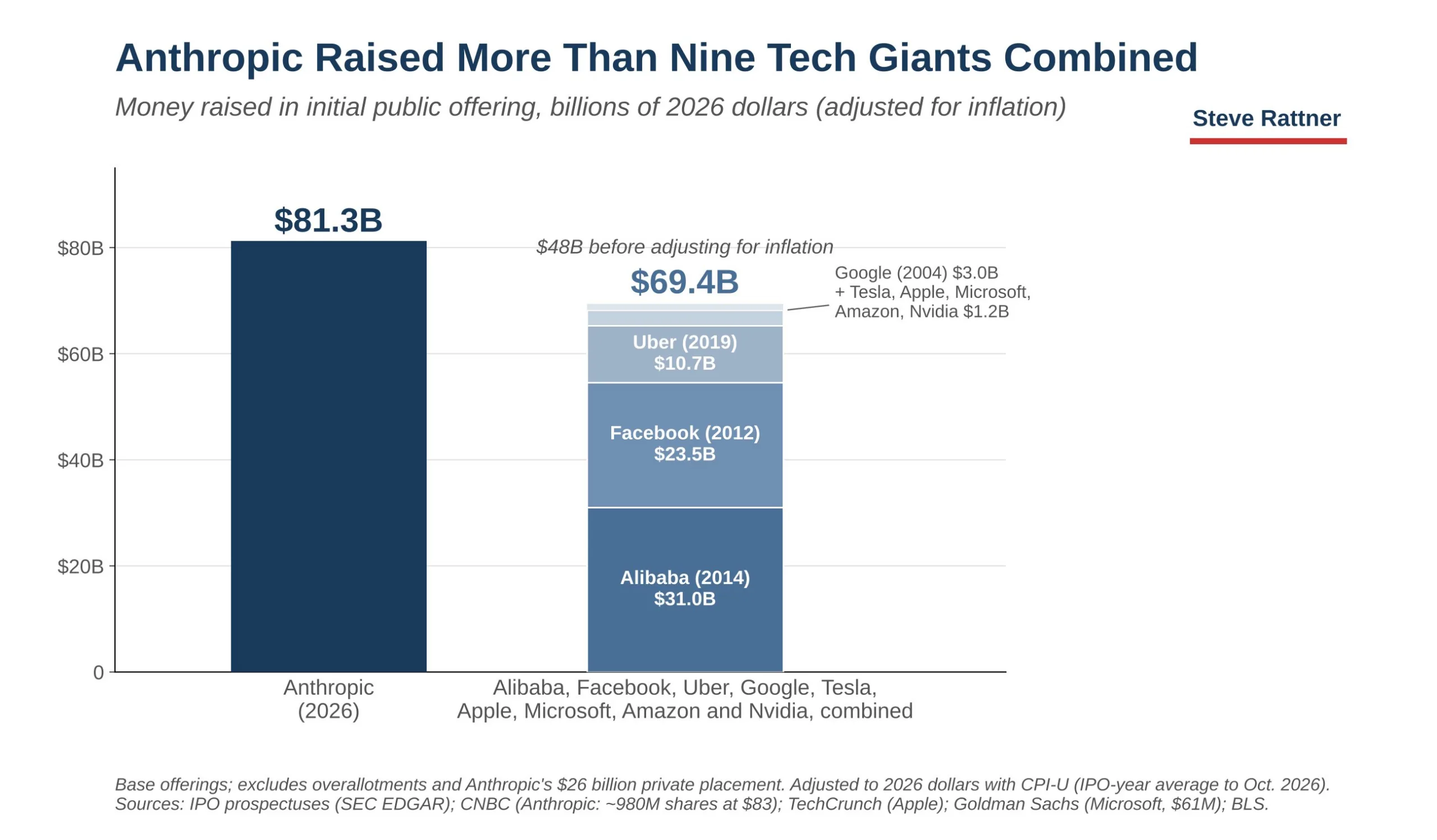
    Anthropic raised more in its IPO than Alibaba, Facebook, Uber, Google, Tesla, Apple, Microsoft, Amazon and Nvidia combined | X (@SteveRattner)
    Anthropic raised more in its IPO than Alibaba, Facebook, Uber, Google, Tesla, Apple, Microsoft, Amazon and Nvidia combined | X (@SteveRattner)

    The IPO, however, is only one part of Anthropic’s massive fundraising exercise. Alongside the public offering, the company raised another $26 billion through a private placement of shares.

    This took the total deal value to approximately $107.3 billion. A private placement is different from an IPO. Instead of offering shares through the stock exchange, a company sells them directly to selected investors.

    Anthropic’s final prospectus also shows that the public offering included shares sold by existing shareholders. The company stated that it would not receive proceeds from those particular sales.

    The bulk of the offering, however, involved new shares issued by Anthropic.

    Claude finds its commercial footing

    The strong investor response reflects the company’s rapid growth and the rising demand for AI products. Its Claude models have become increasingly popular among businesses and software developers.

    Claude Code, in particular, has gained traction as an AI tool for software development. Anthropic had 11,900 customers generating at least $100,000 in annual revenue each over the 12 months ending September 30.

    Its annualised revenue run rate had also reached $81 billion by October 31.

    A revenue run rate is an estimate based on the company’s current earnings pace. It is not the same as revenue already earned over an entire financial year.

    The company’s third-quarter revenue reached $16.96 billion, marking a 47% increase from the previous quarter.

    The bill for brilliance comes due

    Rapid growth has come with enormous expenses. Building and operating advanced AI models requires extensive computing infrastructure, specialised chips and large data centres.

    Anthropic spent nearly $9 billion on computing capacity and infrastructure in the first half of 2026. It incurred another $5 billion in computing costs during the third quarter.

    The company has committed nearly $900 billion in computing spending with infrastructure partners, including Amazon and Google’s parent company Alphabet.

    These are future spending commitments, not money already spent. The company has also warned investors that problems with financing or infrastructure development among its partners could affect the availability and cost of computing capacity.

    All that glitters is not yet earnings

    There are also questions about profitability. Despite its growing revenue, Anthropic reported an operating loss of $567 million in the third quarter, compared with an operating income of $974 million in the preceding quarter.

    Its net loss stood at $23.3 billion, although this figure included non-operating items linked to bonds convertible into company shares.

    The numbers highlight the challenge facing AI companies.

    They must spend heavily to develop more powerful models while ensuring that customers generate enough revenue to justify those investments.

    Competition from OpenAI, Google and other AI developers adds to the pressure.

    Also Read | US flight disruptions: What triggered the FAA outage that grounded flights for second time since 9/11?

    Profit and purpose must now share the room

    Anthropic’s public listing also brings its governance structure into focus. The company operates as a public benefit corporation under Delaware law.

    This structure requires it to consider shareholder interests alongside its stated public benefit purpose of developing advanced AI responsibly. It has also established a Long-Term Benefit Trust, designed to help protect this commitment.

    CEO Dario Amodei and president Daniela Amodei will now have to manage the company’s commercial ambitions while maintaining its emphasis on AI safety.

    The IPO gives Anthropic access to public capital on an enormous scale. Its performance in the coming quarters will show whether the business can sustain the expectations that accompanied its historic market debut.


  • ‘We’d have been better off without it’: ‘Godfather of AI’ Geoffrey Hinton warns of major disaster

    ‘We’d have been better off without it’: ‘Godfather of AI’ Geoffrey Hinton warns of major disaster

    What if one of the biggest technological breakthroughs in human history had never happened? Professor Geoffrey Hinton, widely known as the ‘Godfather of AI’, has raised precisely this uncomfortable question while warning about the potential dangers of artificial intelligence. The Nobel Prize-winning computer scientist believes humanity might have been better off without developing the technology, even as AI continues to reshape workplaces and everyday life.

    However, Hinton’s concerns are not limited to the risks of increasingly powerful machines. He has also identified three abilities that could help humans retain an edge over AI: exceptional creativity, manual dexterity and empathy.

    ‘We would have been better off never developing it’: Geoffrey Hinton on AI risks

    Speaking to The Guardian in an interview published on November 3, Hinton acknowledged that artificial intelligence could lead to a positive future. However, he warned that the consequences could be severe if its development continues without adequate safety measures.

    The publication quoted him as saying, “it might be that we would have been better off never developing it”.

    Also Read | Does your iPhone avoid ‘Modi braggart’ and ‘Rahul is Pappu’? Here’s why

    Hinton also raised the possibility of a major AI-related incident this year or next, warning that it could disrupt essential systems, including electricity and financial infrastructure. Comparing the potential consequences to a Chernobyl-scale disaster, he suggested that such an event might finally push governments and technology companies to prioritise AI safety.

    Godfather of AI Geoffrey Hinton issues stark warning
    ‘Godfather of AI’ highlights three human skills machines may struggle to replicate | AI Generated

    He expressed concern about the race among major technology companies to develop increasingly powerful systems, arguing that commercial interests could take priority over public safety.

    Hinton called for stronger regulation and proposed an oversight mechanism similar to the US Food and Drug Administration (FDA). Under such a system, companies would have to demonstrate that their AI models do more good than harm before releasing them.

    Despite these warnings, he has not ruled out a positive future, maintaining that humanity may still be able to manage the risks with sufficient effort.

    Geoffrey Hinton names 3 human skills AI may not be able to replace

    While artificial intelligence is becoming increasingly capable, Hinton believes certain human abilities could remain difficult for machines to replicate. A report published by NDTV on November 4 highlighted three such areas.

    Also Read | Scientists discover 1,500 km-wide object beyond Pluto, could it be a new dwarf planet?

    Top-level creativity: AI can generate music, images and stories, but Hinton believes it has yet to match the abilities of the best human creative artists. Exceptional originality and artistic judgement could continue to distinguish humans from machines.

    Godfather of AI Geoffrey Hinton issues stark warning
    Nobel laureate Geoffrey Hinton raises fresh concerns over artificial intelligence safety | AI Generated

    Manual dexterity: Robots still face difficulties when handling unfamiliar objects, performing delicate tasks and responding to unpredictable physical environments. These fine motor abilities remain an area where humans have an advantage.

    Empathy: AI can produce seemingly compassionate responses, but Hinton draws a distinction between sounding empathetic and actually experiencing empathy. NDTV noted his observation that AI-generated responses can sometimes receive higher empathy ratings than those from human doctors, highlighting the difference between perceived and genuine emotional understanding.

  • UP man accused of murder stages own death with AI image, arrested

    UP man accused of murder stages own death with AI image, arrested

    In a bizarre case from Uttar Pradesh, a man accused of murder allegedly used an AI-generated image and a goat’s cremation to fake his death and escape trial. The accused, identified as 38-year-old Rajkumar Rajbhar, was arrested on Sunday, October 25, after reportedly spending nearly a year and a half living as a dead man on official records.

    Police said Rajbhar had allegedly arranged a series of forged documents, including a death certificate, to convince the court that he was no longer alive. The deception allowed him to stay away from legal proceedings in a murder case dating back to 2016.

    Rajbhar was arrested near the Khwajajahanpur locality in Mau district by Kotwali Nagar police, assisted by the Special Operations Group (SOG) and the surveillance team. He had been out on bail while facing trial for the alleged murder of Yogesh Singh.

    How AI helped Rajkumar Rajbhar fake his death?

    According to police, Rajbhar allegedly planned the deception in Ghazipur on May 30, 2025. Investigators said an AI-generated image showing a body lying on a funeral pyre at a cremation ground was used to support his claim that he had died.

    The AI-generated image of a funeral that was submitted to the authorities.
    The AI-generated image of a funeral that was submitted to the authorities. Credit: X/ANI

    In place of a human body, a goat was reportedly cremated. Photographs of the funeral procession and last rites were also allegedly arranged to make the supposed death appear genuine.

    The material was then used to obtain a death certificate from the Mau Municipal Council, which was submitted to the court. Police said the documents helped Rajbhar create the impression that he had died while the murder trial was still pending.

    The case highlights how AI-generated images can potentially be misused alongside forged records to support an alleged deception. In this instance, investigators suspect that the technology was used as part of a wider plan rather than as an isolated act of digital forgery.

    2016 murder case: Why was Rajbhar on trial?

    The case against Rajbhar dates back to December 19, 2016, when Yogesh Singh was shot dead near the Munshipura railway line.

    A murder case was registered against Rajkumar Rajbhar and his friend Sudarshan Rajbhar following a complaint filed by the victim’s nephew, Avinash Singh.

    Rajbhar was subsequently released on bail while the trial continued. Police allege that he later devised the fake-death plan to avoid appearing in court and facing the ongoing criminal proceedings.

    His arrest on October 25 has brought him back into the legal process. The murder allegations remain subject to trial, and a court has not established the allegations against him.

    Police allege fake death was also linked to financial disputes

    Additional Superintendent of Police Anoop Kumar said Rajbhar had not cleared his Class 12 examination and worked as a stock market trader.

    Also Read | 4 key military rankings show where India stands against China and the US in 2026

    According to the police, Rajbhar had collected money from prominent individuals in several cities by claiming that he would invest it in the stock market. Investigators suspect that his alleged plan to fake his death was intended not only to evade the murder trial but also to avoid returning the money he had collected.

    A dead goat was put on the pyre, and the man's face was superimposed on it.
    A dead goat was put on the pyre, and the man’s face was superimposed on it. Credit: X/ANI

    Police have registered a separate forgery case in connection with the alleged use of false documents.

    AI misuse adds another dimension to the case

    The alleged scheme involved several elements, including an AI-generated image, a staged funeral, the cremation of a goat and documents that were submitted to a court. Police are investigating the case as Rajbhar faces the murder proceedings and the separate forgery allegations.

    The incident also draws attention to the growing challenges posed by AI-generated content when it is used to create misleading visual evidence. While such images can serve legitimate purposes, they can also be manipulated or presented deceptively.

    Also Read | Why are people protesting against Siang Dam in Arunachal Pradesh?

    For Rajbhar, the reported attempt to establish his own death has not ended the legal proceedings. Following his arrest, he will have to face the pending murder trial, while the separate forgery case adds another layer to the allegations against him.

  • Literary prize for AI-written fiction? France has an interesting offer

    Literary prize for AI-written fiction? France has an interesting offer

    France, known for its historic bookshops, literary cafés and celebrated writers, is opening a new chapter in its literary tradition. The country is drawing attention with the Prix Pascal de Littérature IA, a literary competition that recognises fiction written with the assistance of artificial intelligence (AI).

    The initiative invites writers to explore the possibilities of AI-assisted storytelling while bringing questions about authorship and technology into the literary conversation. Unlike conventional writing competitions, this prize specifically welcomes unpublished French-language fiction developed in collaboration with AI tools.

    What is the Prix Pascal de Littérature IA?

    The Prix Pascal de Littérature IA is a literary prize dedicated to fiction created with the help of artificial intelligence. Writers from across the world can participate, provided their submissions meet the competition’s requirements.

    AI-assisted books enter the spotlight as France opens a new literary competition | File Image
    AI-assisted books enter the spotlight as France opens a new literary competition | File Image

    The initiative reflects the growing intersection of technology and creative writing. By inviting authors to work with AI, the competition creates a platform for stories that combine human creativity with artificial intelligence.

    Also Read | UK urges households to keep 3 days of food, water and emergency supplies

    The winning manuscript is set to receive publication, offering the selected writer an opportunity to bring their work before readers.

    Who is eligible for the AI literature prize?

    The competition is open to writers regardless of nationality, country of residence or publishing background. However, entries must meet two essential conditions: the manuscript must be unpublished fiction written in French, and it must be co-created using AI.

    AI-assisted books enter the spotlight as France opens a new literary competition | File Image
    ChatGPT, Claude and Gemini feature in France’s new AI literature prize | File Image

    Participants are also required to disclose the AI model and prompts used to develop their manuscripts. This includes tools such as ChatGPT, Claude, Gemini and LLaMA.

    These requirements establish transparency around the role artificial intelligence plays in the writing process.

    What is the last date to apply?

    According to the organisers’ published rules, applications for the inaugural Prix Pascal de Littérature IA are scheduled to open on November 2, 2026. The submission deadline is November 30, 2026.

    The winner is expected to be announced in early December 2026.

    AI-assisted books enter the spotlight as France opens a new literary competition | File Image
    AI meets literature in France as a new fiction prize opens for global writers | File Image

    Interested writers should consult the competition’s official website for the complete submission guidelines and eligibility requirements before entering.

    Also Read | What are heat storms? Why global heatwaves are becoming bigger and longer

    Why is this prize relevant to literary travellers?

    France has long attracted visitors interested in literature, from independent bookshops to the cafés and neighbourhoods associated with its literary history. Paris, in particular, remains closely linked to writers, publishers and literary communities.

    The new competition adds a contemporary dimension to that cultural landscape, connecting France’s literary heritage with the changing ways books are created and published. For visitors interested in the country’s literary scene, it offers another development to follow as artificial intelligence becomes part of discussions about modern storytelling.

  • World Tourism Day 2026: Planning a trip? 5 ways AI can help build a smarter travel plan

    World Tourism Day 2026: Planning a trip? 5 ways AI can help build a smarter travel plan

    World Tourism Day 2026: Your holiday may be a few weeks away, but the endless tabs, saved maps and hotel comparisons can start much earlier. Choosing where to stay, what places to visit, where to dine and how to incorporate it into a small timeframe could be quite confusing. That is where AI could help you create a more organised travel plan out of those scattered thoughts.

    Such an approach is consistent with the theme of World Tourism Day 2026 celebrated on September 27. This year’s theme is “Digital Agenda and Artificial Intelligence to Redesign Tourism”. Whether you’re creating a day-by-day itinerary, choosing the right hotels based on your requirements, or suggesting local dining and other experiences, AI can really be a valuable friend during your holiday planning process.

    It is important to know what questions to ask. Just adding a couple of points in your prompt could make it more specific.

    Give AI details about your trip 

    An open-ended question such as “Plan a Trip to Jaipur” will never bring you any helpful answer. Instead, give more information on your visiting dates, budget, time frame, and who you will be traveling with in your prompt.

    World Tourism Day 2026: 5 AI tips for smarter travel planning
    (Representational Image) World Tourism Day 2026 spotlights AI-powered tools for easier travel planning | AI Generated

    The information about your interests will help to limit the suggestions. Say what you want to taste from local cuisine, visit local attractions, go shopping, or avoid visiting the crowded places.

    Also Read | Anti-itinerary travel: Why Gen Z is changing holiday plans

    For example, a three-day family vacation is likely to demand a low-paced itinerary involving fewer trips between various sights. Providing these additional details will be helpful for the AI.

    Build a practical day-wise itinerary 

    AI can also be used for organizing attractions according to their location. Mention the area where you stay in the hotel and have the program organize those sites together on one day. This may assist you to minimize moving from one part of the town to another.

    World Tourism Day 2026: 5 AI tips for smarter travel planning
    (Representational Image) Smart travel planning with AI can help organise hotels, attractions, food and routes | AI Generated

    You can also request for other plans, including having a day less busy than others during the holiday period.

    Find hotels that match your requirements 

    Instead of just asking the AI to recommend a “best hoetel,” tell it what is important to you, like the price, location, room, near the transportation, parking, or breakfast.

    World Tourism Day 2026: 5 AI tips for smarter travel planning
    (Representational Image) AI travel tools can simplify holiday planning with personalised itineraries and hotel options | AI Generated

    The AI will assist you in coming up with a list of options and comparing them. Nevertheless, after that, you should look at the final price, availability, cancellation policy, and the reviews on the website where the booking is being made.

    Discover food and local experiences 

    The use of AI allows it to suggest restaurants and local dishes based on an existing travel itinerary. AI will provide the option for choosing alternatives to the planned itinerary in case there will be crowds at a landmark, including alternative nearby locations.

    Also Read | Autumn Travel Guide: 10 stunning places to visit in India this festive season

    Check important details before travelling 

    AI is not the sole source of up-to-date travel planning tips, as the opening hours and other data can be changed and some of the data suggested by AI may be out-of-date.

    World Tourism Day 2026: 5 AI tips for smarter travel planning
    (Representational Image) From itineraries to local food, AI can help make travel planning more organised | AI Generated

    It is recommended to check the information from official tourism websites, hotels’ websites, and transport providers’ websites prior to departure. AI will help with organizing the information search process.