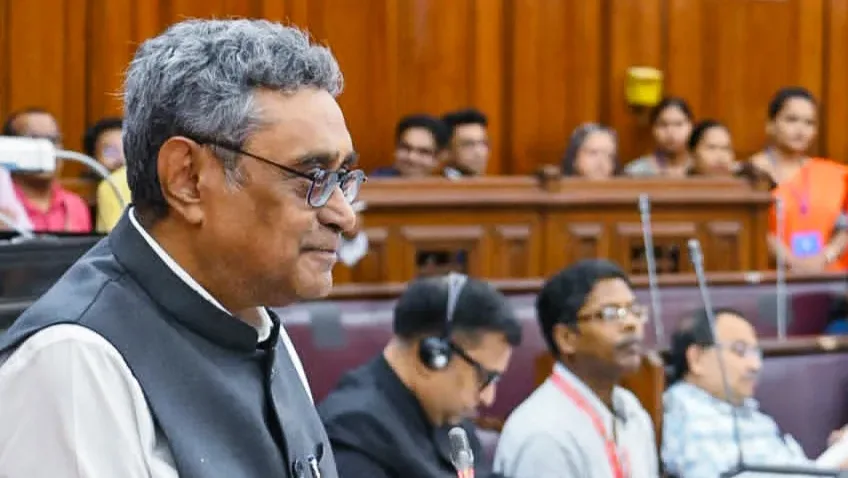
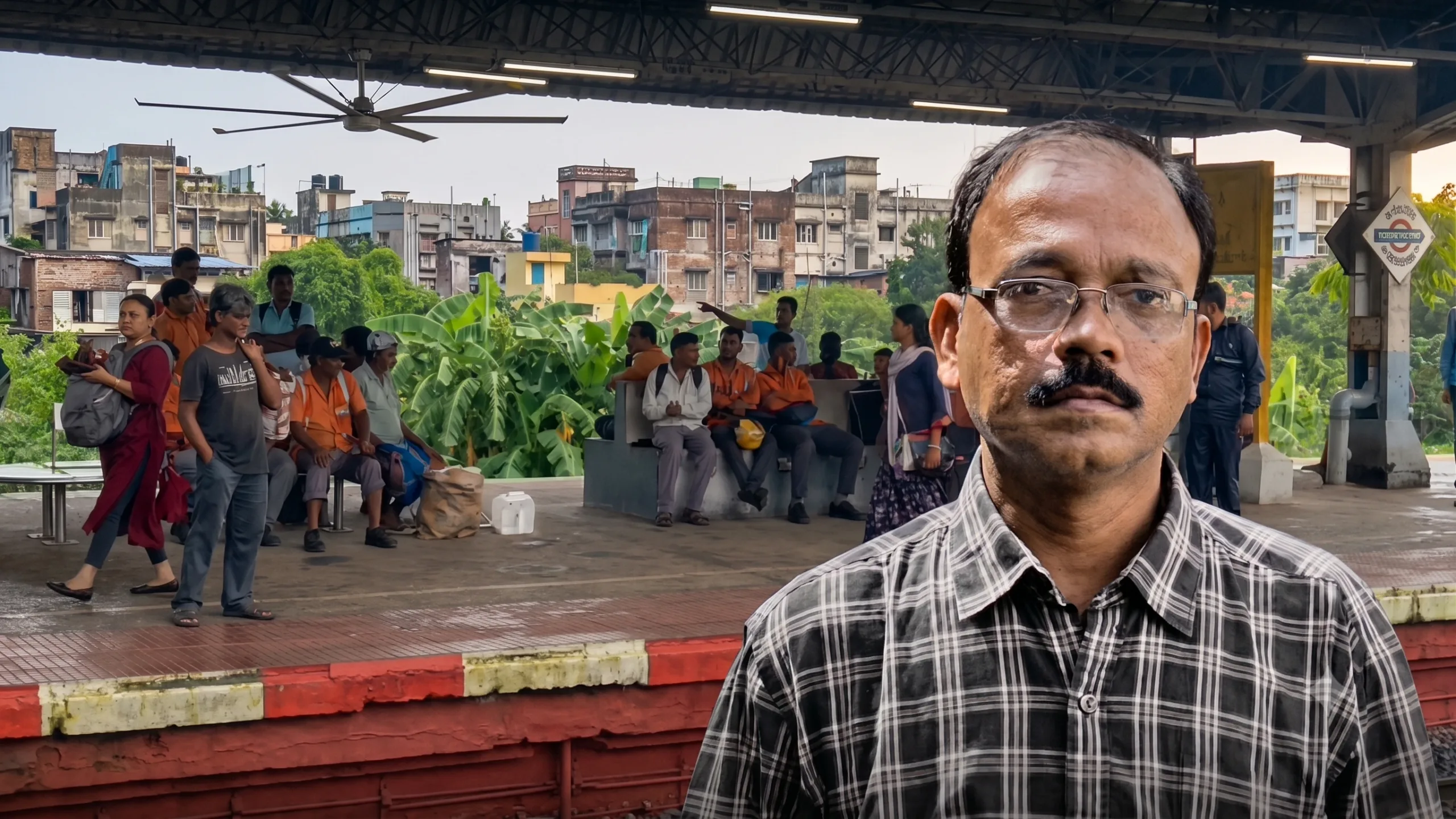
On Thursday, Finance Minister Swapan Dasgupta said the West Bengal government is exploring legislative changes, land pooling, and other reforms to address long-standing difficulties around land use.
Land remains Bengal’s knotty question
Speaking at Business Today’s India at 100 event, Dasgupta described land as one of West Bengal’s most difficult issues. He said the challenge comes from both limited land availability and the fragmented nature of land holdings in the state.
“Land is always a ticklish issue in West Bengal because of two reasons. One, it is in short supply due to sheer population pressure, and secondly, land holdings tend to be of handkerchief size,” Dasgupta said.
The minister said some of the existing land tenures are highly complicated. In some cases, he argued, the rules make it difficult to sell or use land for new purposes. His immediate focus, he said, would be to simplify the legal framework governing land use.
“We have to first get a large amount of legislation done to simplify land use,” Dasgupta said.
Simplifying the rules, parcel by parcel
The proposed approach is not limited to changing land laws. The state is also experimenting with land pooling arrangements, a model that brings together fragmented parcels of land for planned development.
Dasgupta pointed to Gujarat and Haryana as states where such arrangements have been used successfully.
At the same time, he cautioned against expecting West Bengal to offer unlimited land for industrial or commercial projects. The state has high population density and limited availability of large parcels, making land a structural constraint.
“But land is always going to be an issue in Bengal. I am not going to minimise its importance,” he said.
West Bengal wants to shed ‘difficult for business’ tag
The government’s larger goal is to change the perception that West Bengal is difficult for businesses.
Dasgupta said investment decisions are not determined only by financial incentives. Other states may offer more attractive incentives, he noted, but West Bengal wants to compete by highlighting its broader economic ecosystem.
“We have a tradition. We have a skilled workforce. We have a reasonably livable city. We have all these things,” Dasgupta said, adding that the state’s infrastructure has also improved and needs further strengthening.
The land reforms are part of a wider push for deregulation. Dasgupta said the government is also examining ways to use existing assets to improve state finances.
He described public debt as a major challenge and said the government would have to consider measures including deregulation, privatisation, and the better use of underutilised assets.
More than sweeteners for investors
The minister also spoke about simplifying the Goods and Services Tax (GST) system. He said he had yet to attend his first GST Council meeting but stressed that reducing complexity and discretionary powers would be important for businesses.
Dasgupta said the state wants to create conditions where investment can move more easily once regulatory hurdles are reduced.
Can an ordinary person in West Bengal actually own a gun? The answer is yes, but it is certainly not as simple as walking into a shop and buying one.
Under the Indian Arms Act, 1959 and the Arms Rules, 2016, civilians can apply for firearms licences under specific circumstances. Broadly, licences are issued for self-defence, business protection and sports shooting. Each category has its own requirements, and simply wanting to own a gun is not enough.
Notably, just in recent weeks, Trinamool Congress MP Kirti Azad said that he would obtain an arms licence for security. That raises a wider question: what about ordinary citizens? What does the law actually allow?
When can someone get a gun licence for self-defence?
The Arms Act notes that a self-defence licence is primarily meant for people who can demonstrate a genuine threat to their life or property. The authorities do not generally issue such licences merely because an applicant feels unsafe. There has to be some supporting evidence.
Documents that may be required include:
FIR or GD copy.
Police record of any previous assault, threats or blackmail allegations.
Any evidence of threats received through threatening letters or digital means.
People holding sensitive government positions, or those occupying social positions that put their lives at risk, may also apply. Depending on the circumstances and the licence granted, they may be permitted to possess firearms in the Non-Prohibited Bore (NPB) category, including certain pistols, revolvers or shotguns.
What about business owners?
Interestingly, a separate category exists for people whose work involves handling substantial amounts of cash or valuables. Jewellers, banks, cash-handling agencies, petrol pumps and large distributors, for example, may have a reason to seek additional security where large cash transactions occur regularly.
Then in such cases, applicants have to provide documents including:
Specific business licences, including trade licences.
Company’s incorporation certificate.
Proof of financial transactions.
Annual turnover ledger.
GST Return.
Income Tax Return (ITR).
Can sports shooters get a gun licence?
Yes. Firearms licences can also be issued for sports shooting and target practice. But this category is specifically linked to participation in recognised shooting activities.
The applicant must be an active member of a recognised shooting club or rifle association.
The required documents can include:
National Rifle Association of India (NRAI) or State Rifle Association-approved membership card and certificate.
Shooter ID card (special identity card for sports category).
Proof of active participation in various district, state or national level shooting competitions for 2 years.
What kind of gun can a civilian actually own?
This is where the rules become particularly important. A district police official noted that getting a gun license does not mean that all types of guns can be purchased. He said that no type of automatic rifle, machine gun or any military weapon used by the army can be purchased.
303 rifles, 7.62 mm and high-powered firearms meant for military use also cannot be purchased by ordinary civilians, the official made it clear.
With a valid licence, however, certain civilian firearms, such as shotguns and smoothbore guns, may be available. These can include single-barrel or SBBL guns and double-barrel or DBL guns. Depending on the category and conditions of the licence, certain 9 mm pistols may also be permitted.
What is the minimum age?
For personal or business purposes, an applicant must generally be at least 21 years old.
Sports shooting has different provisions. Under special conditions, those aged 12 years and above can apply under the sports category.
How does the application process work?
The applicant has to submit Form A-1, either online or offline, following which the application is sent to the concerned police station. Following this, an officer under the District Magistrate handles the application process in each district.
The police then conduct the necessary verification. A report from the District Intelligence Department is also obtained. The application subsequently moves to the concerned officer under the District Magistrate.
After checking the documents, background information and other details, the file is placed before the District Magistrate. The District Magistrate then takes the final decision after examining the information and verification reports.
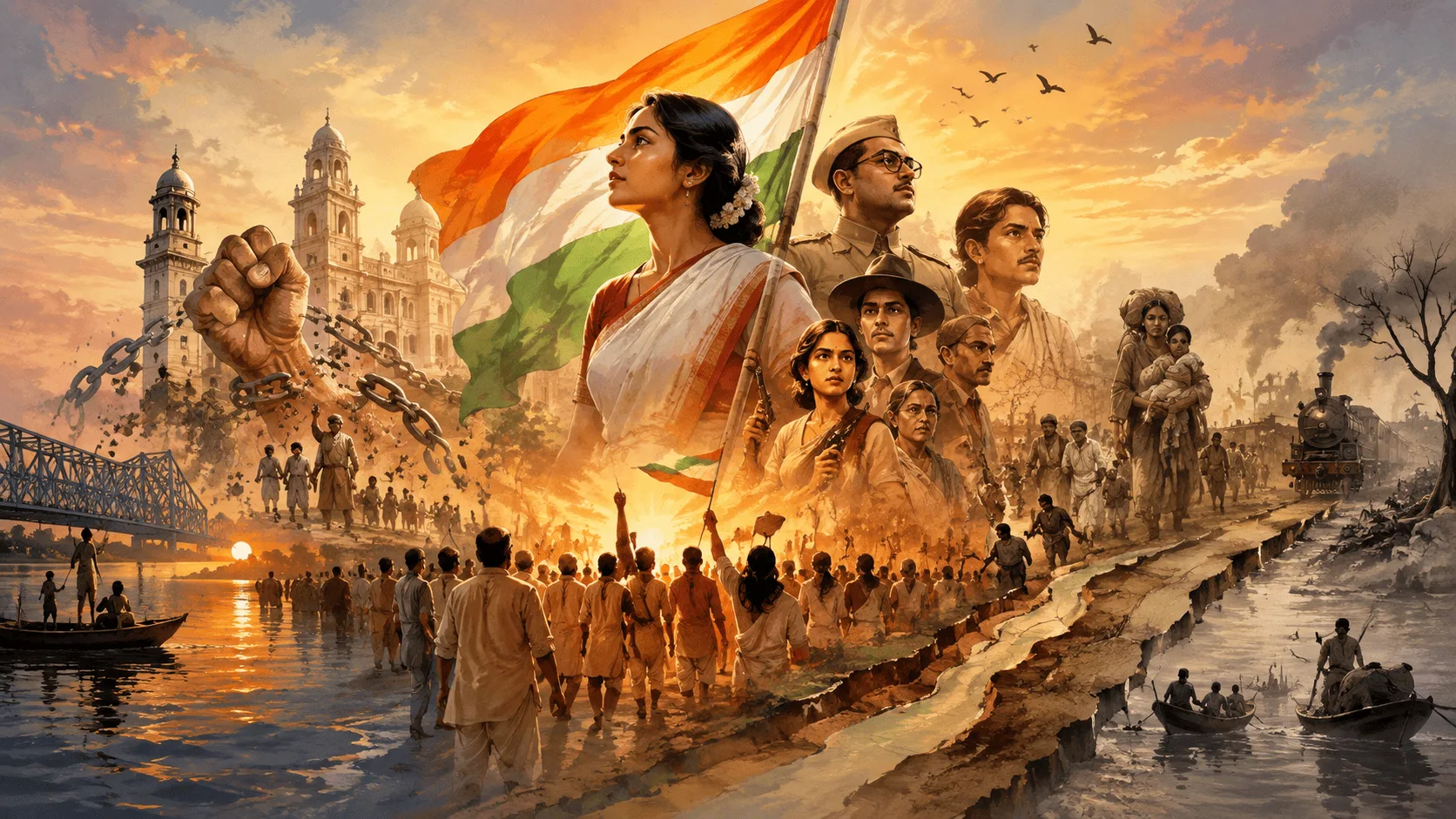
On the night India crossed the threshold of freedom, Bengal occupied a peculiar and almost tragic position in the national imagination: it was at once one of the principal nurseries of Indian nationalism, the birthplace of movements that had challenged the moral authority of the Raj long before independence became an attainable political proposition, and the province that would experience the arrival of freedom through the violence of Partition, with Calcutta itself suspended between jubilation and apprehension. While New Delhi prepared for the ceremonies that would accompany the transfer of power, Bengal confronted a more complicated dawn, for the liberation of a country had arrived alongside the division of a homeland that had for generations been imagined, inhabited and remembered as a cultural whole. Eight decades later, as India marks its 80th Independence Day, that contradiction remains indispensable to any serious understanding of what freedom meant to Bengal and what Bengal, in turn, meant to the making of India.
Long before 15 August became the ceremonial vocabulary through which an independent republic would annually remember itself, Bengal had already supplied much of the intellectual and emotional grammar of the freedom movement. The first Partition of Bengal in 1905, conceived by the colonial administration ostensibly for reasons of administrative convenience but widely perceived as an attempt to fracture an increasingly politically conscious population, produced the Swadeshi movement and transformed resistance from an abstract political sentiment into an everyday practice of boycott, indigenous enterprise, national education and cultural assertion. The streets, classrooms, printing presses and drawing rooms of Bengal became laboratories of nationalism, while literature, music and theatre acquired a political potency that the colonial state found increasingly difficult to contain. Rabindranath Tagore’s songs, Bankim Chandra Chattopadhyay’s Vande Mataram and the writings of a generation of intellectuals did something that political resolutions alone could not accomplish: they gave the idea of India an emotional vocabulary.
Yet Bengal’s nationalism was never confined to the genteel world of intellectual debate. Beneath the public movement existed a subterranean republic of revolutionaries, whose names would eventually become inseparable from the mythology of India’s struggle for independence. Khudiram Bose, barely eighteen when he was executed in 1908, entered nationalist memory as the embodiment of a generation for whom colonial rule had ceased to appear merely unjust and had instead become intolerable; the organisations associated with Anushilan Samiti and Jugantar subsequently cultivated networks of young men who regarded armed resistance as an alternative to petitions, negotiations and constitutional gradualism. Their methods remain historically contentious, and their violence cannot responsibly be romanticised, but their importance lies in what they revealed about the changing psychology of colonial India: the British Empire, once presented as an almost permanent fact of political life, had begun to appear vulnerable to challenge.
That transformation found one of its most formidable expressions in Subhas Chandra Bose, whose political imagination was perhaps too impatient to accommodate itself to the incrementalism of conventional nationalist politics. Netaji’s journey from Congress president to leader of the Indian National Army remains one of the most contested trajectories in the history of India’s freedom struggle, particularly because his wartime alliances with the Axis powers continue to invite legitimate historical scrutiny; yet reducing Bose either to a military romantic or to the controversies surrounding his wartime diplomacy would be to miss the larger significance of his politics. He understood freedom not merely as the legal transfer of sovereignty but as a psychological emancipation, requiring Indians to cease thinking of themselves as subjects awaiting political concessions and to imagine themselves instead as the authors of their own destiny. His famous call to sacrifice was consequently less a piece of rhetoric than an attempt to manufacture political agency among a colonised people.
Bengal’s contribution to the freedom movement was, moreover, never exclusively male, nor was it confined to the celebrated names that populate school textbooks. Pritilata Waddedar, Kalpana Dutta and Bina Das belonged to a generation of women who entered political resistance at considerable personal risk, while Matangini Hazra, the elderly Gandhian revolutionary from Tamluk, became one of the most enduring symbols of the Quit India Movement when she continued advancing with the national flag after being shot by the colonial police in 1942. In the parallel nationalist administration established in Tamluk during the Quit India period, Bengal demonstrated another dimension of resistance: the capacity not merely to oppose colonial authority but to experiment, however imperfectly and briefly, with alternative forms of political organisation.
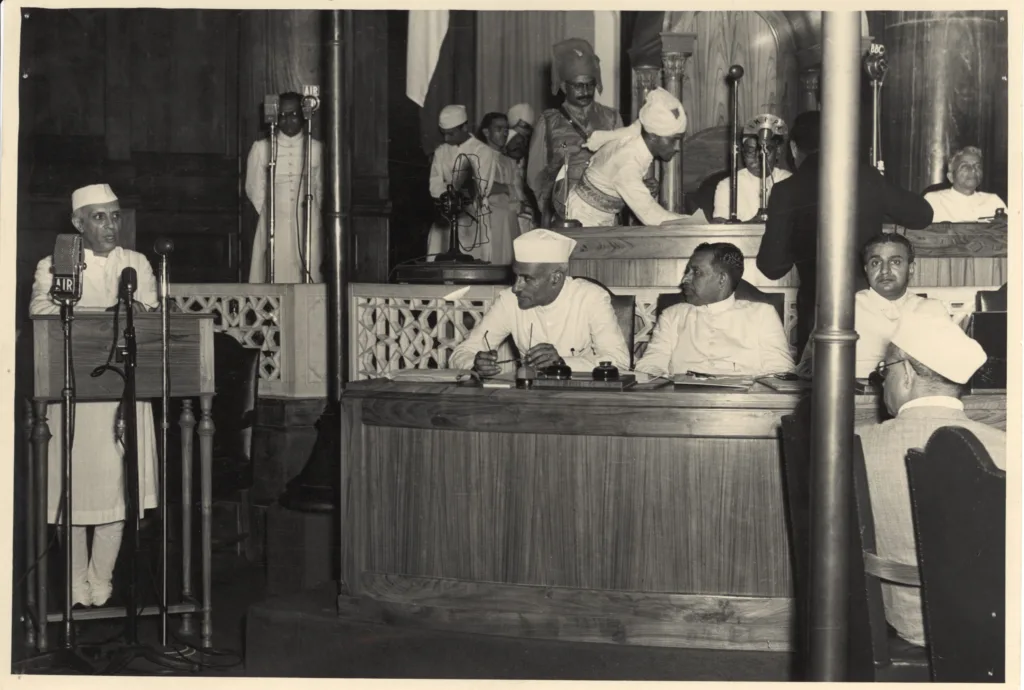
And then came 1947, carrying with it the strange cruelty that history sometimes reserves for places that have contributed most passionately to its making. Nehru’s celebrated Tryst with Destiny speech, delivered on the eve of independence, imagined India awakening to life and freedom after a long night of subjugation; Bengal entered that same dawn with the knowledge that freedom had also redrawn the map beneath its feet. The partition of Bengal divided families, disrupted economies, displaced millions and transformed the meaning of home for communities on both sides of the new border. Calcutta, which had once stood at the centre of an undivided Bengal and had served as the capital of British India until 1911, became a city negotiating the enormous human consequences of Partition even as the new republic attempted to celebrate its arrival.
Jawaharlal Nehru delivering his speech, Tryst with Destiny, on the eve of India’s first independence day | Wikipedia
This is why the Bengal story of Independence cannot be reduced to nostalgia, however seductive nostalgia may be. To remember Khudiram is to remember the ferocity of youthful conviction; to remember Surya Sen is to remember the audacity of organised rebellion; to remember Pritilata and Matangini is to recognise how extensively women participated in the making of freedom; to remember Netaji is to confront the complexity of nationalism itself; and to remember Partition is to understand that political liberation can coexist with profound human loss. The inheritance is therefore not a simple pantheon of heroes but a complicated archive of courage, disagreement, idealism, violence, sacrifice and grief.
For India in 2026, that archive acquires renewed significance because the meaning of freedom has inevitably changed. The generation that fought the Raj sought sovereignty; the generation that inherited sovereignty has had to confront poverty, illiteracy, inequality, communal tension, institutional weakness and the enormous challenge of converting political independence into substantive opportunity. The India that now speaks of becoming a developed nation by 2047 is consequently engaged in a second, very different kind of freedom struggle: not against an external sovereign, but against the internal constraints that prevent citizens from exercising the full possibilities of independence.
Bengal, which once supplied so much of the intellectual energy of India’s freedom movement, must find its place within that unfinished project. The challenge is no longer to overthrow an empire, but to build institutions capable of sustaining aspiration; no longer to demand Swaraj, but to translate political liberty into economic dynamism, educational excellence, technological confidence and social dignity. The Bengal that produced revolutionaries, poets, scientists, reformers and political thinkers cannot afford to treat its history as a museum of former greatness; its more demanding obligation is to convert that inheritance into a capacity for renewal.
Perhaps, then, the most appropriate way to observe Independence Day in Bengal is neither through triumphalism nor through melancholy, but through a more demanding act of remembrance. Eighty years after Nehru spoke of India’s tryst with destiny, the tryst remains unfinished, because freedom, once achieved, does not become self-sustaining merely by virtue of being inherited. Every generation must decide what it will do with the political inheritance placed in its hands.
The tricolour that rises over Bengal each August therefore carries within it more than the memory of 1947. It carries the unfinished arguments of 1905, the courage of the revolutionaries, the imagination of Tagore, the defiance of Netaji, the sacrifice of Matangini and Pritilata, the wounds of Partition and the aspirations of millions who inherited freedom without ever having witnessed its birth. The awakening of 1947 gave India its sovereignty; the responsibility of 2026 is to determine what that sovereignty can become.
And perhaps that is the most enduring lesson Bengal can offer a country approaching its centenary: that freedom is not a destination reached at midnight, but a promise whose meaning must be renewed at every dawn.
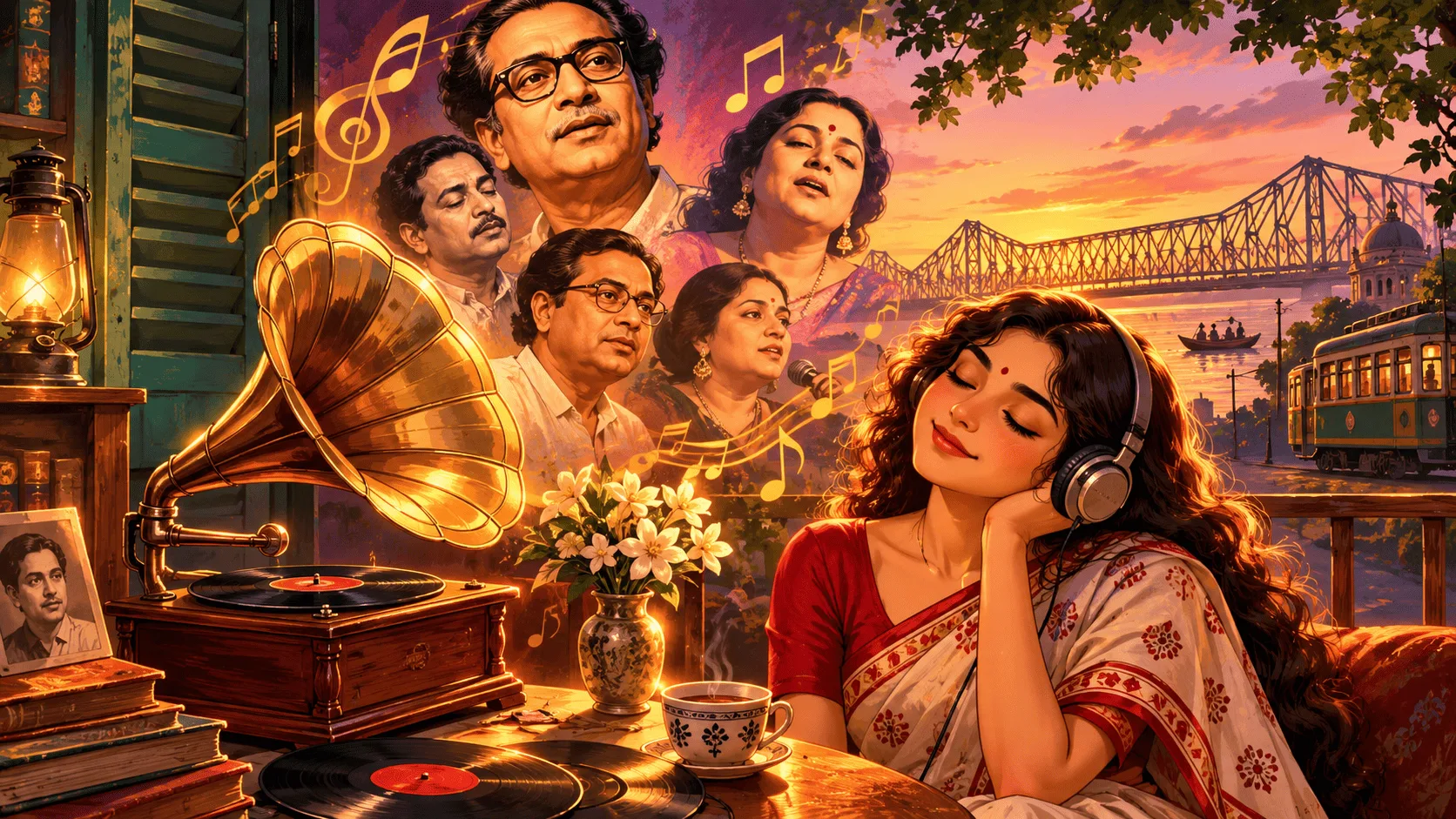
There was a time when Bengal did not merely produce music; it possessed a musical civilisation.
Its songs were not disposable embellishments to cinema, nor ephemeral commodities engineered for a weekend’s streaming numbers. They were cultural artefacts, carrying within their melodies the melancholy of a river, the romance of a rain drenched afternoon, the anguish of partition, the exuberance of youth and the philosophical resignation that Bengalis have long perfected into an aesthetic virtue.
The greats did not simply sing songs. They fashioned an idiom.
Hemanta Mukhopadhyay possessed a baritone that could make solitude sound almost aristocratic. Manna Dey brought classical rigour into popular music without sacrificing accessibility. Sandhya Mukhopadhyay invested romantic longing with an almost operatic tenderness. Shyamal Mitra, Manabendra Mukhopadhyay, Dwijen Mukhopadhyay and Aarti Mukherji added their own hues to an extraordinarily variegated canvas. Behind them stood composers and lyricists such as Salil Chowdhury, Sudhin Dasgupta, Nachiketa Ghosh and Pulak Bandyopadhyay, whose collaborations created songs that have outlived the films for which they were composed.
Sudhin Dasgupta alone worked with an astonishing constellation of voices, including Hemanta, Manna Dey, Shyamal Mitra, Sandhya Mukhopadhyay, Lata Mangeshkar, Asha Bhosle, Mohammed Rafi and Talat Mahmood.
This was Bengal’s great musical paradox: it was fiercely Bengali without ever being culturally insular.
Calcutta and Bombay were not rival musical republics. They were neighbouring provinces of the same imagination. Lata Mangeshkar could sing in Bengali; Kishore Kumar could become an intrinsic part of the Bengali sonic memory; Salil Chowdhury could carry the political conscience and melodic sophistication of Bengal into Hindi cinema. The traffic was not merely commercial. It was artistic.
That cosmopolitanism has gradually receded and the decline did not arrive with the theatricality of an obituary. It came insidiously, through changing economics, altered listening habits and the transformation of cinema music into content. The old ecosystem, in which lyricists, composers, arrangers, singers and musicians could develop enduring artistic partnerships, slowly fragmented. The song became shorter, the production more immediate, the shelf life more precarious.
What disappeared was not talent and Bengal has never been bereft of talent.
What disappeared was the ecosystem that could turn talent into a musical era. This distinction is crucial.
A generation ago, a composer could acquire a signature. A singer could cultivate a recognisable musical personality. A lyricist could become inseparable from a certain emotional vocabulary. Today, songs arrive amid an avalanche of releases, competing not merely with other songs but with reels, remixes, algorithms and an attention span increasingly atomised by the tyranny of immediacy.
And then came the Dev era.
The rise of Dev in Bengali commercial cinema, particularly through the enormously popular soundtracks of films such as Paglu, Shedin Dekha Hoyechilo and others, produced one of the last conspicuous manifestations of Bengal’s older cosmopolitan musical instinct. Jeet Gannguli became a formidable musical force, while voices from the Bombay playback establishment, including Sonu Nigam, Shaan and Kunal Ganjawala, became integral to Bengali popular cinema.
It was commercially unapologetic, musically contemporary and unmistakably ambitious.
More importantly, it demonstrated that Bengali cinema could still summon Bombay’s most recognisable voices and make them sing to a Bengali audience at considerable scale. Songs such as Je Kothati Mone and Shey Chhilo Boroi Anmona became chartbusters, evidence that linguistic particularity did not necessitate musical insularity.
Perhaps that was the last grand bridge between two musical cultures that once conversed with enviable ease.
Today, the irony is almost painful. The old songs refuse to die even as the ecosystem that created them has largely disappeared. They survive in Puja playlists, late night radio, streaming algorithms, family archives and the accidental nostalgia of a younger generation discovering that their grandparents’ music possesses something contemporary music often struggles to manufacture: permanence.
Bengal’s lost musical diadem, therefore, is not really lost.
Its jewels remain scattered across decades of recordings. What has been misplaced maybe is the crown.
And perhaps the challenge before Bengali music is not to resurrect the past, for nostalgia is a poor substitute for creation, but to recover the confidence of that past: the audacity to compose ambitiously, to sing without haste, to write with literary precision and to believe that a Bengali song can travel beyond Bengal without first surrendering its Bengali soul.
For music, like civilisation, does not perish when its practitioners change. It perishes when a culture ceases to believe that what it creates is worthy of being remembered.
On Friday, Kamal Senapati, a 53-year-old senior engineer in the Public Works Department (PWD) of Eastern Railway, died after being hit by a train close to the station at Hooghly railway station. While the exact circumstances surrounding his death are still under investigation, some of his colleagues have alleged that prolonged work pressure may have taken a heavy toll on him. Police are currently investigating whether the death was an accident or a case of suicide.
Who was Kamal Senapati?
Kamal Senapati was serving as a Senior Engineer in the Railway’s Public Works Department at Hooghly station. He had been handling massive responsibilities within the department. On Friday morning, Kamal reportedly left his residence in Hooghly at around 8 am. Sources reported that he was scheduled to travel to Chandannagar for official duties.
Just shortly after leaving home, he was hit by a train near Hooghly railway station, resulting in his death on the spot. Following the incident, personnel from the Bandel Government Railway Police (GRP) reached the location, recovered the body and sent it for post-mortem examination.
What has raised questions?
Eyewitnesses claimed that Kamal was struck by a train running on Line No. 3 at Hooghly station. They also noted that Kamal was expected to board a train to Chandannagar from the down-line platform. If that was the case, they wonder why he was on or near the up-line track, where the fatal accident occurred. Many of his colleagues suspect that the incident may not have been accidental. Even some employees raised concerns over mounting work pressure within the department. According to a section of railway workers, employees have been working under considerable stress for an extended period. They alleged that leave has become increasingly difficult to obtain and that many workers are expected to remain available almost round the clock due to operational demands. Some colleagues further claimed that Kamal had been under huge mental pressure in recent weeks. They alleged that he had also been threatened with suspension and said the matter had already been brought to the attention of the Divisional Railway Manager (DRM).
ALSO READ|Who is Sumit Roy? Supreme Court orders not to arrest Abhishek Banerjee’s close aide The railway workers’ organisation has also warned of industrial action if their concerns remain unaddressed. However, Bandel GRP sources noted that no formal complaint has been lodged so far. Meanwhile, an Eastern Railway official, speaking on condition of anonymity, expressed grief over the incident and told Ei Samay, “This is a very sad incident. We will talk to the people of the house. We are trying to contact them. We are investigating the matter.”
Every once in a while, you stumble upon a story so unbelievable that you instinctively think, “How did I never know about this?” This is one of those stories.
How did the Bengal Air story start?
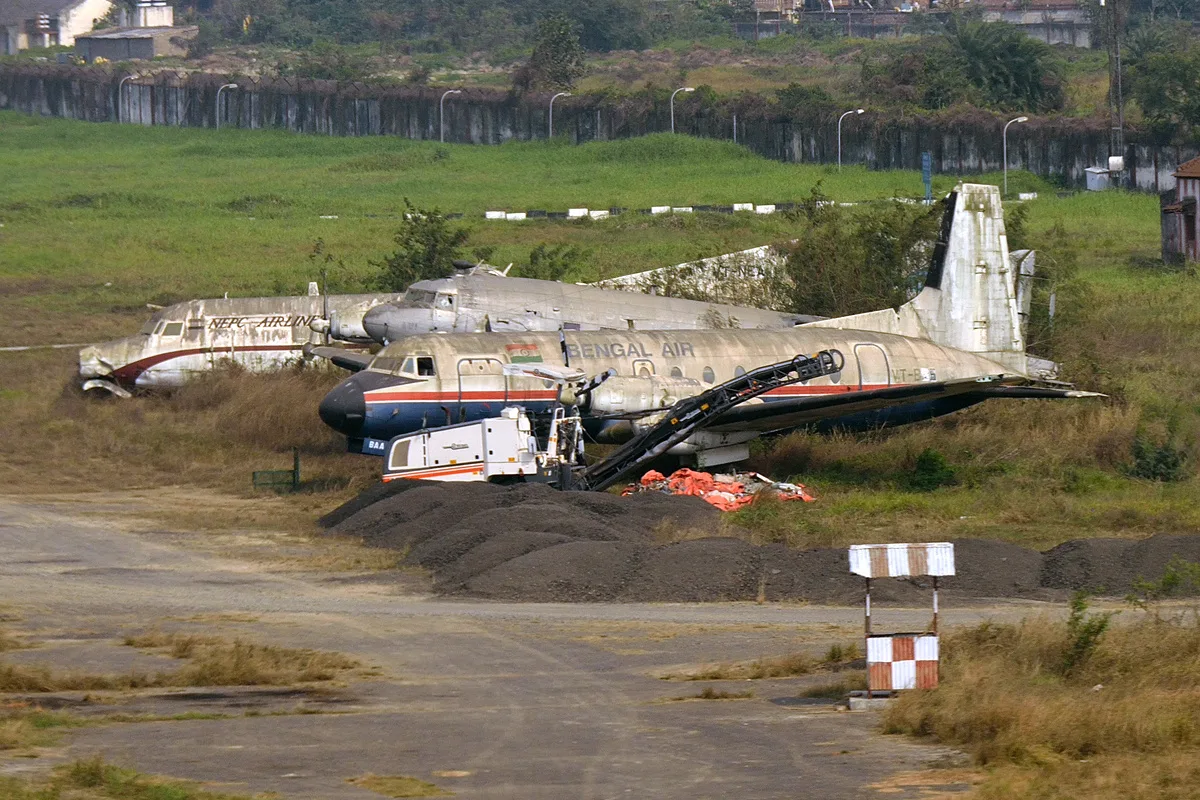
Nearly three decades ago, during the Communist Government, there was a bold move to start a regional airline in West Bengal. It was long before UDAN and the renewed interest in air connectivity between the east and the northeastern part of India that the state government had a vision of an airline that would do just that. The airline was called Bengal Air. But in 2026, that dead dream survives only as a rusting aircraft lying in a scrapyard near Sonipat, Haryana. Bengal Air recently made headlines after a YouTube video went viral, where Eastern India’s flying dream was spotted among other scrapped planes. The aircraft was carrying the registration VT-BAA.
Back in 1998, when the Left Front government under Chief Minister Jyoti Basu was trying to revive Bengal’s industrial landscape, civil aviation emerged as one of the sectors the state wanted to explore. A consortium formed by the West Bengal Industrial Development Corporation (WBIDC) and Bengal Air Services Limited (BASL) proposed launching Bengal Air, a regional airline designed to improve connectivity across eastern and northeastern India.
The plan was simple: to operate three Hawker Siddeley HS-748-2B turboprop aircraft, connecting Kolkata with cities such as Cooch Behar, Bagdogra, Shillong, Agartala, Jamshedpur, Patna, Ranchi, Bhubaneswar and Rourkela. To support operations, Bengal Air partnered with Nepal’s Necon Air, which agreed to provide technical expertise. Interestingly, both airlines carried remarkably similar Trishul logos on their aircraft tails. At first glance, they looked identical, although Necon Air’s logo included Lord Shiva’s damaru, while Bengal Air’s version featured only the trident. The aircraft themselves were to be acquired from Canadian company Dellair Trading Inc. Two of them, registered C-GBCY and C-GBCS (later identified as VT-BAB), were photographed waiting at Winnipeg International Airport in 2001, ready for delivery to India. But then, for reasons that have never been fully explained publicly, the project was called off. The proposed deal with Dellair collapsed before completion. The two aircraft in Canada never reached India.
Where is that single Bengal Air aircraft now?
Even that single aircraft never entered passenger service. Instead, it remained parked at Netaji Subhash Chandra Bose International Airport. Reports suggest that in 2001, the consortium approached the government once again, seeking ₹28 crore to revive the airline and begin operations. The proposal, however, failed to receive the necessary support. Then, the only Bengal Air aircraft was kept in an abandoned condition at the Dum Dum Airport, Kolkata, for almost 20 years until it was auctioned off as scrap in 2018. Today, the same aircraft is in a scrap yard near Sonipat in Haryana. It was bought by a businessman who specialises in the acquisition of retired aircraft and refurbishing them for commercial use as restaurants, theme parks or exhibition materials. Today, very few people remember Bengal Air. There are no airport terminals bearing its logo, no retired pilots sharing stories of its flights, and no passengers recalling journeys aboard its aircraft. Only a weathered fuselage with the words ‘Bengal Air’ painted across its side remains.