Tag: West Bengal

  • West Bengal 933 schools with no students under government review; might hand buildings to other depts

    West Bengal 933 schools with no students under government review; might hand buildings to other depts

    The West Bengal government has formed a committee to decide the future of 933 primary and high schools that have reported no students for several years. School Education Minister Dipak Burman said the government is examining what can be done with the buildings, land, playgrounds and other assets of these institutions.

    The move comes amid a wider review of zero-enrolment schools across the state. According to the latest UDISE+ data, 4,133 schools in West Bengal reported zero enrolment during the 2025-26 academic year, with 19,502 teachers listed against them. The state has ordered physical verification to establish the actual status of these schools and assess their infrastructure.

    What Will Happen To 933 Schools?

    Speaking to reporters at his residence in Falakata, Alipurduar district, Burman said several of the 933 schools had effectively stopped functioning because they had remained without students for years.

    Also Read | Who is Akash? Senior Maoist leader Asim Mondal held in West Bengal

    Their unused infrastructure has now become part of the government’s discussion. One proposal is to allow other government departments to use the properties where appropriate.

    “The thought is whether there can be an interdepartmental exchange. We will give it to the government and they will decide next,” Burman said, adding that the education department would examine the proposal.

    The plan does not mean that every zero-enrolment school will automatically be closed or converted. The government is also carrying out physical verification because UDISE+ records may not always reflect the situation on the ground.

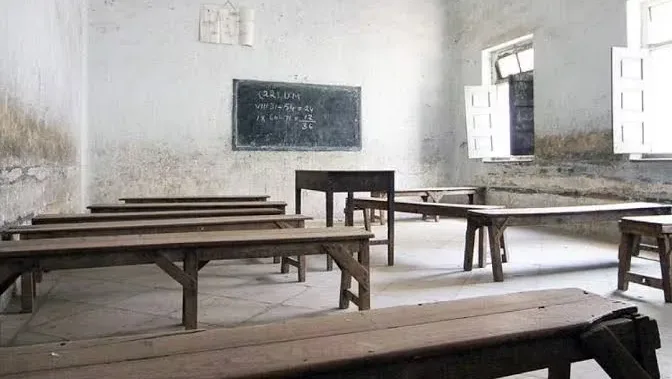
    Picture of an empty classroom
    Picture of an empty classroom | Representational Image

    West Bengal Zero-Enrolment Schools Under Review

    The 933 schools are part of a much larger group of institutions listed with zero enrolment. The latest UDISE+ figures put the number in West Bengal at 4,133.

    The government has directed district administrations to inspect these schools and prepare details about their land, buildings and other facilities. The exercise is also intended to determine whether unused infrastructure could serve other public purposes.

    The issue is closely linked to the uneven distribution of teachers across schools. Government data shows that 6,769 schools have only one teacher, serving around 2.3 lakh students. A teacher deployment policy allows staff and sanctioned posts from zero or very low-enrolment schools to be shifted to institutions facing shortages.

    Also Read | 32 Kolkata tourists missing in Nepal: Here are all the helpline numbers for you

    Remote Schools In West Bengal To Continue

    Burman said the government would not apply the same approach to schools in remote locations where there are few students and no nearby alternatives.

    “Even if there are schools in remote areas where students are less, population is less and no other school nearby, that school will continue to function. But, if we see that there are a number of schools nearby, we will have to think about these,” he said.

    On teacher shortages, Burman said the ongoing recruitment process was expected to improve staffing levels.

    “The process is going on and hopefully … by 2027 academic year, every school will have the required teachers,” he said.

    Teacher Recruitment And School Staffing

    The staffing issue comes after the Supreme Court’s April 2025 judgment cancelled the appointments of 25,753 teaching and non-teaching staff recruited through the 2016 process. A fresh recruitment exercise has since been initiated, including more than 35,000 assistant-teacher vacancies for Classes 9 to 12, according to the information provided.

    For now, the committee’s review of the 933 schools will determine how their unused properties are handled, while remote schools and institutions serving communities without nearby alternatives remain under consideration for continued operation.

    FAQs

    Why is West Bengal reviewing 933 schools?

    The schools have had no students for several years, leaving their buildings, land and other assets largely unused.

    Will remote-area schools be closed?

    No. Minister Dipak Burman said remote schools with few students and no nearby alternatives will continue to function.
  • Kolkata rain alert: Will thunderstorms continue despite low pressure moving west?

    Kolkata rain alert: Will thunderstorms continue despite low pressure moving west?

    The low-pressure system over Bengal has now shifted westward. But its exit hasn’t ended the rain overnight. However, a few areas in the state, like in Kolkata, are expected to see continued rain in the coming days, as the Alipore Meteorological Department has predicted heavy showers at isolated places in North and South Bengal.

    No new area of low pressure or cyclone is forming over the sea at present. Despite this, the dry spells are not expected to become more severe anytime soon. The remaining moisture along with an active monsoon axis will help to keep building rain clouds over other parts of the state.

    Kolkata, Howrah and Hooghly may see thunderstorms

    Kolkata and neighbouring districts are likely to experience a mix of cloudy weather, rain and thunderstorms. Scattered showers accompanied by thundershowers are expected in Kolkata, Howrah and Hooghly on Monday and Tuesday.

    ALSO READ| Why do the survivors describe the Kolkata hotel fire as ‘a scene from a horror movie’?

    North 24 Parganas, South 24 Parganas and Purulia may also receive scattered rain from Saturday.

    From Monday, Bankura, Jhargram, West Midnapore, East Midnapore and South 24 Parganas may receive heavy rainfall. Gusty winds with speeds of around 20 to 40 kmph could accompany the showers in some places.

    However, the current forecast does not indicate any weather warning after Tuesday.

    North Bengal remains under the rain cloud

    Jalpaiguri and Alipurduar are likely to experience heavy rain from Saturday through Wednesday. Cooch Behar and Darjeeling may see scattered heavy showers on Monday, while Kalimpong could receive heavy rain on Saturday.

    North Dinajpur, South Dinajpur and Malda are not currently expected to witness heavy rainfall. However, scattered showers are likely in these districts between Saturday and Tuesday.

    ALSO READ| Will West Bengal’s new land reforms make it easier to set up businesses? Exploring

    So, while the main weather system has moved away, Bengal is certainly not out of the rain zone yet.

    Why is rain continuing despite the low pressure moving away?

    Although the monsoon has passed its official peak and autumn has already begun, the seasonal wind system has not completely withdrawn. The monsoon axis remains active, allowing local thunderclouds to develop and trigger rain in different pockets.

    This means the next few days could bring the familiar late-monsoon pattern: rain in one neighbourhood while another remains relatively dry, followed by sudden thunderstorms and showers.

    For now, the sea is relatively calm. So, the weather department has not issued any warning for fishermen.

    Rain decreases, but Kolkata heat begins to return

    Compared with the heavier spells seen earlier, the overall amount of rain has already declined in the city. And as the showers become less persistent, the heat is beginning to make its presence felt again.

    ALSO READ| Who was Asish Banerjee? Close Mamata Banerjee aide found dead at TMC party office in Birbhum

    Kolkata’s temperatures are already running above normal.
    On Saturday, the city recorded a minimum temperature of 28.2 degrees Celsius, which was 1.8 degrees above normal. On Friday, the maximum temperature reached 33.1 degrees Celsius, around 1.1 degrees above the normal level.

  • Will West Bengal’s new land reforms make it easier to set up businesses? Exploring

    Will West Bengal’s new land reforms make it easier to set up businesses? Exploring

    On Thursday, Finance Minister Swapan Dasgupta said the West Bengal government is exploring legislative changes, land pooling, and other reforms to address long-standing difficulties around land use.

    Land remains Bengal’s knotty question

    Speaking at Business Today’s India at 100 event, Dasgupta described land as one of West Bengal’s most difficult issues. He said the challenge comes from both limited land availability and the fragmented nature of land holdings in the state.

    “Land is always a ticklish issue in West Bengal because of two reasons. One, it is in short supply due to sheer population pressure, and secondly, land holdings tend to be of handkerchief size,” Dasgupta said.

    ALSO READ| Can you buy a gun for self-defence in West Bengal? Know the rules

    The minister said some of the existing land tenures are highly complicated. In some cases, he argued, the rules make it difficult to sell or use land for new purposes. His immediate focus, he said, would be to simplify the legal framework governing land use.

    “We have to first get a large amount of legislation done to simplify land use,” Dasgupta said.

    Simplifying the rules, parcel by parcel

    The proposed approach is not limited to changing land laws. The state is also experimenting with land pooling arrangements, a model that brings together fragmented parcels of land for planned development.

    Dasgupta pointed to Gujarat and Haryana as states where such arrangements have been used successfully.

    At the same time, he cautioned against expecting West Bengal to offer unlimited land for industrial or commercial projects. The state has high population density and limited availability of large parcels, making land a structural constraint.

    “But land is always going to be an issue in Bengal. I am not going to minimise its importance,” he said.

    West Bengal wants to shed ‘difficult for business’ tag

    The government’s larger goal is to change the perception that West Bengal is difficult for businesses.

    Dasgupta said investment decisions are not determined only by financial incentives. Other states may offer more attractive incentives, he noted, but West Bengal wants to compete by highlighting its broader economic ecosystem.

    ALSO READ| Why do the survivors describe the Kolkata hotel fire as ‘a scene from a horror movie’?

    “We have a tradition. We have a skilled workforce. We have a reasonably livable city. We have all these things,” Dasgupta said, adding that the state’s infrastructure has also improved and needs further strengthening.

    The land reforms are part of a wider push for deregulation. Dasgupta said the government is also examining ways to use existing assets to improve state finances.

    He described public debt as a major challenge and said the government would have to consider measures including deregulation, privatisation, and the better use of underutilised assets.

    More than sweeteners for investors

    The minister also spoke about simplifying the Goods and Services Tax (GST) system. He said he had yet to attend his first GST Council meeting but stressed that reducing complexity and discretionary powers would be important for businesses.

    Dasgupta said the state wants to create conditions where investment can move more easily once regulatory hurdles are reduced.

    ALSO READ| Who was Asish Banerjee? Close Mamata Banerjee aide found dead at TMC party office in Birbhum

    His broader ambition is for West Bengal to regain its position as a major growth centre.

    “If, in the next four years, we can register the highest growth rate in India, I think that pride will return,” he said.

  • Can you buy a gun for self-defence in West Bengal? Know the rules

    Can you buy a gun for self-defence in West Bengal? Know the rules

    Can an ordinary person in West Bengal actually own a gun? The answer is yes, but it is certainly not as simple as walking into a shop and buying one.

    Under the Indian Arms Act, 1959 and the Arms Rules, 2016, civilians can apply for firearms licences under specific circumstances. Broadly, licences are issued for self-defence, business protection and sports shooting. Each category has its own requirements, and simply wanting to own a gun is not enough.

    Notably, just in recent weeks, Trinamool Congress MP Kirti Azad said that he would obtain an arms licence for security. That raises a wider question: what about ordinary citizens? What does the law actually allow?

    ALSO READ| Is the magic of Bengal’s music now lost, or is another story waiting to unfold?

    When can someone get a gun licence for self-defence?

    The Arms Act notes that a self-defence licence is primarily meant for people who can demonstrate a genuine threat to their life or property. The authorities do not generally issue such licences merely because an applicant feels unsafe. There has to be some supporting evidence.

    Documents that may be required include:

    1. FIR or GD copy.
    2. Police record of any previous assault, threats or blackmail allegations.
    3. Any evidence of threats received through threatening letters or digital means.

    People holding sensitive government positions, or those occupying social positions that put their lives at risk, may also apply. Depending on the circumstances and the licence granted, they may be permitted to possess firearms in the Non-Prohibited Bore (NPB) category, including certain pistols, revolvers or shotguns.

    What about business owners?

    Interestingly, a separate category exists for people whose work involves handling substantial amounts of cash or valuables.
    Jewellers, banks, cash-handling agencies, petrol pumps and large distributors, for example, may have a reason to seek additional security where large cash transactions occur regularly.

    ALSO READ| Did you know Bengal once had its own airline? Here’s why it never took flight

    Then in such cases, applicants have to provide documents including:

    1. Specific business licences, including trade licences.
    2. Company’s incorporation certificate.
    3. Proof of financial transactions.
    4. Annual turnover ledger.
    5. GST Return.
    6. Income Tax Return (ITR).

    Can sports shooters get a gun licence?

    Yes. Firearms licences can also be issued for sports shooting and target practice. But this category is specifically linked to participation in recognised shooting activities.

    The applicant must be an active member of a recognised shooting club or rifle association.

    The required documents can include:

    National Rifle Association of India (NRAI) or State Rifle Association-approved membership card and certificate.

    Shooter ID card (special identity card for sports category).

    Proof of active participation in various district, state or national level shooting competitions for 2 years.

    What kind of gun can a civilian actually own?

    This is where the rules become particularly important. A district police official noted that getting a gun license does not mean that all types of guns can be purchased. He said that no type of automatic rifle, machine gun or any military weapon used by the army can be purchased.

    303 rifles, 7.62 mm and high-powered firearms meant for military use also cannot be purchased by ordinary civilians, the official made it clear.

    ALSO READ| Who is Sumit Roy? Supreme Court orders not to arrest Abhishek Banerjee’s close aide

    With a valid licence, however, certain civilian firearms, such as shotguns and smoothbore guns, may be available. These can include single-barrel or SBBL guns and double-barrel or DBL guns. Depending on the category and conditions of the licence, certain 9 mm pistols may also be permitted.

    What is the minimum age?

    For personal or business purposes, an applicant must generally be at least 21 years old.

    Sports shooting has different provisions. Under special conditions, those aged 12 years and above can apply under the sports category.

    How does the application process work?

    The applicant has to submit Form A-1, either online or offline, following which the application is sent to the concerned police station. Following this, an officer under the District Magistrate handles the application process in each district.

    The police then conduct the necessary verification. A report from the District Intelligence Department is also obtained. The application subsequently moves to the concerned officer under the District Magistrate.

    After checking the documents, background information and other details, the file is placed before the District Magistrate. The District Magistrate then takes the final decision after examining the information and verification reports.

  • When is the best time to visit Kalimpong? Here’s a season-by-season travel guide

    When is the best time to visit Kalimpong? Here’s a season-by-season travel guide

    Perched in the foothills of the Himalayas, Kalimpong offers a different reason to visit with every changing season. Spring brings rhododendron blooms and adventure activities, autumn paints the surrounding forests in warmer shades, while winter offers some of the clearest views of the snow-covered Himalayas.

    And then there is the food. From jhol momos and thukpa to sel roti and Nepali thalis, Kalimpong’s culinary appeal doesn’t disappear when the weather changes.

    Thus, what would be the best time to visit Kalimpong? Well, according to the season-wise travel guide published in the magazine of Conde Nast Traveller India, the widest period suitable for travelling falls between October and February.

    ALSO READ| Did you know there’s a secret trail between Kedarnath and Badrinath? Discover the lost Himalayan path of the gods

    When is the best time to visit Kalimpong?

    October to February is the recommended period if your priority is comfortable weather, autumn landscapes and clear Himalayan views.

    Sal forests surrounding Sikkim will be decked up with autumn colours during October and November. December through February are famous for clear skies and better views of Mount Kanchenjunga.

    On the other hand, for those who like adventure sports and would like to enjoy nature’s beauty, March and April may turn out to be more favourable seasons. Wildflowers and rhododendron bloom in this period.

    The monsoon months can be less convenient for travel, with the source noting muggy conditions, difficult roads and the possibility of flash-flood warnings.

    What can you see in Kalimpong during spring?

    If flowers are the reason for your trip, late February to April is the season to consider.

    The forests around Lava and Neora Valley National Park come alive with rhododendrons, with March and April generally considered a good period to see the blooms. Flowering can vary depending on altitude and weather conditions each year.

    Spring also works well for hiking, birdwatching and scenic drives, while the surrounding hills offer opportunities for adventure activities.

    When is the best time to see Kanchenjunga?

    For Himalayan views, October to February is the strongest window.

    Post-monsoon skies are generally clearer and humidity is lower. Early mornings are particularly favourable because clouds can gather around the mountains later in the day.

    Deolo Hills and Durpin Dara Hill are among the viewpoints highlighted in the source. Travellers willing to venture farther can also explore Ramdhura, Lava and Rishop for mountain views.

    ALSO READ| Sawan 2026: Planning a Jyotirlinga Yatra? Here’s a travel guide for you

    What about Kalimpong’s food scene?

    You don’t necessarily need perfect weather to visit Kalimpong if food is your priority.

    The town’s culinary landscape draws from Lepcha, Nepali, Tibetan and Bhutanese influences, with dishes ranging from jhol momos and tingmo to thukpa, kewa datshi, pork momos and Nepali thalis.

    The local Haat Bazaar, held on Wednesdays and Saturdays, is another attraction for food lovers, with local produce, pickled bamboo, millet-based ferments and street food.

    How many days do you need in Kalimpong?

    Three days can be enough to explore Kalimpong itself, according to the source.

    However, travellers who want to explore surrounding tea estates and natural attractions at a slower pace can plan for a week or more.

    The town can also be combined with a Darjeeling trip. Kalimpong is roughly a two-hour drive from Darjeeling, while Bagdogra International Airport is around 2.5 hours away by road, according to the source.

    Kalimpong weather by season
    March-April: 13°C-25°C
    May-October: 17°C-30°C
    November-February: 5°C-21°C

    ALSO READ| Pancha Kedar–Part 1: Why did Lord Shiva hide from the Pandavas?

    Ultimately, the best time to visit Kalimpong depends on what you want from the hills. Choose spring for rhododendrons and adventure, autumn for walks and changing forests, and winter for crisp mountain views. If food is the main attraction, Kalimpong’s momos, thukpa and local specialities are reason enough to visit year-round.

  • Did you know Bengal once had its own airline? Here’s why it never took flight

    Did you know Bengal once had its own airline? Here’s why it never took flight

    Every once in a while, you stumble upon a story so unbelievable that you instinctively think, “How did I never know about this?” This is one of those stories.


    How did the Bengal Air story start?


    Nearly three decades ago, during the Communist Government, there was a bold move to start a regional airline in West Bengal. It was long before UDAN and the renewed interest in air connectivity between the east and the northeastern part of India that the state government had a vision of an airline that would do just that.
    The airline was called Bengal Air. But in 2026, that dead dream survives only as a rusting aircraft lying in a scrapyard near Sonipat, Haryana.
    Bengal Air recently made headlines after a YouTube video went viral, where Eastern India’s flying dream was spotted among other scrapped planes. The aircraft was carrying the registration VT-BAA.

    ALSO READ| Lok Sabha goes Gen Z: ‘Clock It’, ‘Delulu’ and ‘FOMO’ steal the spotlight during Exam Bill debate

    Back in 1998, when the Left Front government under Chief Minister Jyoti Basu was trying to revive Bengal’s industrial landscape, civil aviation emerged as one of the sectors the state wanted to explore. A consortium formed by the West Bengal Industrial Development Corporation (WBIDC) and Bengal Air Services Limited (BASL) proposed launching Bengal Air, a regional airline designed to improve connectivity across eastern and northeastern India.

    The plan was simple: to operate three Hawker Siddeley HS-748-2B turboprop aircraft, connecting Kolkata with cities such as Cooch Behar, Bagdogra, Shillong, Agartala, Jamshedpur, Patna, Ranchi, Bhubaneswar and Rourkela.
    To support operations, Bengal Air partnered with Nepal’s Necon Air, which agreed to provide technical expertise. Interestingly, both airlines carried remarkably similar Trishul logos on their aircraft tails. At first glance, they looked identical, although Necon Air’s logo included Lord Shiva’s damaru, while Bengal Air’s version featured only the trident.
    The aircraft themselves were to be acquired from Canadian company Dellair Trading Inc. Two of them, registered C-GBCY and C-GBCS (later identified as VT-BAB), were photographed waiting at Winnipeg International Airport in 2001, ready for delivery to India.
    But then, for reasons that have never been fully explained publicly, the project was called off. The proposed deal with Dellair collapsed before completion. The two aircraft in Canada never reached India.

    Where is that single Bengal Air aircraft now?


    Even that single aircraft never entered passenger service. Instead, it remained parked at Netaji Subhash Chandra Bose International Airport. Reports suggest that in 2001, the consortium approached the government once again, seeking ₹28 crore to revive the airline and begin operations. The proposal, however, failed to receive the necessary support.
    Then, the only Bengal Air aircraft was kept in an abandoned condition at the Dum Dum Airport, Kolkata, for almost 20 years until it was auctioned off as scrap in 2018.
    Today, the same aircraft is in a scrap yard near Sonipat in Haryana. It was bought by a businessman who specialises in the acquisition of retired aircraft and refurbishing them for commercial use as restaurants, theme parks or exhibition materials.
    Today, very few people remember Bengal Air. There are no airport terminals bearing its logo, no retired pilots sharing stories of its flights, and no passengers recalling journeys aboard its aircraft.
    Only a weathered fuselage with the words ‘Bengal Air’ painted across its side remains.