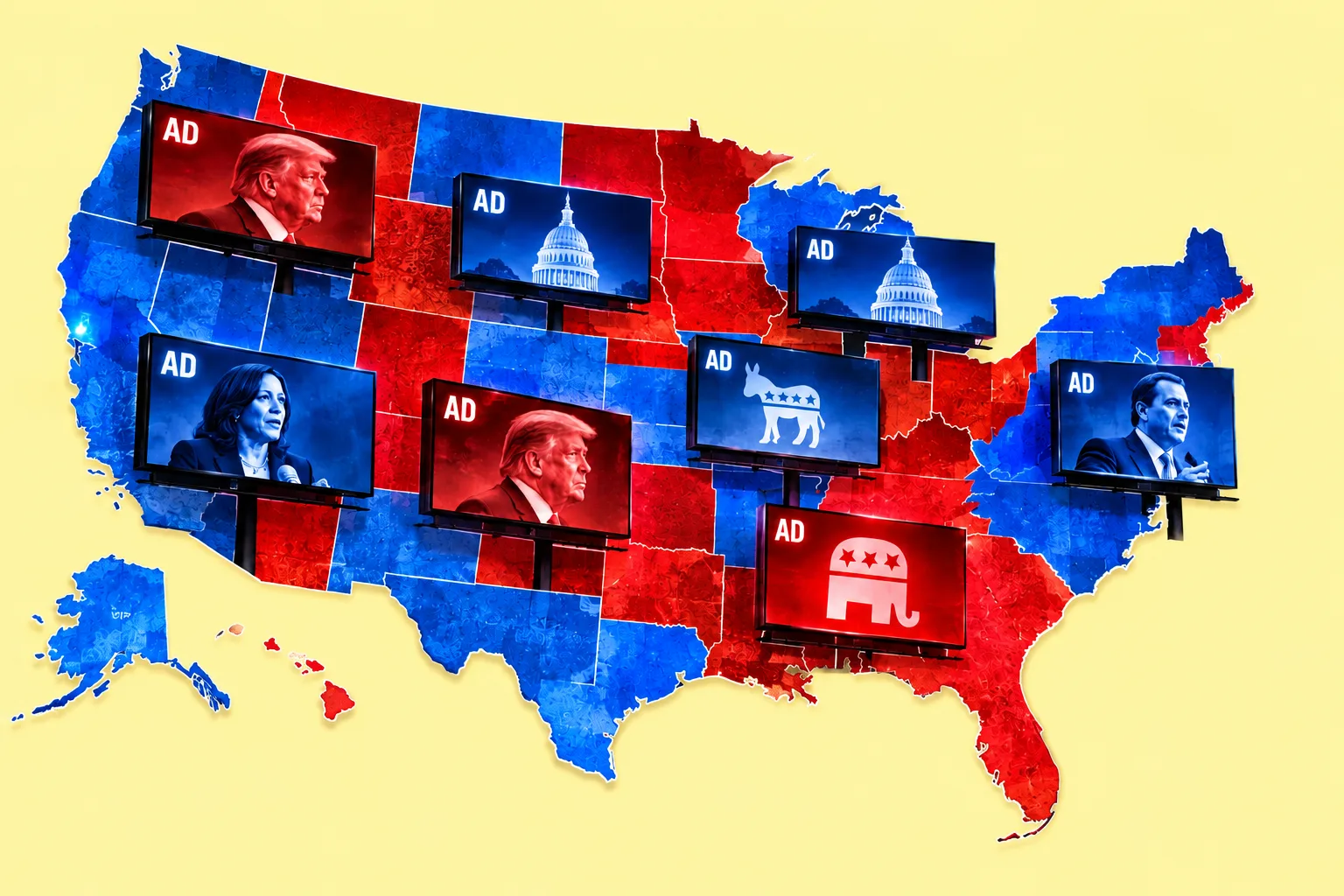
The 2026 US midterm elections are entering a crucial final stretch, and one number is drawing attention, money.
Republicans and their allies have booked about $888 million in advertising through Election Day on November 3, compared with roughly $666 million for Democrats and their allies, according to AdImpact.
The Republican side therefore has about a $221 million advertising advantage in the closing weeks. Yet the picture is not as simple as one party simply having more money.
Democratic candidates have, in many important races, raised more directly from donors. Republicans are instead relying heavily on super PACs, party committees and wealthy backers to expand their advertising push.
The White House is facing backlash for a new taxpayer-funded TV ad aired during NFL broadcasts Sunday, five weeks before the midterm elections.
— Mosheh Oinounou (@Mosheh) September 28, 2026
The ad, nearly identical to one aired during Trump’s 2024 presidential campaign, is part of what the White House is calling a “PSA… pic.twitter.com/sQo0gfOsr6
Also Read | Starship is finally in orbit. Can it make Starlink cheaper too?
Campaign cash finds its way
US campaign finance is spread across several kinds of political organisations. Candidates raise and spend money through their own campaigns.
Party committees can also spend on races, while super PACs can raise and spend large sums independently.
In this election cycle, Republican-aligned outside groups have built a major financial reserve. Donald Trump’s MAGA Inc. entered September with about $416 million in cash, while other Republican-linked groups have booked additional advertising.
The Wall Street Journal reported that Republican-aligned advertisers spent more than $204 million across 10 key Senate races during the first 18 days of September alone.
That was $83 million more than Democratic-aligned advertisers during the same period.
Republican groups and megadonors have begun spending in at least 39 US congressional races where they had not previously deployed money this cycle, after internal polling showed even Republican strongholds could be vulnerable in the November 3 election, according to three… pic.twitter.com/nz3skx8I2X
— VPol (@VocalPolitics1) September 28, 2026
The safe seats suddenly look less cosy
The spending is increasingly defensive as well as offensive. Reuters reported on September 27 that Republican groups and major donors had begun spending in at least 39 House races where they had not previously invested heavily this cycle.
Several of those districts were traditionally regarded as safe Republican seats. Party leaders have also warned campaigns not to assume those seats are secure, according to people familiar with the strategy.
At the same time, Democrats have been trying to use their fundraising strength at the candidate level to remain competitive and force Republicans to spend resources across a wider map.
Democratic Senator Elizabeth Warren said that Republican advertising cannot by itself erase voter concerns over the economy and other issues.
Republican Senator John Kennedy, meanwhile, offered a different view, saying, “I think we’re going to have enough money.”
REPUBLICAN SPENDING RESHAPES MIDTERM BATTLE
— Washington Eye (@washington_EY) September 27, 2026
Matt Whitlock said increased Republican campaign spending is reshaping several competitive races, while noting that polling remains unfavorable in some contests.#WashingtonEye pic.twitter.com/gMSxyxrgep
Also Read | ‘Possibly [be] needed in 90-120 days’: Why is the US checking Cuba readiness?
Congress comes down to where the money lands
The spending race shows where both parties believe the electoral battlefield is widening. Republicans currently hold a narrow House majority, with 218 Republicans, 214 Democrats, one independent caucusing with Republicans and two vacancies; Democrats would need a net gain of four seats to control the chamber next year.
The financial push is therefore aimed not only at winning Democratic-held seats but also at protecting Republican districts that may be facing stronger-than-expected competition.
In the Senate, advertising has also surged in races such as Texas, where Republican Ken Paxton has received far more outside advertising support than Democrat James Talarico this month.
With Election Day approaching, the central question is no longer simply who has raised more from donors. It is how effectively each side can turn its money into voter contact, advertising and support in the races that will decide control of Congress.
🚨 NOW: Republicans are outspending Democrats by nearly $200 MILLION DOLLARS and President Trump is gearing up to barnstorm America for rallies ahead of the final midterm push
— MAGA Girl (@magagirl00) September 28, 2026
47 is trying to SAVE Republicans' trifecta! 🇺🇸
pic.twitter.com/H0l6Y0bTB7