Tag: Rahul Gandhi

  • INDIA bloc protest: 5 moments that turned Rahul Gandhi’s march into a standoff

    INDIA bloc protest: 5 moments that turned Rahul Gandhi’s march into a standoff

    The INDIA bloc’s march towards the Election Commission headquarters in Delhi turned into a prolonged standoff on Tuesday after police stopped the opposition leaders near Parliament Street. What initially appeared to be the end of the protest took an unexpected turn when Rahul Gandhi moved towards Akashvani Bhavan and entered its premises.

    The protest had been organised to demand the resignation of Chief Election Commissioner Gyanesh Kumar over opposition allegations concerning the electoral roll revision process. Several opposition leaders were detained after the march was stopped, but Rahul Gandhi’s decision to remain at the site prolonged the confrontation into the afternoon.
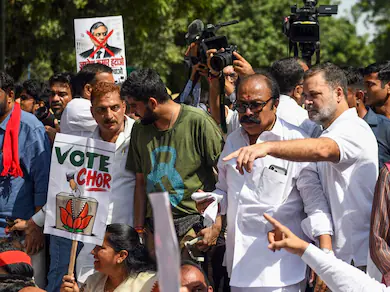
    The INDIA bloc’s march towards the Election Commission headquarters in Delhi turned into a prolonged standoff on Tuesday after police stopped the opposition leaders near Parliament Street. (PTI)
    The INDIA bloc’s march towards the Election Commission headquarters in Delhi turned into a prolonged standoff on Tuesday after police stopped the opposition leaders near Parliament Street. (PTI)

    Rahul Gandhi changes the course of the protest

    The protest began with INDIA bloc MPs marching from Parliament towards the Election Commission office. Security personnel stopped the leaders near the NITI Aayog office, after which several MPs sat on the road.

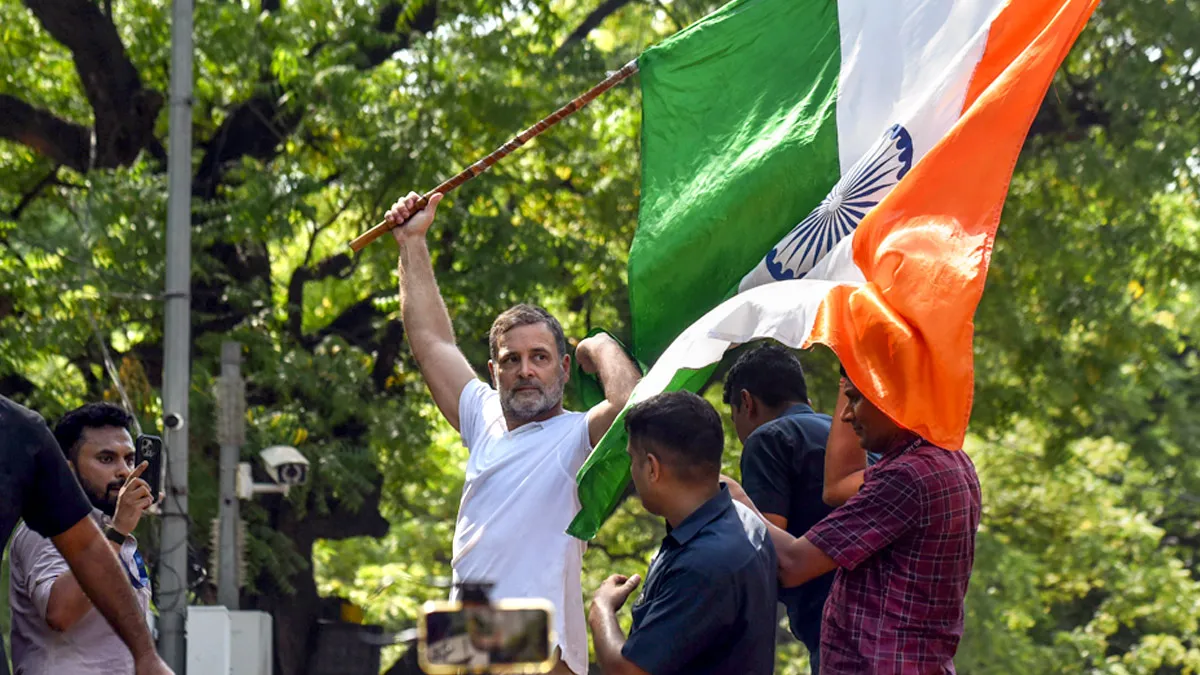
    Rahul Gandhi became the centre of attention when he climbed a barricade and waved the Tricolour as cameras recorded the confrontation. Police subsequently began detaining opposition leaders and putting them into buses.

    Among those detained were Samajwadi Party chief Akhilesh Yadav, Trinamool Congress leaders Abhishek Banerjee, Derek O’Brien and Mahua Moitra, and CPI(M) MP John Brittas.

    With several leaders being taken away and some Congress leaders leaving, the protest appeared to be winding down. Rahul Gandhi, however, remained outside the buses.

    Around 12.20 pm, he moved towards the reception entrance of Akashvani Bhavan, a development that surprised several opposition MPs and changed the direction of the protest.

    Also Read | Voter roll row reaches the Supreme Court: 5 key questions over SIR and ECI
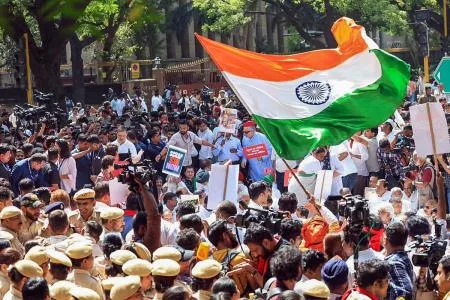
    The protest began with INDIA bloc MPs marching from Parliament towards the Election Commission office. (PTI)
    The protest began with INDIA bloc MPs marching from Parliament towards the Election Commission office. (PTI)

    Rahul and Priyanka Gandhi enter Akashvani Bhavan

    At the reception entrance near Gate 3, staff initially attempted to prevent Rahul Gandhi from entering the premises. A tense confrontation followed before Gandhi entered the building accompanied by his security personnel.

    Priyanka Gandhi Vadra later got down from a bus and joined her brother. The two eventually sat near a tree close to Gate 4 as the situation attracted attention from Akashvani staff, journalists and people in the surrounding area.

    The gathering soon expanded as more opposition leaders sought to enter the premises. Congress general secretary K C Venugopal and Rajya Sabha MP Pawan Khera reached the gate and held discussions with police officials before eventually entering.

    Congress MPs Praniti Shinde, Deepender Singh Hooda and Charanjit Singh Channi, along with Seva Dal chief Srinivas B V, were also present.

    Some opposition MPs who had earlier been detained returned after their release, allowing the protest to continue inside and around the broadcasting complex.

    Also Read | Delhi Police deploys 5,000 personnel ahead of EC protest marches at India Gate-Jantar Mantar
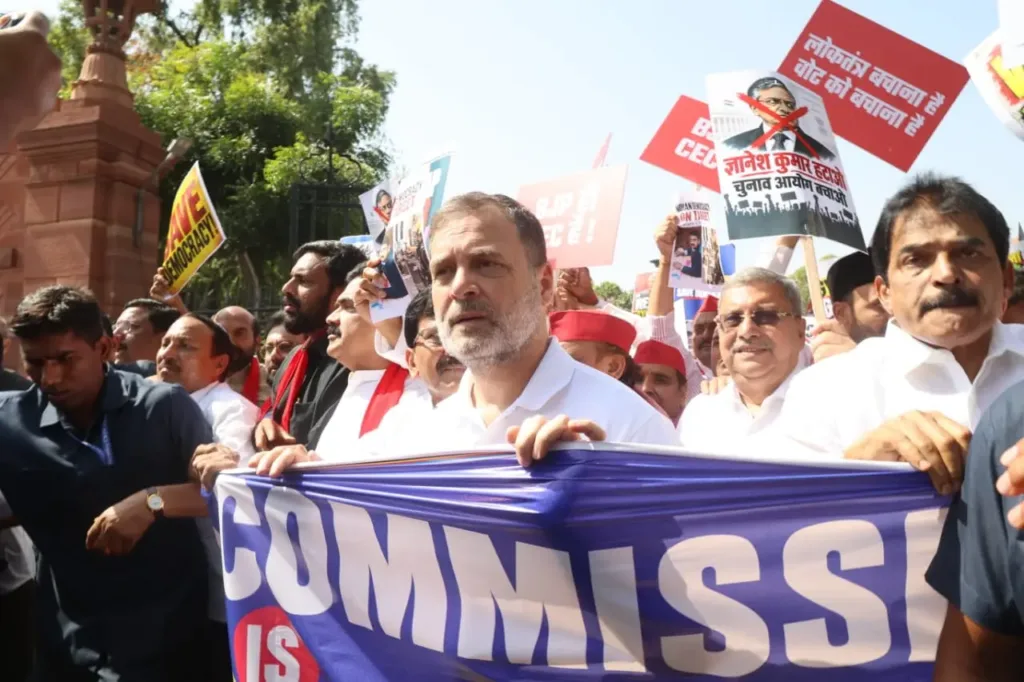
    At the reception entrance near Gate 3, staff initially attempted to prevent Rahul Gandhi from entering the premises. (PTI)
    At the reception entrance near Gate 3, staff initially attempted to prevent Rahul Gandhi from entering the premises. (PTI)

    Rahul Gandhi delivers message from protest site

    The standoff continued through the afternoon, with opposition leaders remaining inside the premises. Food, water and refreshments were brought for those participating in the protest as journalists gathered outside to follow developments.

    Around 2.30 pm, Rahul Gandhi spoke to reporters from inside the premises. He rejected the BJP’s criticism of the protest and said he was standing there to protect democracy.

    Gandhi also accused Prime Minister Narendra Modi, Union Home Minister Amit Shah, RSS chief Mohan Bhagwat and Chief Election Commissioner Gyanesh Kumar of actions he described as damaging to the country. These were political allegations made during the protest and are not facts.

    The confrontation began with the INDIA bloc demanding Gyanesh Kumar’s resignation and seeking to reach the Election Commission headquarters. After police halted the march, the protest shifted to Akashvani Bhavan and continued for several hours.

    The episode demonstrated how a demonstration that appeared close to ending after the detention of several opposition leaders developed into a fresh standoff. With Rahul Gandhi, Priyanka Gandhi Vadra and other opposition leaders remaining inside the premises, the protest continued to draw political and public attention through the afternoon.
  • ECI dissent report sparks Opposition attack as poll panel rejects formal dissent claim

    ECI dissent report sparks Opposition attack as poll panel rejects formal dissent claim

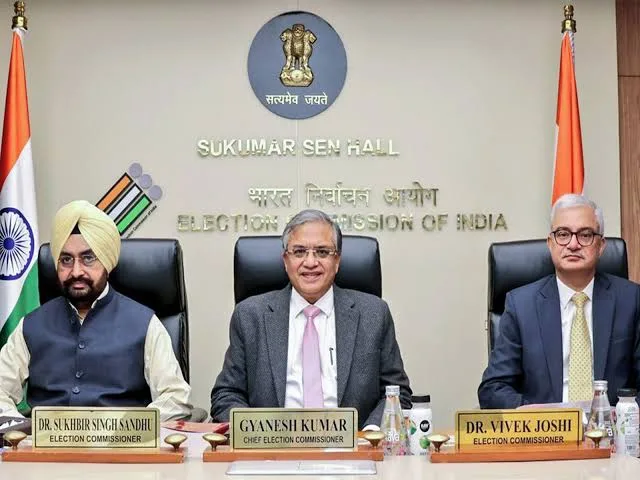
    An ECI dissent report has triggered a fresh political confrontation between the Opposition and the Election Commission of India after an Indian Express investigation reported that Election Commissioners Sukhbir Singh Sandhu and Vivek Joshi had raised formal objections to decisions taken by the poll panel. The report said the two commissioners recorded at least 14 objections over 10 months on issues linked to voter registration, deletion and restoration of names, changes to electoral forms and the management of voter data. The ECI, however, has rejected the description of these objections as formal dissent, saying differences and observations are part of institutional deliberations and that decisions of the full Commission were unanimous.

    An ECI dissent report has triggered a fresh political confrontation between the Opposition and the Election Commission of India after an Indian Express investigation reported that Election Commissioners Sukhbir Singh Sandhu and Vivek Joshi had raised formal objections to decisions taken by the poll panel. (ANI)
    An ECI dissent report has triggered a fresh political confrontation between the Opposition and the Election Commission of India after an Indian Express investigation reported that Election Commissioners Sukhbir Singh Sandhu and Vivek Joshi had raised formal objections to decisions taken by the poll panel. (ANI)

    ECI dissent report puts internal decision-making under scrutiny

    The ECI dissent report centres on objections reportedly raised by Sandhu and Joshi, who are members of the three-person Election Commission headed by Chief Election Commissioner Gyanesh Kumar. According to the Indian Express investigation, the two commissioners objected on record at least 14 times, including four instances on a single day, over decisions and orders they said had been taken without their knowledge.

    The reported objections covered matters directly connected with electoral rolls, including the addition of new voters, deletion and restoration of names and the handling of the voter database. The investigation also reported concerns over the centralisation of access to electoral-roll systems in Delhi and changes to Form 6, which is used by citizens seeking registration as voters.

    The ECI has disputed the interpretation of the exchanges. Its position is that commissioners may raise observations or suggestions during deliberations without those necessarily amounting to dissent on a final decision. The poll panel said all decisions taken by the full Commission during the period were unanimous.

    Also Read | What is ERONET? The ECI software at the centre of the SIR row

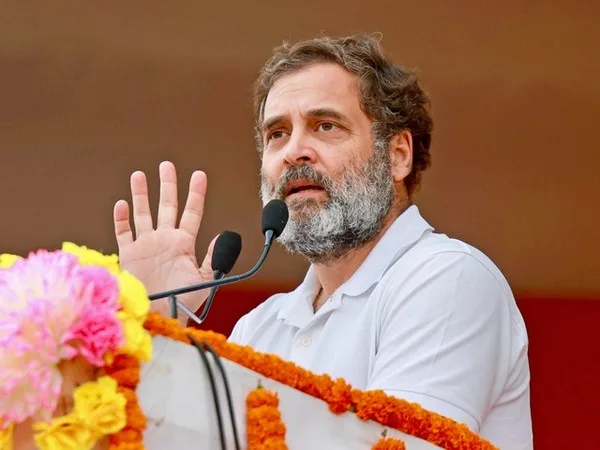
    The ECI dissent report quickly became a political issue, with Congress leaders using the findings to renew their criticism of the poll panel and its handling of the Special Intensive Revision, or SIR, of electoral rolls. (ANI)
    The ECI dissent report quickly became a political issue, with Congress leaders using the findings to renew their criticism of the poll panel and its handling of the Special Intensive Revision, or SIR, of electoral rolls. (ANI)

    Rahul Gandhi, Congress step up attack after ECI dissent report

    The ECI dissent report quickly became a political issue, with Congress leaders using the findings to renew their criticism of the poll panel and its handling of the Special Intensive Revision, or SIR, of electoral rolls.

    Congress leader Rahul Gandhi accused the Election Commission, BJP and RSS of being involved in what he described as “vote chori” and said the issue amounted to an attack on the Constitution. These are political allegations and have not been independently established.

    Congress MP Manish Tewari also referred to the ECI dissent report while questioning whether the Election Commission was being influenced by an “invisible hand”. Tewari argued that if the reported objections reflected decisions being taken without following established procedures, the legality and credibility of those decisions would need examination. He also raised the possibility of proceedings against the Chief Election Commissioner. These were his political and legal arguments, rather than findings by a court.

    Trinamool Congress MP Derek O’Brien separately renewed a call for a Rajya Sabha motion seeking the removal of CEC Gyanesh Kumar. The Opposition’s response has therefore extended beyond the reported internal objections to broader questions about the functioning and accountability of the poll panel.

    Also Read | India asks Pakistan to back anti-terror claims with action as tensions rise

    The ECI dissent report has emerged at a time when the Election Commission's SIR exercise is already facing intense political and legal scrutiny. (ANI)
    The ECI dissent report has emerged at a time when the Election Commission’s SIR exercise is already facing intense political and legal scrutiny. (ANI)

    ECI dissent report comes amid wider SIR controversy

    The ECI dissent report has emerged at a time when the Election Commission’s SIR exercise is already facing intense political and legal scrutiny. The Indian Express investigation said the objections raised by Sandhu and Joshi concerned issues at the heart of electoral-roll management, including new voter registration and deletion of names.

    One reported dispute involved changes to Form 6, with the two commissioners objecting to the addition of questions related to voters’ or their relatives’ presence in earlier electoral rolls. The investigation reported that they described the change as unauthorised and illegal.

    At the same time, the ECI has maintained that the reported exchanges do not establish a formal split in the Commission. It has said that individual views, observations and suggestions are normal during deliberations and that final decisions remained unanimous.

    The ECI dissent report has consequently opened a debate over how a constitutional body should record and understand internal disagreements. While Opposition parties have treated the reported objections as evidence of serious concerns, the poll panel has characterised them as part of its normal decision-making process. The significance of the controversy will depend on how the coming weeks examine the underlying objections, procedures, and decisions.