Tag: Indian Railways

  • Vande Bharat Sleeper: Switchable Privacy Glass Steals the Show in First AC Cabin

    Vande Bharat Sleeper: Switchable Privacy Glass Steals the Show in First AC Cabin

    A cabin window that turns opaque at the press of a button, individual reading lights and ergonomically designed berths — the First AC section of the Delhi–Varanasi Vande Bharat Sleeper is drawing attention for its focus on passenger comfort and privacy.

    Travel creator Akshay Malhotra, who posts on Instagram as @journeyswithak, shared a video offering a glimpse inside the train’s First AC accommodation. His reaction to the cabin design went like “Bhai look at this, bhai ye kya design kiya hai”. He captures the surprise surrounding one of its standout features.

    Also Read | Lakshadweep tourism rules 2026: Here’s what changes for tour operators

    The video gives rail enthusiasts a closer look at what passengers can expect from the new overnight service, which is scheduled to connect New Delhi and Varanasi.

    Switchable privacy glass is the standout feature

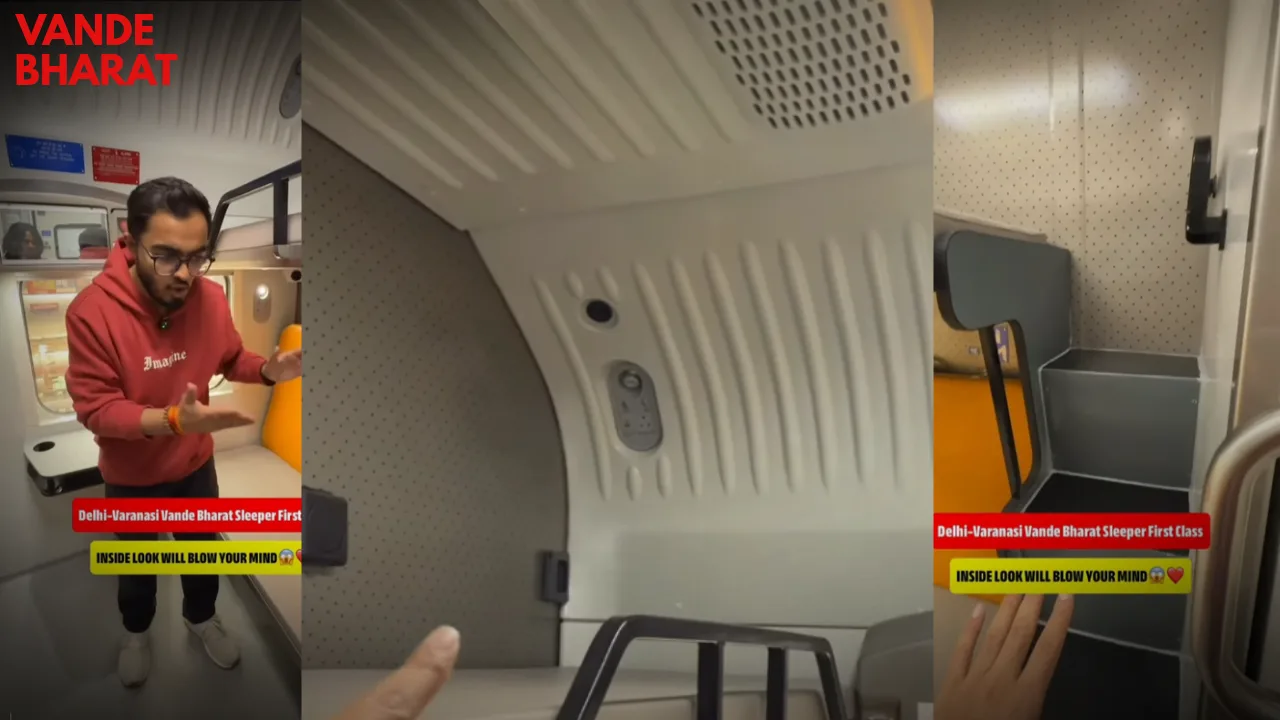
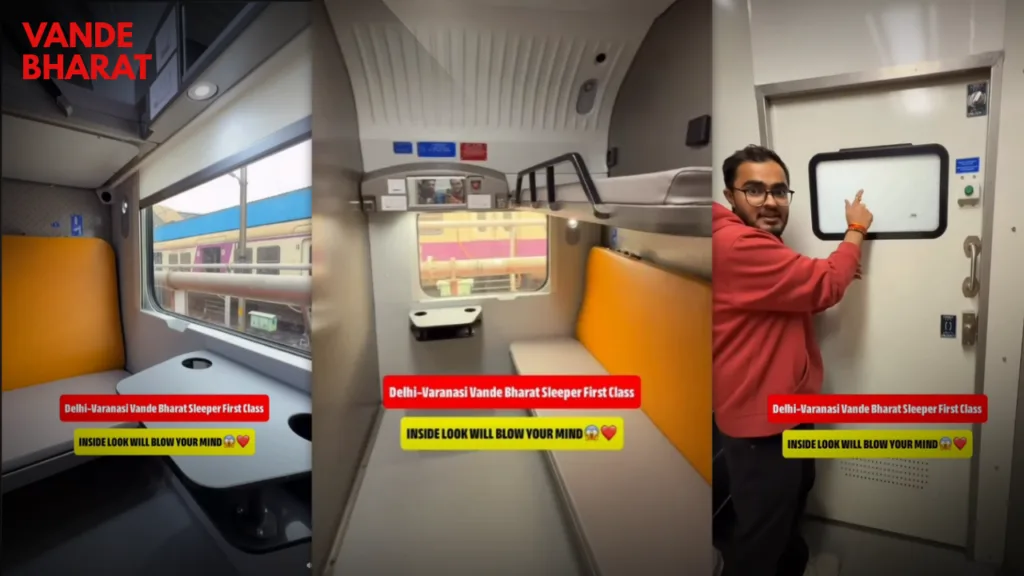
    The most striking detail in the cabin tour is the window on the cabin door, which can be switched to an opaque setting with the press of a button. The feature allows passengers to block the view from outside when they want more privacy inside their compartment.

    While it may appear to be a small design addition, it could make a difference during an overnight journey, particularly for those travelling in First AC.

    The cabin also features individual reading lights, charging points, water-bottle holders, a table holder, a mirror and window blinds. The berths have been designed with cushioning and ergonomics in mind, while non-slip material on the steps leading to the upper berths is intended to make climbing up and down more convenient.

    Delhi–Varanasi Vande Bharat Sleeper: Route and timings

    The new service is expected to cover approximately 760 km between New Delhi and Varanasi, with a journey time of around nine hours and five minutes in either direction.

    According to the timetable reported on October 30, the service will operate under two train numbers:

    • Varanasi to New Delhi — Train 27421: Departs Varanasi at 8:50 pm and arrives in New Delhi at 5:55 am the following day.
    • New Delhi to Varanasi — Train 27422: Departs New Delhi at 9:40 pm and arrives in Varanasi at 6:45 am the next morning.

    The service is scheduled to operate six days a week. The Varanasi-originating train will not run on Fridays, while the New Delhi-originating service will not operate on Saturdays.
    Delhi–Varanasi Vande Bharat Sleeper
    Delhi–Varanasi Vande Bharat Sleeper / IG, journeyswithak’s profile picture
    journeyswithak

    The train is scheduled to be inaugurated on October 31, with Railway Minister Ashwini Vaishnaw and Uttar Pradesh Chief Minister Yogi Adityanath expected to jointly flag it off, according to the report.

    What else will the Vande Bharat Sleeper offer?

    The 16-coach train will offer three accommodation categories, catering to different passenger needs and budgets:

    • AC First Class: 24 berths
    • AC 2-Tier: 188 berths
    • AC 3-Tier: 611 berths

    Beyond the cabin interiors, the train is listed as having several safety and convenience features, including the indigenous KAVACH train protection system, CCTV cameras in all coaches, automatic doors, fire detection and suppression systems, and an emergency talk-back facility.

    Noise-reduction measures, ergonomically designed berths and modern toilets are also among the features outlined in the report.

    How is it different from the existing Vande Bharat trains?

    The Delhi–Varanasi route already has Vande Bharat Chair Car services, but the sleeper variant is designed for a different kind of journey.

    Also Read | Digi Yatra trials begin for international passengers at 7 airports

    Chair Car services are suited to daytime travel, while the sleeper train is intended for passengers who want to board in the evening, rest during the journey and reach their destination the following morning.

    For travellers taking the overnight route, the combination of sleeping accommodation and features such as switchable privacy glass could make the journey more convenient. The actual passenger experience, however, will become clearer once the service begins operating.

  • IRCTC’s 365-day booking window is not for everyone: Who qualifies?

    IRCTC’s 365-day booking window is not for everyone: Who qualifies?

    Indian Railways allows eligible foreign tourists and Non-Resident Indians (NRIs) to book train tickets up to 365 days before their journey under a special reservation facility.

    The provision is an exception to the standard advance reservation period of 60 days that applies to most passengers. However, the longer booking window comes with specific eligibility requirements, a separate booking process and restrictions on seat availability.

    The facility is available through the Foreign Tourist Quota on the Indian Railway Catering and Tourism Corporation (IRCTC) e-ticketing website.

    It is not a general booking option that every passenger can use to reserve a seat a year before travelling.

    Also Read | 18 of the world’s best metro systems and what makes them stand out

    Less lead time, fewer empty seats?

    Indian Railways reduced the Advance Reservation Period (ARP) for most Mail and Express trains from 120 days to 60 days, excluding the date of travel, with effect from November 1, 2024. The change was announced by the Ministry of Railways in October 2024.

    The ministry cited booking patterns and the need to reduce cancellations and no-shows as reasons for the decision. According to the Railway Ministry, around 21% of reservations made between 61 and 120 days before travel were being cancelled.

    Another 5% of passengers neither cancelled their reservations nor undertook their journeys.

    The shorter booking window was intended to improve visibility of genuine passenger demand and help the Railways plan additional trains during busy periods.

    The 60-day limit remains the standard for most passengers. Certain daytime express trains, including the Taj Express and Gomti Express, continue to follow their existing, shorter reservation periods.

    The separate 365-day facility for foreign tourists remains unchanged.

    One year ahead, but not for everyone

    The extended booking facility is designed for foreign tourists and NRIs who qualify to use the Foreign Tourist Quota. According to IRCTC’s official booking guide, eligible users must hold a valid passport and provide the required passenger details when booking.

    The scheme was introduced in July 2017 to make advance planning easier for international visitors travelling across India. It allows eligible passengers to make reservations up to one year ahead rather than waiting for the standard 60-day booking window.

    The facility is not restricted only to premium classes. IRCTC’s current guide lists Executive Class, First AC, Second AC, Third AC, AC Chair Car, Sleeper Class and Second Sitting among the eligible classes.

    Nonetheless, the availability of seats under the special quota depends on the applicable allocation and the train.

    How to book tickets through IRCTC

    Eligible passengers must register on the IRCTC e-ticketing website or update their existing profiles. They must verify an international mobile number through a one-time password (OTP).

    After logging in, users can select the Foreign Tourist Ticket Booking option under the Services section.

    A valid passport number must be provided for every passenger. IRCTC also lists international debit and credit cards as payment options for these bookings.

    Also Read | Greenland has no roads connecting its towns: 5 facts about the icy island

    Booked early does not mean berthed early

    There is an important distinction between booking a ticket a year ahead and receiving a confirmed berth immediately.

    IRCTC states that when a reservation is made beyond the regular 60-day Advance Reservation Period, berth allocation takes place later, when the normal reservation window opens and the railway reservation system allots accommodation.

    This means that the 365-day facility does not guarantee an immediately allocated berth for every booking. If the railway reservation system does not allot a berth, IRCTC’s guide states that the ticket will be automatically cancelled, with a cancellation message sent to the registered contact details.

    For most domestic travellers, the regular 60-day window continues to apply. The 365-day provision is a separate facility for eligible users booking through the Foreign Tourist Quota, with its own requirements and availability conditions.

    Checking the applicable quota and booking status on IRCTC is therefore essential before making travel plans.