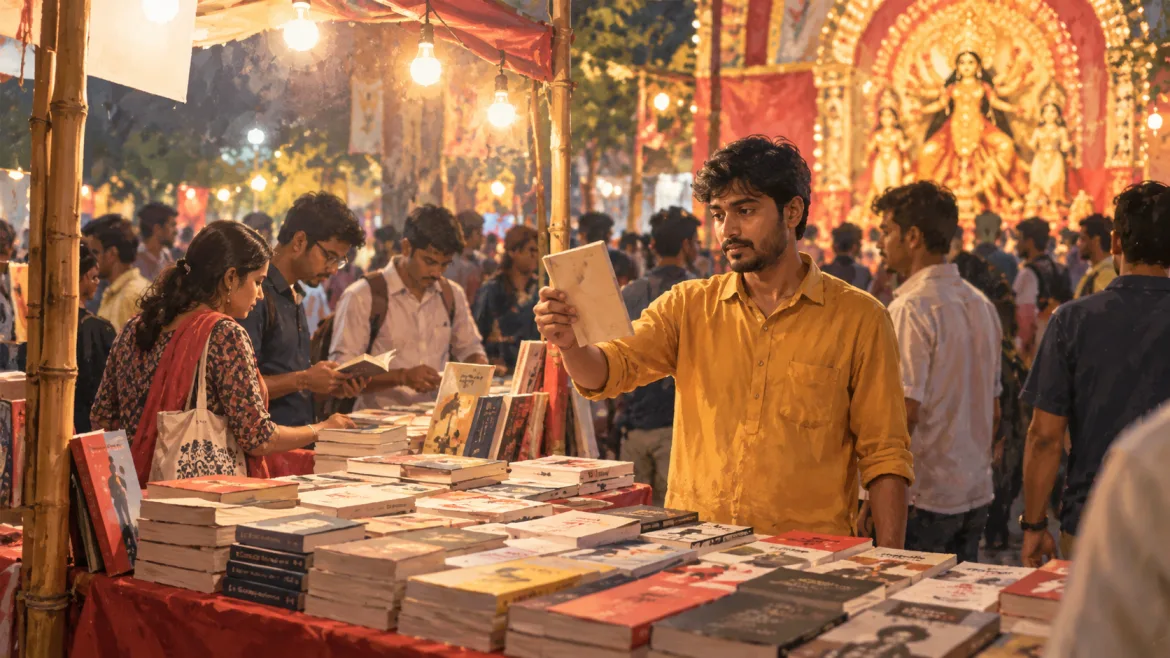
West Bengal’s Durga Puja celebrations have become the centre of a political controversy after Left parties alleged that their temporary bookstalls near puja pandals were vandalised at several locations.
The allegations have drawn criticism from unexpected quarters, including West Bengal Finance Minister Swapan Dasgupta, a senior BJP leader, and Rashtriya Swayamsevak Sangh (RSS) leader Jishnu Basu.
Both have defended the Left’s right to display and sell books, arguing that political and ideological differences cannot justify attacks on freedom of expression.
Meanwhile, Chief Minister Suvendu Adhikari has continued to criticise the Communists, exposing a difference in approach within the broader BJP camp.
Bengal govt bulldozing @CPIM_WESTBENGAL
book stalls & BJP junglees vandalising them during Durga Puja. While 19 people die in a stampede due to govt’s lack of oversight & management. What a fall, Bengal . https://t.co/Iscuq6GAMd
The CPI(M), the Socialist Unity Centre of India (SUCI) and other Left parties have alleged that their bookstalls were damaged at several places across West Bengal.
The locations reported include Jadavpur, Haridevpur, Rashbehari, Nagerbazar and Dhakuria in and around Kolkata, as well as Dinhata in Cooch Behar district and Shibpur in Howrah.
There have been allegations that some stalls were demolished or set on fire.
The Left has accused people allegedly aligned with the BJP and the saffron camp of targeting the stalls. However, these allegations should not be treated as proof of responsibility.
BJP state president Samik Bhattacharya has denied that the party was involved, saying he did not believe a genuine BJP worker would destroy bookstalls. He also said the government would take necessary steps.
Kolkata, West Bengal: On Book Stalls set up near Durga Puja pandals, CPI(M) State Secretary Md. Salim says, "This situation highlights the government’s priorities, showing that instead of addressing essential needs like road repairs, drinking water, food, and basic ration supplies, the entire administration is focused on a single book stall in Naihati, shifting its arguments daily. In High Court proceedings regarding jurisdiction, the government lawyer shifted the issue from a police matter to a PWD matter…"
For decades, left parties have set up temporary bookstalls near Durga Puja pandals. These stalls sell political publications, Marxist literature, progressive writing and other books.
They also give party workers an opportunity to interact with visitors during Bengal’s biggest annual festival.
Their presence reflects a distinctive part of the state’s political and cultural life. Durga Puja is primarily a religious and community celebration, but it is also a major public gathering.
Political groups have used that space to share their ideas and publications. The Left argues that its bookstalls are part of this longstanding tradition and should not be excluded simply because its ideology differs from that of the ruling party.
A war of words over the words for Puja
The controversy predates the latest vandalism allegations. On September 10, Adhikari had urged Durga Puja committees not to allow CPI(M) bookstalls outside pandals if the party used the term Sharodotsav, meaning autumn festival, instead of Durga Puja.
He argued that the alternative term diluted the festival’s religious significance and accused sections of the Left of selectively targeting Hindu traditions.
The dispute has become a clash over how Durga Puja should be described, who should be allowed to participate in its public spaces, and whether political or religious differences should influence access to those spaces.
Disagree with the book, not its right to exist
Swapan Dasgupta has said that his ideological opposition to the Left does not mean its members should be prevented from selling books.
“Yes, they are atheists, ideologically. But so what? I cannot support hooliganism on that excuse,” he said.
He also expressed shame over the incidents while stating that he did not know who was responsible or what their political affiliations were.
Jishnu Basu took a similar position. He said the CPI(M), CPI and SUCI had the right to set up bookstalls, provided their activities did not endanger anyone’s life.
He also argued that vandalism undermined the principles of tolerance and freedom of expression associated with the broader Hindutva ideology.
The dispute has reached the courts. The CPI(M) has moved the Calcutta High Court over an alleged attempt by the Kolkata Municipal Corporation and police to remove its temporary bookstall in Jadavpur.
The party has claimed that its application for permission had not been considered.
Its lawyer said the matter was scheduled to be mentioned before the court’s vacation bench on October 22, seeking an urgent hearing.
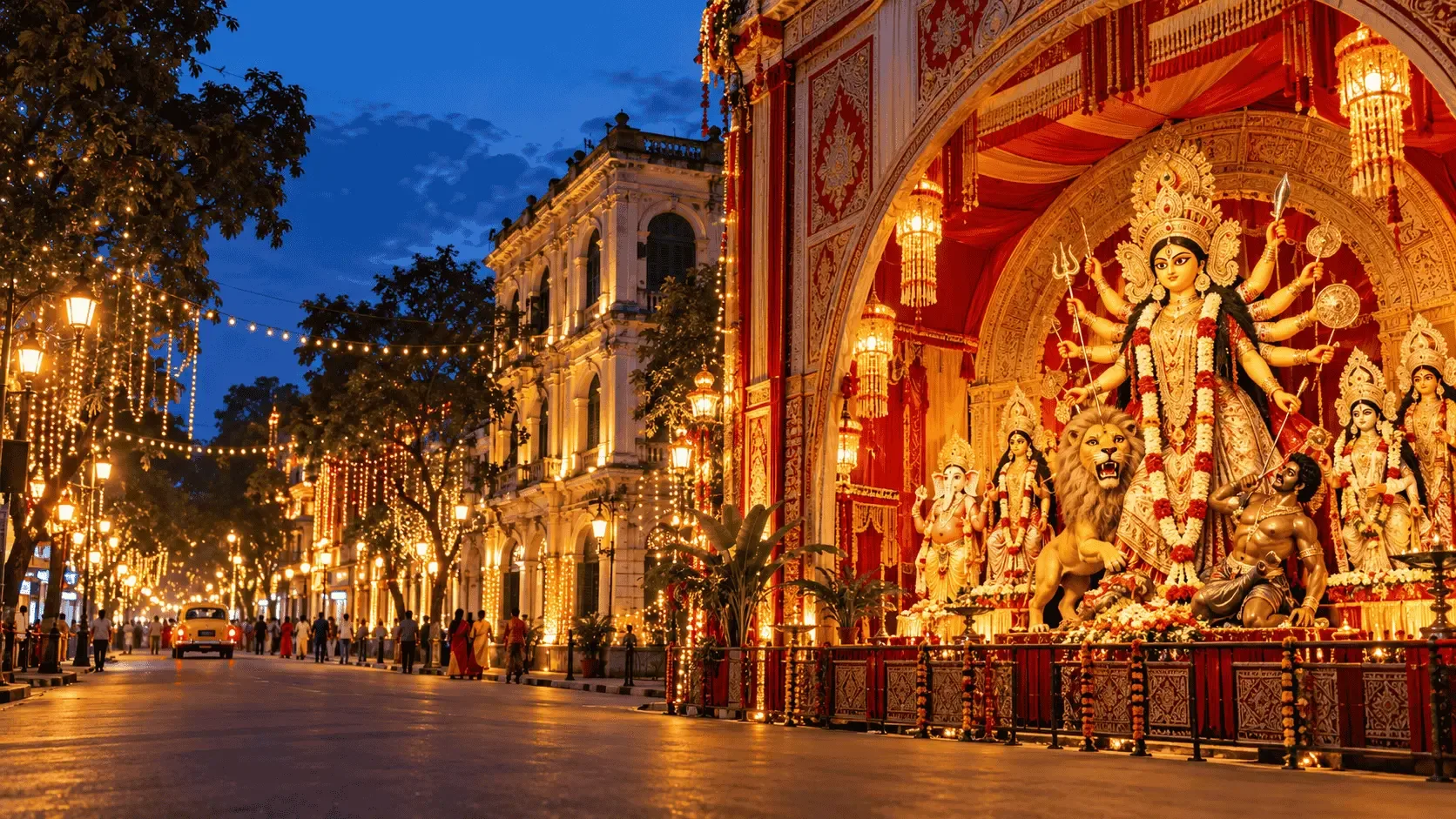
Durga Puja in Kolkata is synonymous with elaborate pandals, dazzling lights and long queues of people moving from one neighbourhood to another. But the biggest festival in the city does not have to revolve entirely around pandal-hopping. For those looking to avoid the crowds or spend the holidays differently, Kolkata offers plenty of alternatives, from theatre performances and movie outings to museum visits, food trails and lazy afternoons at home.
Whether you want to explore the city’s cultural side, catch up on the latest film releases or simply enjoy a few days of rest, here are five ways to make the most of Durga Puja in Kolkata without following the usual pandal route.
Watch a Theatre Play Instead of Pandal-Hopping
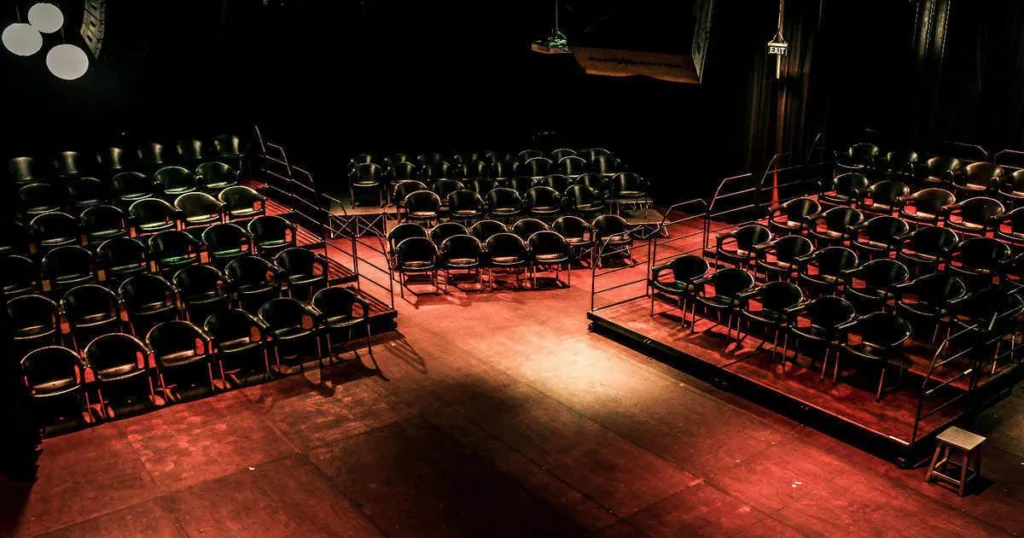
Kolkata has a rich theatre culture, making a live performance a worthwhile addition to your Durga Puja plans. Instead of spending hours navigating crowded streets, you can enjoy an evening of drama at one of the city’s established venues.
The Academy of Fine Arts is scheduled to host Macbeth 2.0, directed by Koushik Sen, on October 18. Theatre enthusiasts can also catch Aparajito’s Raktakarabi on October 20.
Theatre play auditorium | Representational Image
Those looking for performances in other languages can consider A Woman Alone at Cave Studio, scheduled to run from October 17 to 24. The venue also lists Main Madhubala and Main Tainu Phir Milangi for October 17.
With different productions on the calendar, theatre offers an alternative for anyone hoping to enjoy Kolkata’s artistic scene during the festive break.
Catch the Latest Films During Durga Puja
A cinema outing is another way to enjoy the holidays without dealing with pandal crowds. The festive period brings a varied selection of films, giving moviegoers plenty of options across languages and genres.
Bengali cinema enthusiasts can look forward to titles such as DeSu7, Bohurupi: The Golden Daku, The Eken: Kerala-e Kurukshetra and Emperor vs Sarat Chandra.
Poster of the movie DeSu7 poster, releasing this pujo. Credit: X/Subhasree Ganguly
For those interested in Hollywood releases, Street Fighter and Whalefall are among the titles listed for the festive period. Other Hindi and South Indian films mentioned in the lineup include Nayyi Navelli, Jailer 2, Ranabaali, Raftaar and Vishwambhara.
Checking local cinema schedules before heading out is advisable, as showtimes and availability may vary.
Explore Kolkata’s Museums and Heritage
Durga Puja is also an opportunity to discover the city’s history and cultural treasures away from the busy streets.
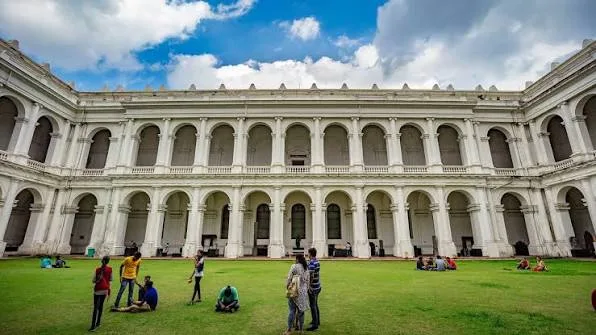
The Indian Museum offers visitors a chance to explore historical collections and ancient artefacts. Another option is the Museum of Word, which provides a different cultural experience for those interested in language and the written word.
Indian Museum in Kolkata. Credit: X/ANI
Before planning a visit, check the opening schedules. The Indian Museum is closed on Mondays, while the Museum of Word is closed on Mondays, Ashtami and Dussehra.
A museum visit can be a quieter way to spend a festive afternoon while learning more about history, heritage and culture.
Make Food a Major Part of Your Puja Plans
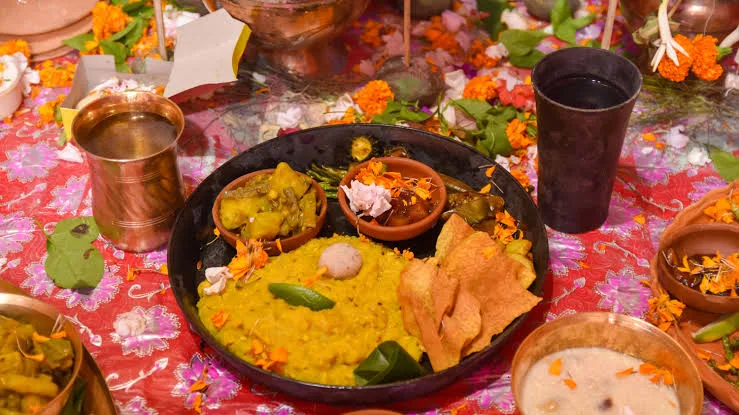
No Durga Puja celebration in Kolkata feels complete without good food. From elaborate Bengali meals to international cuisines, the city offers plenty of choices for those who want to make eating a central part of their holiday.
You can plan a meal around traditional Bengali favourites, starting with breakfast and ending with dessert. Alternatively, explore restaurants serving Italian, African and other international cuisines.
Food items people are fond mailny during Durga Puja | Representational Image
Those who prefer staying indoors can order their favourite dishes and enjoy a relaxed meal with family or friends. For food enthusiasts, the festive break is an opportunity to try something new or return to familiar comfort food.
Enjoy the Bengali Art of ‘Lyadh’ at Home
Not every Puja day needs a packed schedule. After months of work and daily responsibilities, the holidays can be the perfect time to slow down.
The Bengali concept of ‘lyadh’ celebrates doing very little without feeling guilty about it. Whether it means enjoying a long bhaat-ghum, waking up around noon or spending an entire afternoon chatting with friends, relaxation can be a plan in itself.
A sleepover with friends or family, accompanied by good food and plenty of adda, can make for a memorable Puja without stepping outside.
Celebrate Durga Puja Your Own Way
Pandal-hopping remains one of Kolkata’s most loved traditions, but it is far from the only way to celebrate. Theatre, films, museums, food outings and quiet days at home all offer different ways to enjoy the festive season.
Whether you prefer cultural experiences or simply want to recharge, these Durga Puja activities in Kolkata let you make the holidays your own, with or without the crowds.
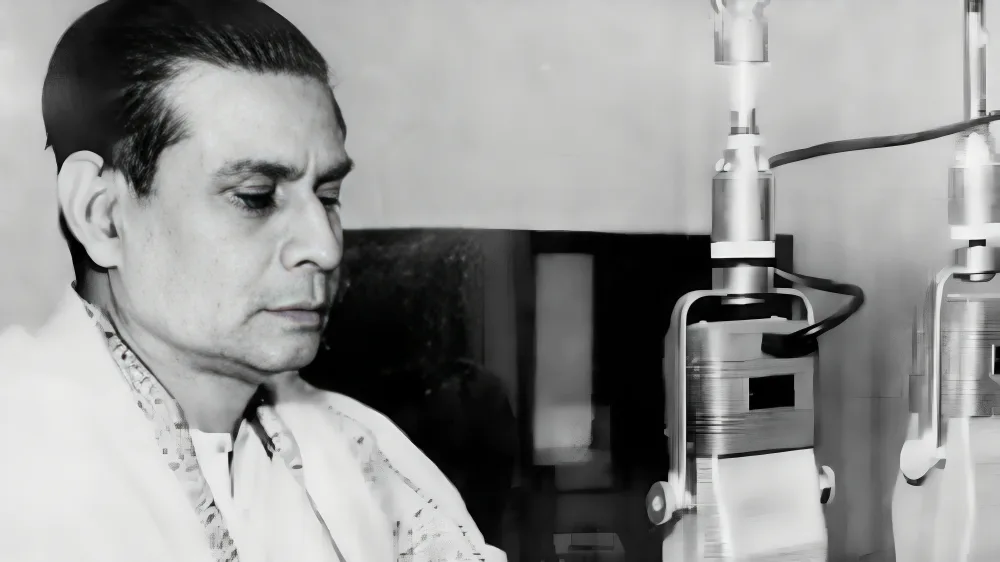
Birendra Krishna Bhadra’s iconic voice transforms the 4 am dawn of Mahalaya into a timeless celebration of Bengali identity. From Kolkata’s lanes to London’s streets, his Mahishasura Mardini remains an inseparable part of Durga Puja, awakening devotion, nostalgia and the spirit of Bengal with every rendition of his legendary Chandipath.
Who was Birendra Krishna Bhadra?
Born in August 1905 in Ahiritola, North Kolkata, Birendra Krishna Bhadra was the son of Roy Bahadur Kalikrishna and Sarala Bala Devi. He was a man of the theatre and words – a playwright, actor, broadcaster, and narrator.
But his fate scripted his immorality while working in All India Radio, where his voice became inseparable from the spirit of Durga Puja in Bengal.
Mahishasura Mardini remains the timeless Mahalaya tradition cherished by Bengalis worldwide | ANI
Why is he remembered on Mahalaya?
Bhadra’s place in history rests on a single creation: Mahishashur Mardini, first aired in 1931. This show became a dawn ritual on Mahalaya. Every year, as the sky still holds the last trace of night, Bhadra’s sonorous recitation fills the sky, the homes, marking the transition from Pitri Paksha (a time of remembrance) to Debi Paksha (the time of worship). For Bengalis across the world, Mahalaya is incomplete without Birendra Krishna Bhadra’s Mahishashur Mardini echoing through pre-dawn darkness.
About Mahishasur Mardini
It is a nearly two-hour-long epic that tells the legendary tale of Goddess Durga’s battle against Mahishasura, mixing Sanskrit shlokas with 19 devotional songs. With Bani Kumar’s powerful script, Pankaj Kumar Mallik’s timeless Music Direction, and Bhadra’s spellbinding voice, it is part myth, part music, part prayer, and wholly a magic.
Mahalaya 2026 marks the sacred beginning of Devi Paksha and Durga’s homecoming | ANI
Uttam Kumar vs Birendra Krishna Bhadra
In 1976, legendary Bengali actor Uttam Kumar was persuaded to record a new version. Although intrigued, he hesitated to replace Bhadra’s iconic rendition. And instead, a new programme titled Durga Durgatiharini with Hemanta Mukhopadhyay’s music was released on September 23, 1976.
Despite Uttam’s charisma, Bengalis rejected it. For them, Mahalaya was not just about a story but about a voice. And the voice was Birendra Krishna Bhadra’s.
Even after his passing, decades after decades, travelling across generations and geographies, Bengal and Bengalis still wake each Mahalaya to the same voice- the voice which turned sound into ritual and ritual into memory.
Mahalaya 2026 falls on Saturday, October 10, marking the close of Pitru Paksha and the beginning of Devi Paksha. For Bengalis, the dawn of Mahalaya signals that Durga Puja is drawing closer. Across Bengal, homes wake up before sunrise to the familiar sound of Mahishasura Mardini, the iconic radio programme narrated by Birendra Krishna Bhadra.
But why is Goddess Durga invoked on Mahalaya, and what is the mythology behind this centuries-old tradition?
Mahalaya and the arrival of Goddess Durga
Mahalaya is associated with the beginning of the goddess’s journey towards Earth. In Bengali tradition, Durga is believed to leave her heavenly abode and travel to her maternal home, where she is welcomed during the Durga Puja festivities.
Goddess Durga’s arrival begins with the dawn chants of Mahishasura Mardini | ANI
The day also marks the transition from Pitru Paksha, traditionally observed to honour ancestors, to Devi Paksha, the fortnight devoted to the worship of the goddess. This transition gives Mahalaya its distinctive spiritual significance.
The story of Goddess Durga and Mahishasura
The mythology surrounding Durga’s invocation is closely linked to the demon king Mahishasura. After performing intense penance, Mahishasura received a boon from Lord Brahma that protected him from being killed by any man or god.
The Mahalaya dawn recalls Durga’s victory over the demon king Mahishasura | Wikipedia
Believing himself unbeatable, Mahishasura attacked the three worlds and drove the gods from heaven. Unable to defeat him, the gods turned to Brahma, Vishnu and Shiva.
Their combined divine energy manifested as Goddess Durga. Armed with weapons gifted by the gods and riding a lion, she emerged as the embodiment of Shakti, the supreme feminine force.
Why Mahishasura Mardini is heard at dawn
The battle between Durga and Mahishasura continued for nine nights and ten days. The demon repeatedly changed forms, but Durga eventually defeated him and restored cosmic order.
The story is central to the Devi Mahatmya, from which the ritual of Chandipath draws its verses. The recitation invokes the goddess and celebrates her victory over demonic forces.
Bengal welcomes Devi Paksha as Goddess Durga begins her journey home | ANI
That is why Mahalaya begins with an invocation of Durga. Before the dhak fills the streets, the chants of Mahishasura Mardini announce the goddess’s approaching homecoming.
For Bengal, Mahalaya is therefore both a religious observance and the emotional beginning of Durga Puja, when the wait for the goddess finally starts to feel real.
Durga Puja in West Bengal is entering a new political chapter in 2026. With a new government in office, several familiar features of Kolkata’s biggest annual festival are changing, from the Red Road carnival and puja patronage to government grants, food practices and the way pandals are inaugurated.
The biggest change is perhaps the end of the Durga Puja carnival on Red Road, a much-remembered feature of the Mamata Banerjee years. Instead, the new government is preparing a major Mahalaya programme at Eden Gardens on October 10, which Prime Minister Narendra Modi is expected to attend.
But the changes go beyond the calendar. Several well-known pujas have seen changes in their organising committees, while questions around food, themes, political stalls and the religious character of the festival have also emerged.
At the same time, the number of Durga Pujas across Bengal continues to rise. As of September 24, 2,318 pujas had registered on Kolkata’s Sahaj single-window permission portal. The figure included 270 new applicants. In 2025, the final number of applications reached 2,936, the highest recorded till then.
Across West Bengal, the state power department expects the number of community pujas to cross 65,000 this year, based partly on demand for temporary electricity connections.
Durga Puja’s long tradition of change
The community Durga Puja, or barowari puja, is generally associated with late-18th-century Guptipara. Historians, however, differ over the exact year and even over whether the earliest community festival there was Durga Puja or Jagaddhatri Puja.
The term barowari is commonly linked to baro yaar, meaning “twelve friends”.
Bengal’s Puja traditions have evolved repeatedly. Zamindars once played a major role in patronage, while political leaders later became closely associated with prominent community celebrations.
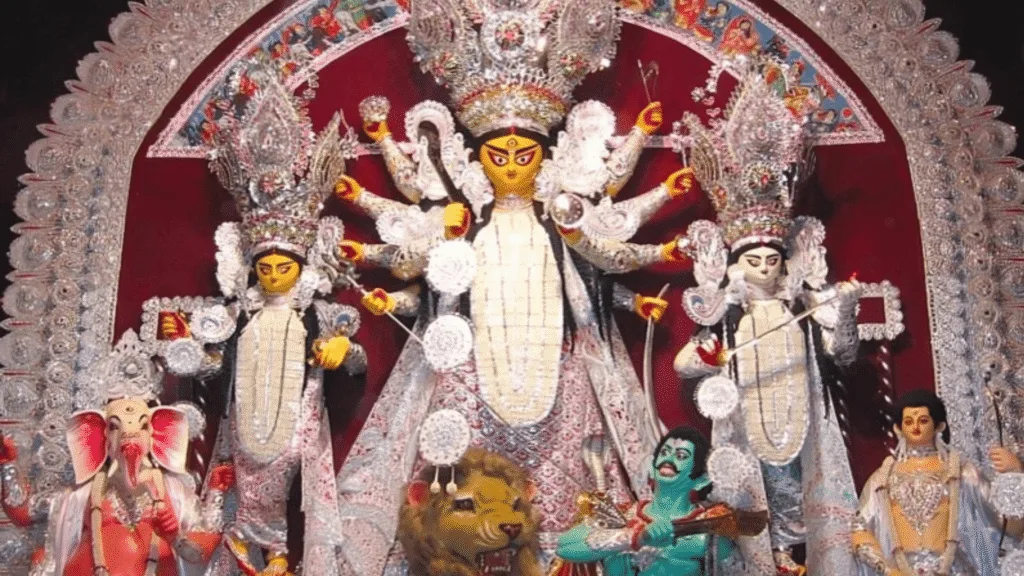
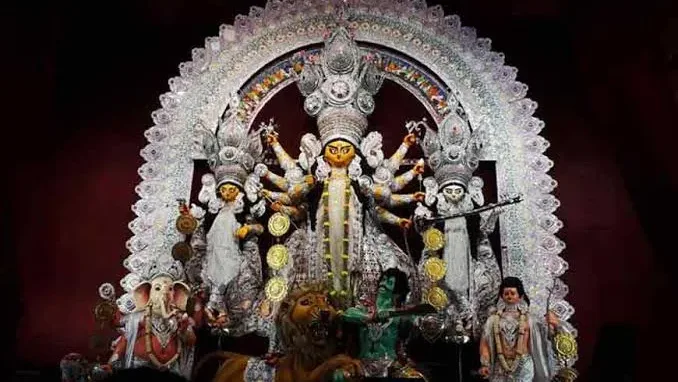
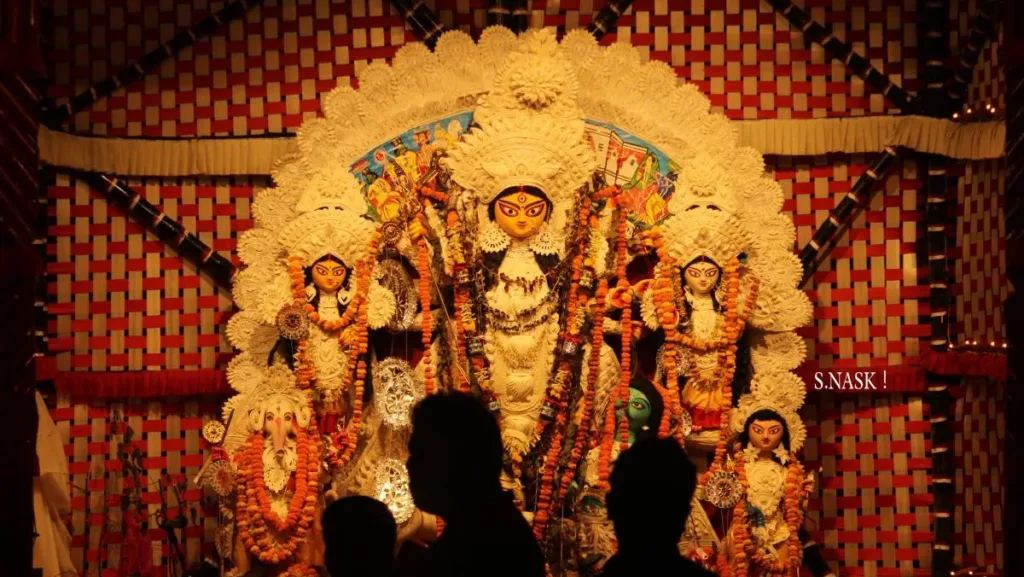
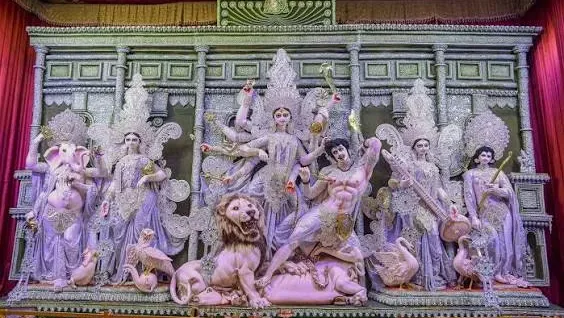
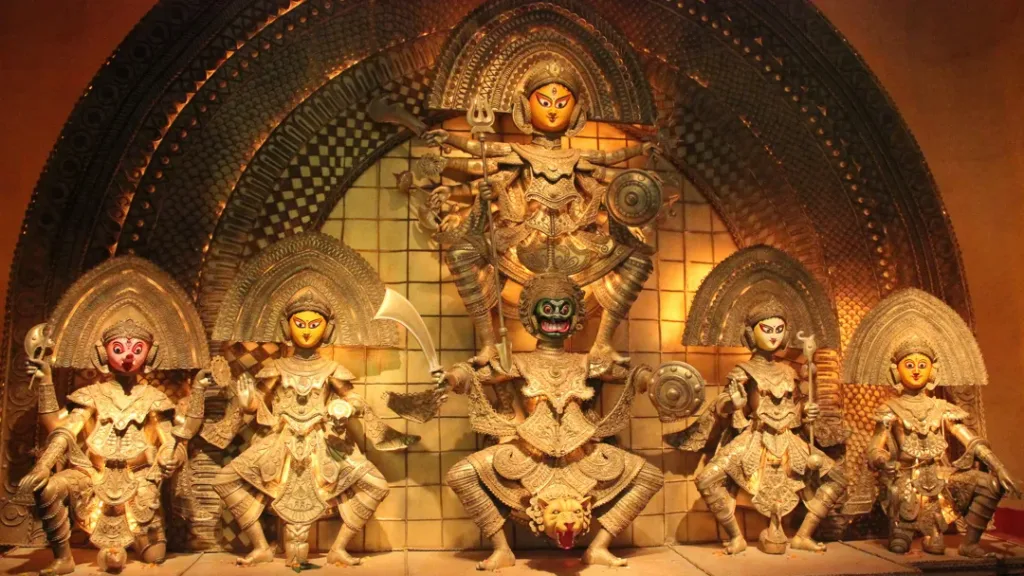
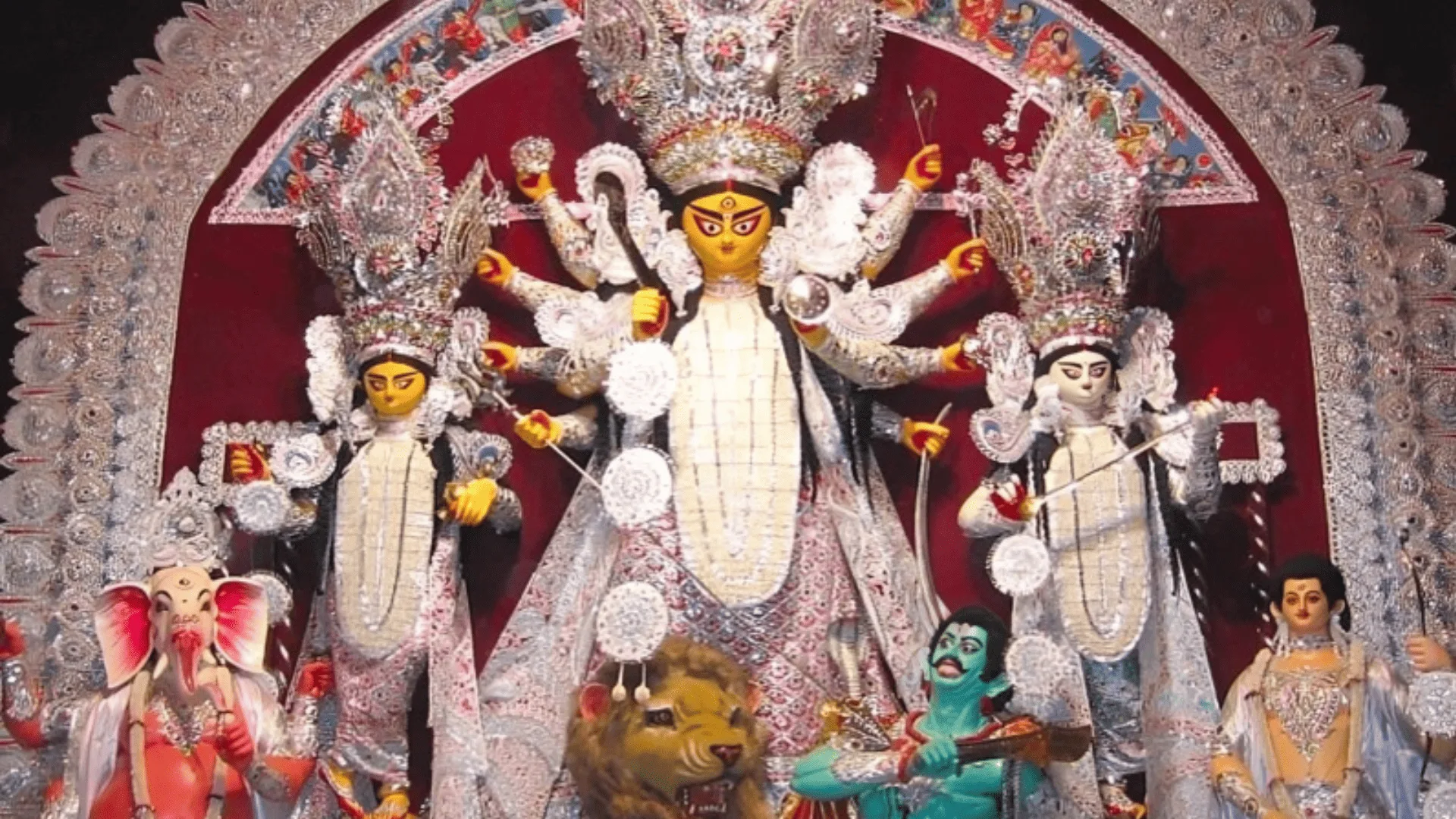
The visual language of Puja has changed too. Traditional ek-chalar thakur, where Durga and her family are presented together within one frame, now exists alongside elaborate multi-part installations. Sabeki pratima, or traditional idols, stand alongside theme-based creations made with unusual materials.
A look at traditional Durga puja in Bengal. Credit: X/asutoshhalder
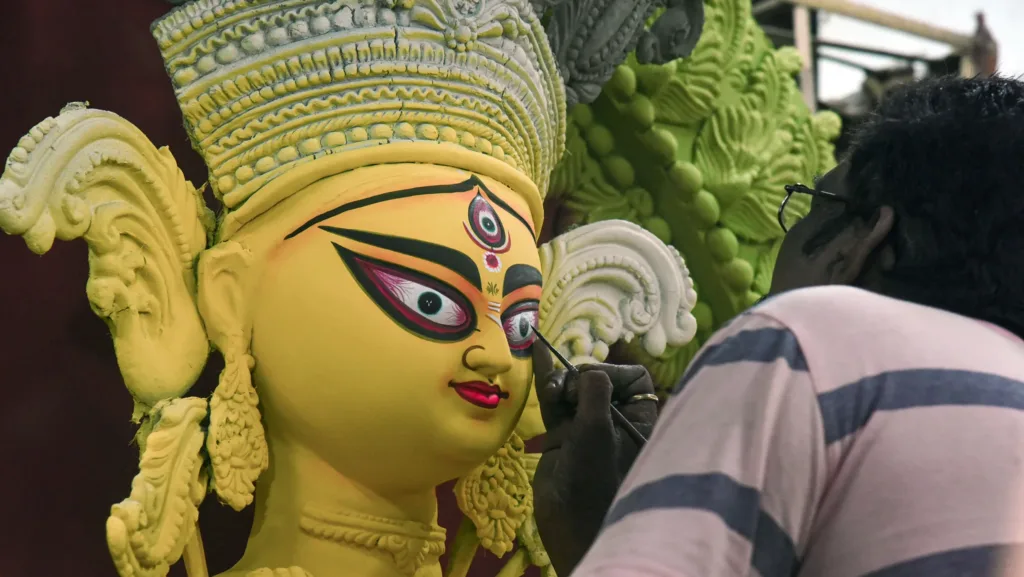
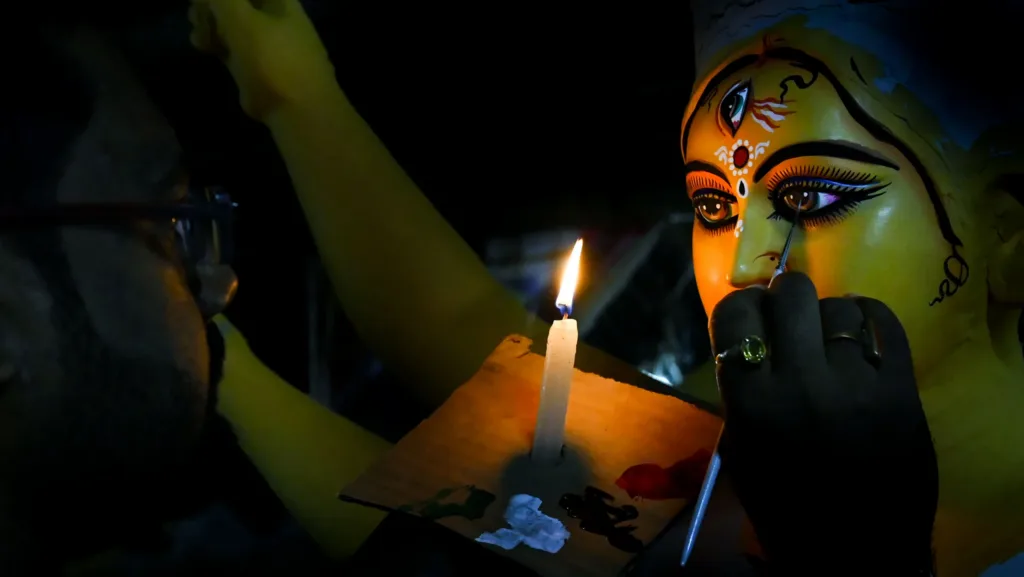
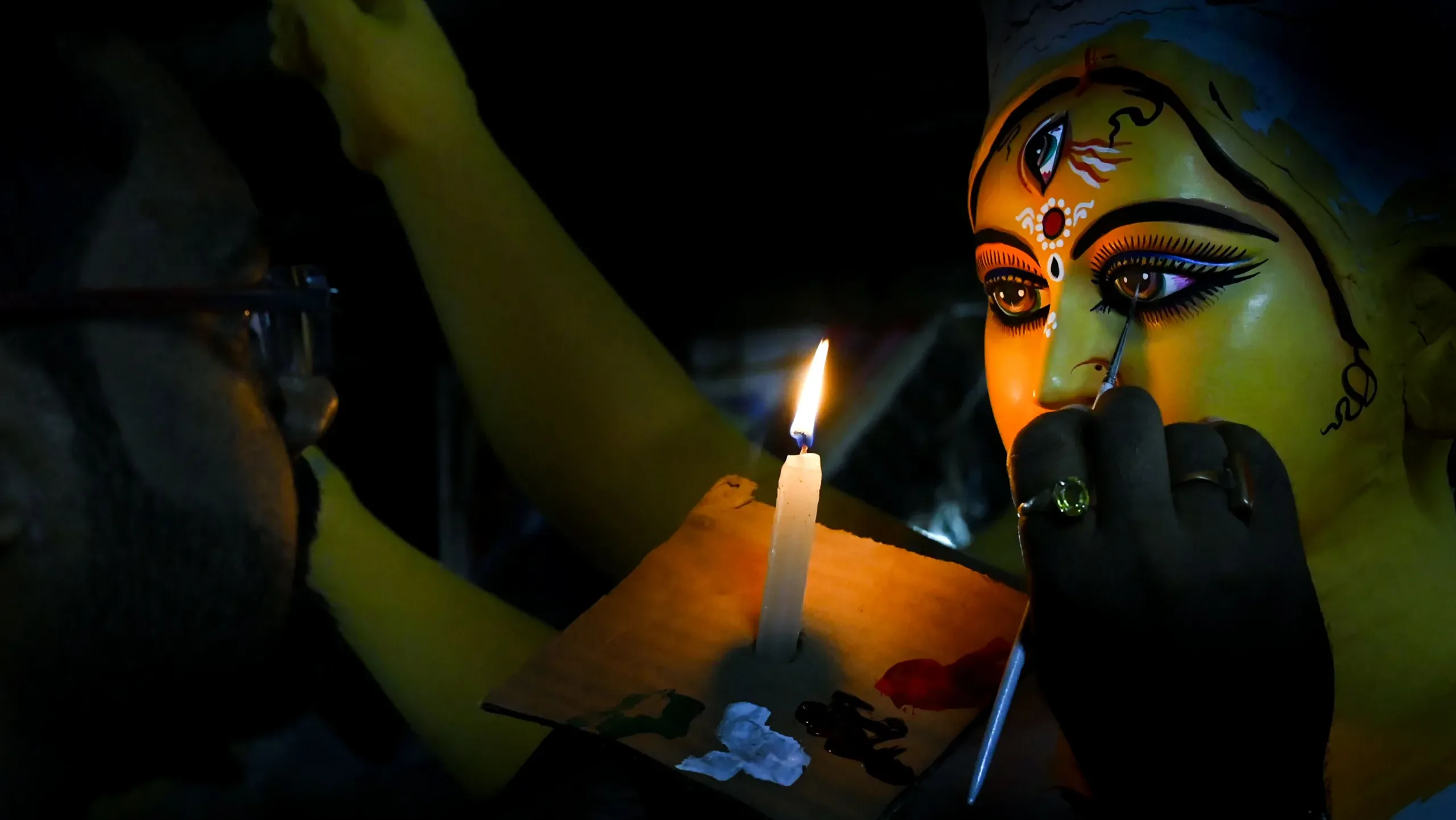
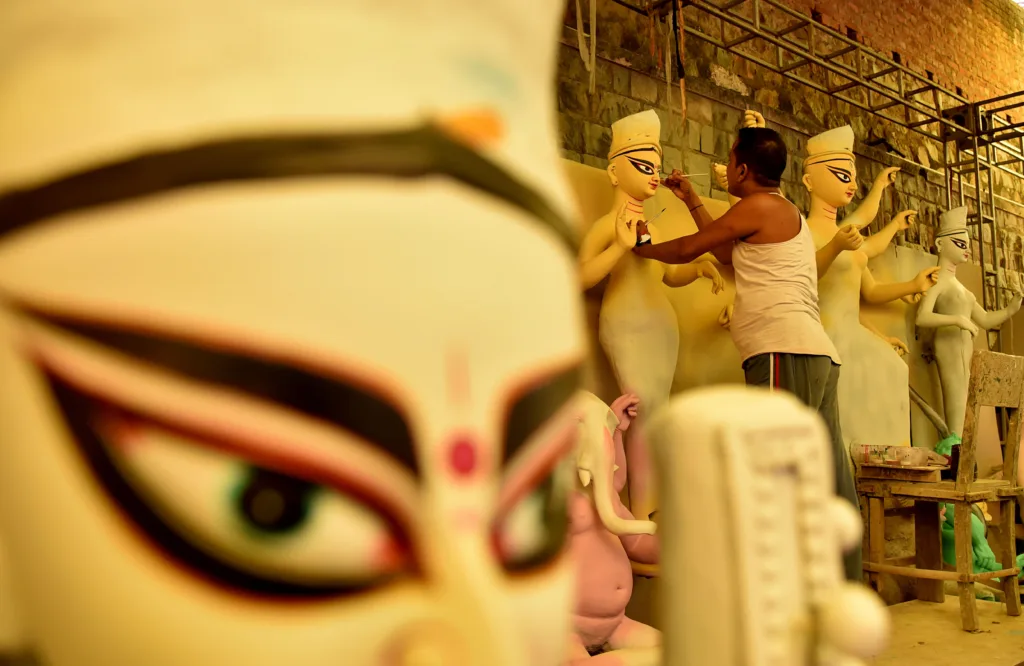
Kumartuli remains at the centre of Kolkata’s idol-making tradition. As Mahalaya approaches, its narrow lanes become increasingly busy with visitors, photographers and people looking for a glimpse of the idols before they leave for the city’s pandals.
The nearby Kumartuli Ghat is also being developed. A Rs 10-crore project covers a 300-metre stretch of the Hooghly riverfront and includes viewing areas, walkways and improved public facilities.
Political patronage of Kolkata’s big pujas changes
One of the most noticeable developments in Durga Puja 2026 is the change in leadership at several prominent pujas.
During the Trinamool Congress years, several major celebrations became closely identified with influential party leaders. Sreebhumi was associated with Sujit Bose, Suruchi Sangha with Arup Biswas and his brother Swarup, Chetla Agrani with Firhad Hakim, and Naktala Udayan Sangha with Partha Chatterjee. That pattern is now changing.
At Sreebhumi Sporting Club, a new committee is overseeing this year’s Puja. BJP leader Kanak Debnath is its president. Organisers have said the scale of the celebration will remain while efforts will be made to reduce prolonged road blockades.
A look at Sreebhumi Durga Puja. IG/sreebhumisportingclub
Suruchi Sangha has also undergone a leadership change. BJP MLA Sourav Sikdar is now secretary, with the new committee replacing the earlier arrangement associated with the Biswas brothers. The transition, however, was met with protests from some residents.
At Tala Prattoy, known in recent years for its striking themes, much of the previous organising structure has changed. Sushanta Shibani Pal is handling this year’s theme.
The changes are not limited to individual puja committees. A new statewide organisation called the Paschim Banga Durga Puja Samannay Samiti, or West Bengal Durga Puja Coordination Committee, is taking shape. Kartik Maharaj is its chairman, while BJP MLA Rudranil Ghosh is chief adviser.
The organisation could provide another coordination platform alongside the established Forum for Durgotsab, which represents hundreds of Puja committees.
New pujas and disputes add to the churn
Some familiar Kolkata locations are also entering new territory. Allen Park on Park Street, better known for its Christmas and New Year celebrations, will host a Durga Puja for the first time. The celebration is being organised by Kolkata Sanatani Sangha, fronted by BJP leader Shankudeb Panda.
Mohammad Ali Park has also seen a dispute, with competing committees putting up banners under different names after BJP councillor Meena Devi Purohit proposed changing the venue’s name to Mahabali Park.
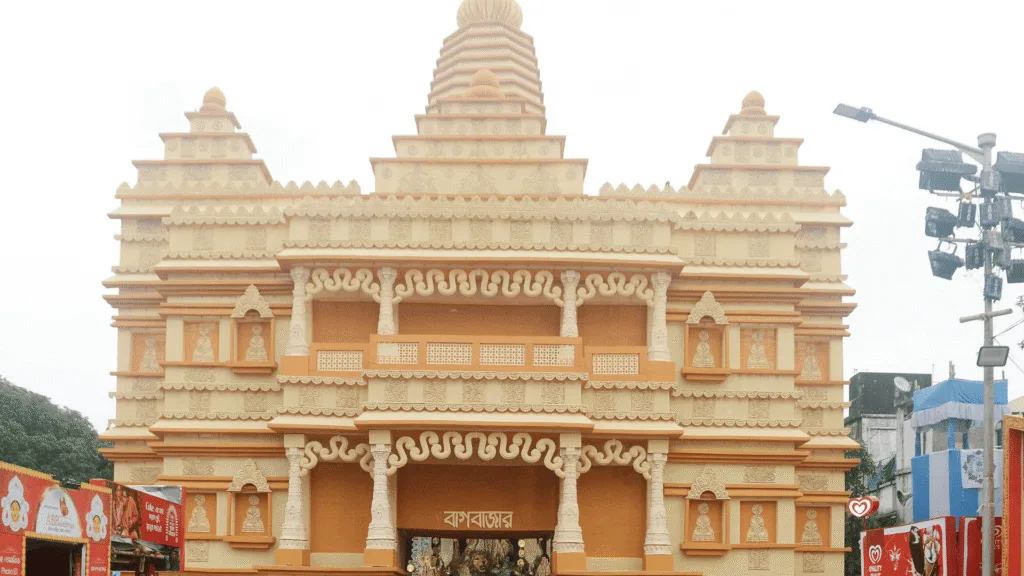
Bagbazar’s historic Puja faced a separate problem after a committee election became deadlocked. The matter eventually went to court.
Durga Puja grants and free electricity
The financial system supporting community Durga Puja is also being altered. The Mamata Banerjee government began providing annual assistance of Rs 10,000 to Puja committees in 2018. The amount was gradually increased and stood at Rs 1.1 lakh in 2025.
For 2026, the new BJP government has announced Rs 1 lakh per committee. Chief minister Suvendu Adhikari has also appealed to larger pujas to leave the assistance for smaller celebrations that require financial support. Several prominent committees have agreed to forgo the grant.
Suvendu Adhikari cut Durga Puja grants by 10000 rupees and declared Ashtami a dry day while telling big pujas to refuse state aid. Free electricity and fire licence waivers cannot replace lost excise revenue and community funding.https://t.co/9GUnkoXZWH
The government has also asked electricity suppliers to provide free power to Puja organisers. In 2025, the electricity waiver under the previous government stood at 80%.
There was also a controversy in Birbhum after BJP district president Uday Shankar Banerjee reportedly told committees that those accepting the 2026 government grant would have to display the chief minister’s photograph or face action. Minister Dilip Ghosh rejected the claim.
Will Bengal’s Durga Puja food traditions change?
Food has emerged as another important point of discussion ahead of Durga Puja.
In August, VHP central advisory council member Swami Nirgunananda suggested that non-vegetarian food should be kept away from the immediate Puja area. He also acknowledged that Bengal’s Durga Puja has never been entirely vegetarian.
VHP leaders later clarified that no official or binding instruction was prohibiting non-vegetarian food during Durga Puja.
Religious preacher Dhirendra Krishna Shastri, popularly known as Bageshwar Baba, subsequently criticised the consumption of non-vegetarian food during Puja and described those who did so as “pakhandis”, or hypocrites.
The remarks drew criticism, including from within the BJP. State party president Samik Bhattacharya defended Bengal’s food traditions. Adhikari later visited Kalighat temple and ate traditional prasad that included fried fish, fish head and basanti pulao.
At Suruchi Sangha, organisers have said mutton and hilsa will continue to be served during the Maha Navami feast.
Some housing societies have similarly said their Puja feasts will retain their existing traditions and remain largely non-vegetarian, except on Maha Ashtami.
However, some organisers are creating clearer boundaries around the sacred space. Thakurpukur SB Park and Chaltabagan have restricted visitors from entering while eating. The new Allen Park Puja will not have food stalls inside the park.
Theme pujas continue, but with a different emphasis
Theme-based Durga Puja remains part of Kolkata’s festival landscape in 2026. There is no official census dividing theme pujas from traditional celebrations.
Organisers have been asked to ensure that idols and themes do not hurt religious sentiments or undermine what the new government describes as Sanatani traditions.
Yet experimental themes have not disappeared. Subjects linked to care workers, gender identity and ecology continue to feature in this year’s celebrations.
Alongside them, some major pujas are placing greater emphasis on patriotism, nationalism and Hindu cultural identity.
Santosh Mitra Square, headed by BJP MLA Sajal Ghosh, has selected Vande Mataram as its theme. New Town Sanatani Durga Puja is exploring what its organisers describe as the connection between ancient Indian traditions and modern science.
The association between Durga and political or nationalist ideas, however, has a much longer history.
Bankimchandra Chattopadhyay used the image of Durga as a symbol of Bengal in Amar Durgotsav, included in Kamalakanter Daptar. Later, Kazi Nazrul Islam invoked Durga as Shakti in his poems and Agomani compositions. His 1922 poem Anandamoyeer Agamane used the Goddess’s arrival as an anti-colonial metaphor, leading to his prosecution for sedition by the British.
Why ‘Sharadotsav’ has become a political issue
Another debate concerns the word “Sharadotsav”, a term widely associated with Bengal’s autumn festivities and Durga Puja.
Suvendu Adhikari has asked Puja committees not to accommodate CPI(M) bookstalls using the term “Sharadotsav” instead of “Durga Puja”. The argument is that the terminology dilutes the festival’s religious identity.
The Left has pointed out that Rabindranath Tagore wrote Sharadotsav, a play celebrating autumn, in 1908.
A Puja committee at Kamardanga in Tangra has gone further, announcing that CPI(M), DYFI, SUCI and other Left-wing organisations would not be allowed to operate stalls at its celebration. The committee has urged other organisers to take a similar position, while the CPI(M) has criticised the move.
Mahalaya replaces the Red Road carnival
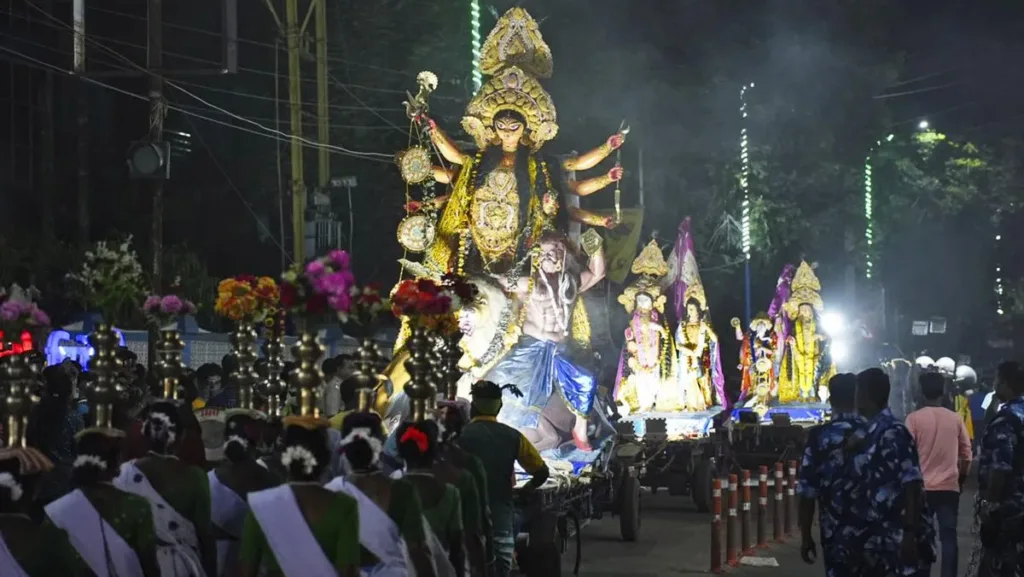
The Red Road immersion carnival, introduced in 2016 during the Mamata Banerjee government’s tenure, has been discontinued.
Durga puja carnival in Red Road in 2024. Credit: X/ANI
Its replacement is a large Mahalaya programme at Eden Gardens on October 10, 2026. Maha Shashthi falls on October 17 this year.
The event is expected to feature traditional performers, thousands of dhakis, fireworks and a drone show. Narendra Modi is expected to attend and virtually inaugurate prominent Kolkata pujas associated with the programme.
Mahalaya carries a special place in Bengal’s cultural calendar. Along with the tradition of tarpan, the day is strongly associated with Birendra Krishna Bhadra’s recitation of Mahishasuramardini, which has been linked with Mahalaya since the 1930s.
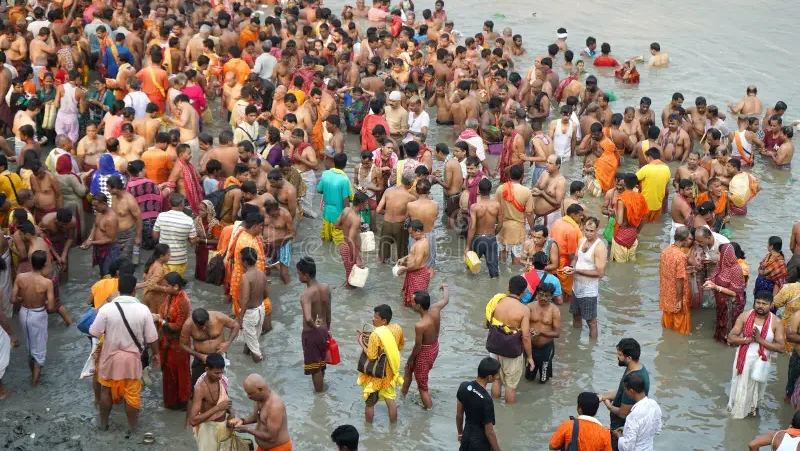
People performing Tarpan at Babughaat in Kolkata in 2025. Credit: X/ANI
The Eden Gardens event therefore places the new government at the centre of the ceremonial beginning of the Puja season.
More changes for Kolkata pandal-hoppers
The rules for Puja celebrations are changing in several other ways. Puja pandals will not be allowed to hold inaugurations before Mahalaya, according to the new government.
Maha Ashtami will be observed as a dry day, with liquor sales prohibited. DJs have also been banned during Puja celebrations and immersion processions.
Organisers have been asked to prevent prolonged road blockades and complete immersions within the prescribed period.
Even the look of Kolkata Police’s crowd-management volunteers is expected to change. A police tender has proposed orange T-shirts and caps in place of the familiar white-and-blue attire.
Bengal’s Durga Puja has never had one fixed identity
Despite the changes around politics, patronage, food and presentation, Bengal’s Durga Puja tradition has always contained considerable variation.
Historical accounts show that there was never a single rule governing the appearance of idols or the food served during Puja.
Mahendranath Datta, Swami Vivekananda’s younger brother, recorded differences between Shakta and Vaishnava households. He noted that the lion accompanying Durga could have a conventional lion’s face in Shakta homes, while Gosain or Vaishnava households sometimes depicted it with a horse-like face.
Food customs differed as well. Brahmin households could serve rice, vegetables, curd and payesh, while Shakta Brahmin homes permitted fish. Kayastha households served luchi.
Old family pujas continue to reflect that diversity. The Sabarna Roy Chowdhury family offers katla as Nabami bhog, while fish is offered during Puja at Chorbagan Chatterjee Bari. At the Janbazar home of Rani Rashmoni’s descendants, the Goddess receives vegetarian bhog even though non-vegetarian food is served to guests.
That history makes Bengal’s Durga Puja difficult to fit into a single cultural or dietary template.
The committees may change, political associations may shift and new rules may shape the festival’s public face. But the traditions of Durga Puja in Bengal have developed over centuries through different communities, families, artists and organisers.
For 2026, the most visible changes are already clear. The Red Road carnival is gone, Eden Gardens will host the Mahalaya celebration, several prominent pujas have new leadership, and debates over food, themes and political participation have entered the festival conversation.
The fate of Bagbazar Sarbojanin Durga Puja, Kolkata’s oldest community Durga Puja, now lies before the Calcutta High Court after an election for key managing committee posts ended without a clear winner.
The puja, which is entering its 108th year, saw a deadlock on Sunday as both sides received 33 votes each for the posts of general secretary and four managing committee members. The High Court had earlier appointed two observers to oversee the election.
Bagbazar Puja election ends in 33-33 tie
A total of 66 members voted out of the 77 eligible voters. Eleven members, including several prominent members of the organising body, stayed away from the election.
Goutam Neogi, who is tied for the general secretary’s post, said the committee president, Samar Kumar Pal, should have been allowed to use a casting vote under the organisation’s bylaws when the election ended in a stalemate.
“The observers did not allow the casting vote after an objection from one of the parties. We are now awaiting the court’s decision,” Times of India reported Neogi as saying.
The observers were appointed by the High Court after a plea was filed by the rival camp.
Legal wrangle puts preparations for Kolkata’s iconic Bagbazar Puja in focus | ANI
Woman alleges assault over voting
The election was also followed by a police complaint alleging assault and intimidation. A woman resident of Bosepara Lane approached Shyampukur Police Station, alleging that she was heckled, abused and physically assaulted after voting against a particular group.
Sukumar Mondal, who was named in the complaint, is reportedly aligned with former ward 7 councillor Bapi Ghosh. Ghosh has been seeking control of the puja’s organising committee since last year.
The dispute has added uncertainty to preparations for one of Kolkata’s most prominent traditional Durga Pujas. Organisers are yet to begin preparations in full swing, raising concern in the locality as the festival approaches.
Why Bagbazar Sarbojanin is significant
Bagbazar Sarbojanin began in 1919 at 55 Bagbazar Street as Nebubagan Barowari Durga Puja. After shifting through locations including Pashupati Bose Lane and Bagbazar Kali temple, it eventually moved to its permanent grounds.
Social worker Nagendra Nath Ghoshal helped formalise the committee and gave it the name Bagbazar Sarbojanin Durgotsav.
In 1930, Calcutta Municipal Corporation alderman Durgacharan Bandyopadhyay became president and introduced a Swadeshi exhibition to promote Indian-made products. The venue was also associated with freedom movement activities. Netaji Subhas Chandra Bose served as president in 1938-39, while Chittaranjan Das also used the venue to mobilise support and provide shelter to underground revolutionaries.
The puja continues to draw lakhs of devotees every year and retains its traditional format, including its well-known ekchala Durga idol, rather than adopting theme-based presentations.
Members seeking re-election have said they oppose a minister or councillor becoming the face of the puja. A panel backed by former minister Shashi Panja lost the 2022 election. Ghosh, who was then a councillor, allegedly attempted to take control of the puja last year but did not succeed.