Tag: Bengal

  • West Bengal Durga puja 2026: What is changing this year with Bengal’s regime change?

    West Bengal Durga puja 2026: What is changing this year with Bengal’s regime change?

    Durga Puja in West Bengal is entering a new political chapter in 2026. With a new government in office, several familiar features of Kolkata’s biggest annual festival are changing, from the Red Road carnival and puja patronage to government grants, food practices and the way pandals are inaugurated.

    The biggest change is perhaps the end of the Durga Puja carnival on Red Road, a much-remembered feature of the Mamata Banerjee years. Instead, the new government is preparing a major Mahalaya programme at Eden Gardens on October 10, which Prime Minister Narendra Modi is expected to attend.

    But the changes go beyond the calendar. Several well-known pujas have seen changes in their organising committees, while questions around food, themes, political stalls and the religious character of the festival have also emerged.

    At the same time, the number of Durga Pujas across Bengal continues to rise. As of September 24, 2,318 pujas had registered on Kolkata’s Sahaj single-window permission portal. The figure included 270 new applicants. In 2025, the final number of applications reached 2,936, the highest recorded till then.

    Across West Bengal, the state power department expects the number of community pujas to cross 65,000 this year, based partly on demand for temporary electricity connections.

    Durga Puja’s long tradition of change

    The community Durga Puja, or barowari puja, is generally associated with late-18th-century Guptipara. Historians, however, differ over the exact year and even over whether the earliest community festival there was Durga Puja or Jagaddhatri Puja.

    The term barowari is commonly linked to baro yaar, meaning “twelve friends”.

    Bengal’s Puja traditions have evolved repeatedly. Zamindars once played a major role in patronage, while political leaders later became closely associated with prominent community celebrations.

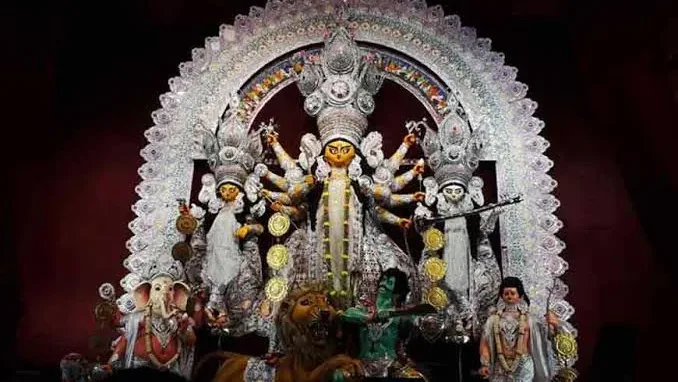
    The visual language of Puja has changed too. Traditional ek-chalar thakur, where Durga and her family are presented together within one frame, now exists alongside elaborate multi-part installations. Sabeki pratima, or traditional idols, stand alongside theme-based creations made with unusual materials.
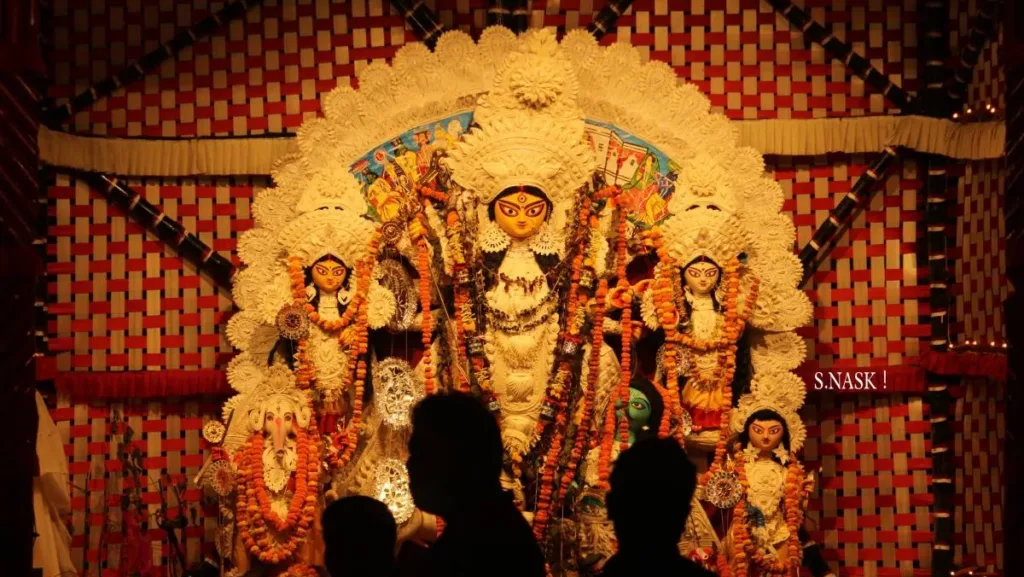
    A look at traditional Durga puja in Bengal
    A look at traditional Durga puja in Bengal. Credit: X/asutoshhalder

    Kumartuli remains at the centre of Kolkata’s idol-making tradition. As Mahalaya approaches, its narrow lanes become increasingly busy with visitors, photographers and people looking for a glimpse of the idols before they leave for the city’s pandals.

    The nearby Kumartuli Ghat is also being developed. A Rs 10-crore project covers a 300-metre stretch of the Hooghly riverfront and includes viewing areas, walkways and improved public facilities.

    Political patronage of Kolkata’s big pujas changes

    One of the most noticeable developments in Durga Puja 2026 is the change in leadership at several prominent pujas.

    During the Trinamool Congress years, several major celebrations became closely identified with influential party leaders. Sreebhumi was associated with Sujit Bose, Suruchi Sangha with Arup Biswas and his brother Swarup, Chetla Agrani with Firhad Hakim, and Naktala Udayan Sangha with Partha Chatterjee. That pattern is now changing.

    At Sreebhumi Sporting Club, a new committee is overseeing this year’s Puja. BJP leader Kanak Debnath is its president. Organisers have said the scale of the celebration will remain while efforts will be made to reduce prolonged road blockades.
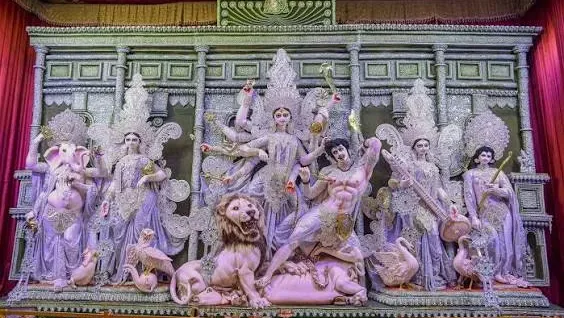
    A look at Sreebhumi Durga Puja
    A look at Sreebhumi Durga Puja. IG/sreebhumisportingclub

    Suruchi Sangha has also undergone a leadership change. BJP MLA Sourav Sikdar is now secretary, with the new committee replacing the earlier arrangement associated with the Biswas brothers. The transition, however, was met with protests from some residents.

    At Tala Prattoy, known in recent years for its striking themes, much of the previous organising structure has changed. Sushanta Shibani Pal is handling this year’s theme.

    The changes are not limited to individual puja committees. A new statewide organisation called the Paschim Banga Durga Puja Samannay Samiti, or West Bengal Durga Puja Coordination Committee, is taking shape. Kartik Maharaj is its chairman, while BJP MLA Rudranil Ghosh is chief adviser.

    The organisation could provide another coordination platform alongside the established Forum for Durgotsab, which represents hundreds of Puja committees.

    New pujas and disputes add to the churn

    Some familiar Kolkata locations are also entering new territory. Allen Park on Park Street, better known for its Christmas and New Year celebrations, will host a Durga Puja for the first time. The celebration is being organised by Kolkata Sanatani Sangha, fronted by BJP leader Shankudeb Panda.

    Mohammad Ali Park has also seen a dispute, with competing committees putting up banners under different names after BJP councillor Meena Devi Purohit proposed changing the venue’s name to Mahabali Park.

    Bagbazar’s historic Puja faced a separate problem after a committee election became deadlocked. The matter eventually went to court.

    Durga Puja grants and free electricity

    The financial system supporting community Durga Puja is also being altered. The Mamata Banerjee government began providing annual assistance of Rs 10,000 to Puja committees in 2018. The amount was gradually increased and stood at Rs 1.1 lakh in 2025.

    For 2026, the new BJP government has announced Rs 1 lakh per committee. Chief minister Suvendu Adhikari has also appealed to larger pujas to leave the assistance for smaller celebrations that require financial support. Several prominent committees have agreed to forgo the grant.

    The government has also asked electricity suppliers to provide free power to Puja organisers. In 2025, the electricity waiver under the previous government stood at 80%.

    There was also a controversy in Birbhum after BJP district president Uday Shankar Banerjee reportedly told committees that those accepting the 2026 government grant would have to display the chief minister’s photograph or face action. Minister Dilip Ghosh rejected the claim.

    Will Bengal’s Durga Puja food traditions change?

    Food has emerged as another important point of discussion ahead of Durga Puja.

    In August, VHP central advisory council member Swami Nirgunananda suggested that non-vegetarian food should be kept away from the immediate Puja area. He also acknowledged that Bengal’s Durga Puja has never been entirely vegetarian.

    VHP leaders later clarified that no official or binding instruction was prohibiting non-vegetarian food during Durga Puja.

    Religious preacher Dhirendra Krishna Shastri, popularly known as Bageshwar Baba, subsequently criticised the consumption of non-vegetarian food during Puja and described those who did so as “pakhandis”, or hypocrites.

    The remarks drew criticism, including from within the BJP. State party president Samik Bhattacharya defended Bengal’s food traditions. Adhikari later visited Kalighat temple and ate traditional prasad that included fried fish, fish head and basanti pulao.

    At Suruchi Sangha, organisers have said mutton and hilsa will continue to be served during the Maha Navami feast.

    Some housing societies have similarly said their Puja feasts will retain their existing traditions and remain largely non-vegetarian, except on Maha Ashtami.

    However, some organisers are creating clearer boundaries around the sacred space. Thakurpukur SB Park and Chaltabagan have restricted visitors from entering while eating. The new Allen Park Puja will not have food stalls inside the park.

    Theme pujas continue, but with a different emphasis

    Theme-based Durga Puja remains part of Kolkata’s festival landscape in 2026. There is no official census dividing theme pujas from traditional celebrations.

    Organisers have been asked to ensure that idols and themes do not hurt religious sentiments or undermine what the new government describes as Sanatani traditions.
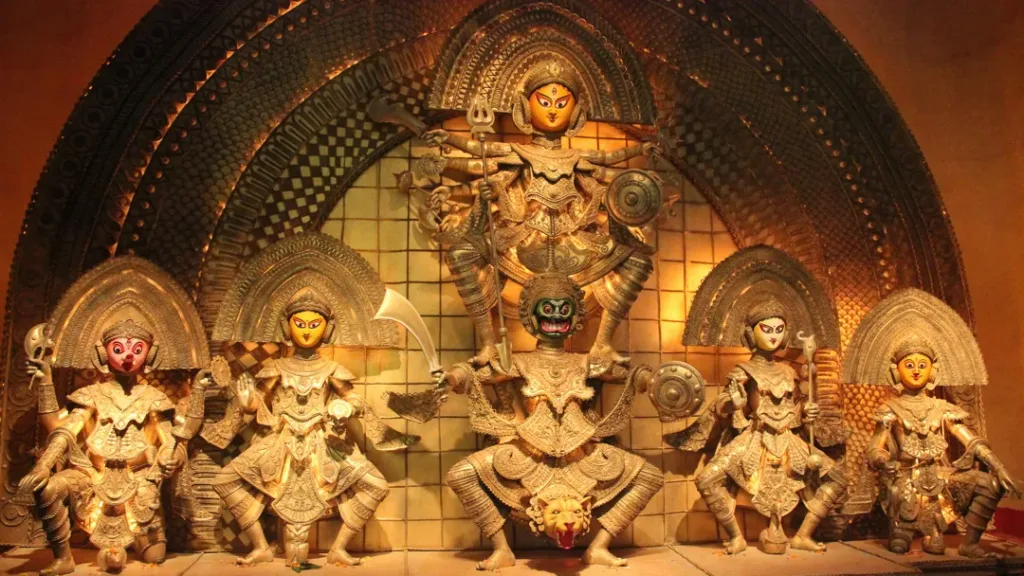
    A theme-based Durga puja in Kolkata in 2025
    Idols conceptualised as Purulia ‘Chhau’ dancers, Ajeya Sanghati club, Kolkata, 2025.

    Yet experimental themes have not disappeared. Subjects linked to care workers, gender identity and ecology continue to feature in this year’s celebrations.

    Alongside them, some major pujas are placing greater emphasis on patriotism, nationalism and Hindu cultural identity.

    Santosh Mitra Square, headed by BJP MLA Sajal Ghosh, has selected Vande Mataram as its theme. New Town Sanatani Durga Puja is exploring what its organisers describe as the connection between ancient Indian traditions and modern science.

    The association between Durga and political or nationalist ideas, however, has a much longer history.

    Bankimchandra Chattopadhyay used the image of Durga as a symbol of Bengal in Amar Durgotsav, included in Kamalakanter Daptar. Later, Kazi Nazrul Islam invoked Durga as Shakti in his poems and Agomani compositions. His 1922 poem Anandamoyeer Agamane used the Goddess’s arrival as an anti-colonial metaphor, leading to his prosecution for sedition by the British.

    Why ‘Sharadotsav’ has become a political issue

    Another debate concerns the word “Sharadotsav”, a term widely associated with Bengal’s autumn festivities and Durga Puja.

    Suvendu Adhikari has asked Puja committees not to accommodate CPI(M) bookstalls using the term “Sharadotsav” instead of “Durga Puja”. The argument is that the terminology dilutes the festival’s religious identity.

    The Left has pointed out that Rabindranath Tagore wrote Sharadotsav, a play celebrating autumn, in 1908.

    A Puja committee at Kamardanga in Tangra has gone further, announcing that CPI(M), DYFI, SUCI and other Left-wing organisations would not be allowed to operate stalls at its celebration. The committee has urged other organisers to take a similar position, while the CPI(M) has criticised the move.

    Mahalaya replaces the Red Road carnival

    The Red Road immersion carnival, introduced in 2016 during the Mamata Banerjee government’s tenure, has been discontinued.
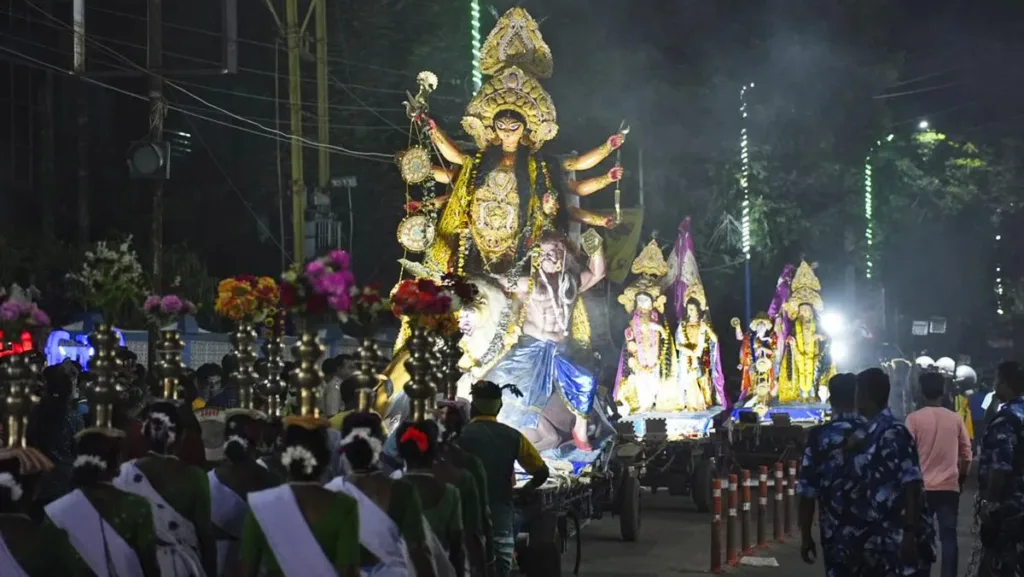
    Durga puja carnival in Red Road in 2024
    Durga puja carnival in Red Road in 2024. Credit: X/ANI

    Its replacement is a large Mahalaya programme at Eden Gardens on October 10, 2026. Maha Shashthi falls on October 17 this year.

    The event is expected to feature traditional performers, thousands of dhakis, fireworks and a drone show. Narendra Modi is expected to attend and virtually inaugurate prominent Kolkata pujas associated with the programme.

    Also Read | Kumartuli: The 300-year-old Kolkata neighbourhood where Maa Durga comes to life before Puja

    Mahalaya carries a special place in Bengal’s cultural calendar. Along with the tradition of tarpan, the day is strongly associated with Birendra Krishna Bhadra’s recitation of Mahishasuramardini, which has been linked with Mahalaya since the 1930s.
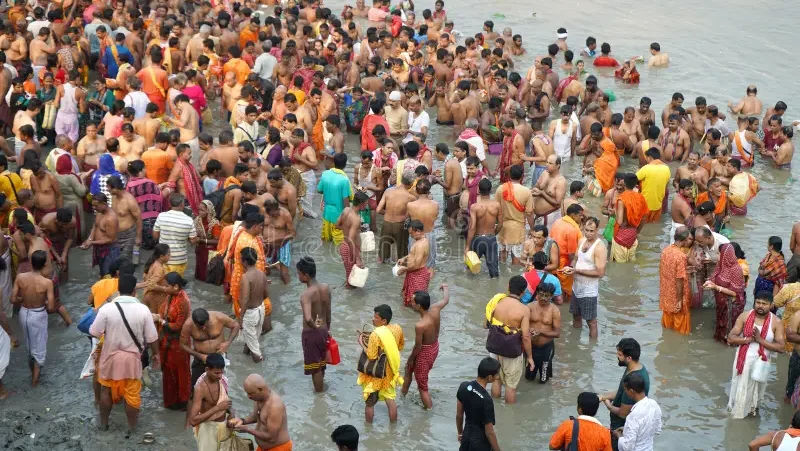
    People performing Tarpan at Babughaat in Kolkata in 2025
    People performing Tarpan at Babughaat in Kolkata in 2025. Credit: X/ANI

    The Eden Gardens event therefore places the new government at the centre of the ceremonial beginning of the Puja season.

    More changes for Kolkata pandal-hoppers

    The rules for Puja celebrations are changing in several other ways. Puja pandals will not be allowed to hold inaugurations before Mahalaya, according to the new government.

    Maha Ashtami will be observed as a dry day, with liquor sales prohibited. DJs have also been banned during Puja celebrations and immersion processions.

    Organisers have been asked to prevent prolonged road blockades and complete immersions within the prescribed period.

    Even the look of Kolkata Police’s crowd-management volunteers is expected to change. A police tender has proposed orange T-shirts and caps in place of the familiar white-and-blue attire.

    Bengal’s Durga Puja has never had one fixed identity

    Despite the changes around politics, patronage, food and presentation, Bengal’s Durga Puja tradition has always contained considerable variation.

    Historical accounts show that there was never a single rule governing the appearance of idols or the food served during Puja.

    Mahendranath Datta, Swami Vivekananda’s younger brother, recorded differences between Shakta and Vaishnava households. He noted that the lion accompanying Durga could have a conventional lion’s face in Shakta homes, while Gosain or Vaishnava households sometimes depicted it with a horse-like face.

    Food customs differed as well. Brahmin households could serve rice, vegetables, curd and payesh, while Shakta Brahmin homes permitted fish. Kayastha households served luchi.

    Old family pujas continue to reflect that diversity. The Sabarna Roy Chowdhury family offers katla as Nabami bhog, while fish is offered during Puja at Chorbagan Chatterjee Bari. At the Janbazar home of Rani Rashmoni’s descendants, the Goddess receives vegetarian bhog even though non-vegetarian food is served to guests.

    That history makes Bengal’s Durga Puja difficult to fit into a single cultural or dietary template.

    Also Read | Calm restored at SRFTI campus after clash between students and ABGP

    The committees may change, political associations may shift and new rules may shape the festival’s public face. But the traditions of Durga Puja in Bengal have developed over centuries through different communities, families, artists and organisers.

    For 2026, the most visible changes are already clear. The Red Road carnival is gone, Eden Gardens will host the Mahalaya celebration, several prominent pujas have new leadership, and debates over food, themes and political participation have entered the festival conversation.
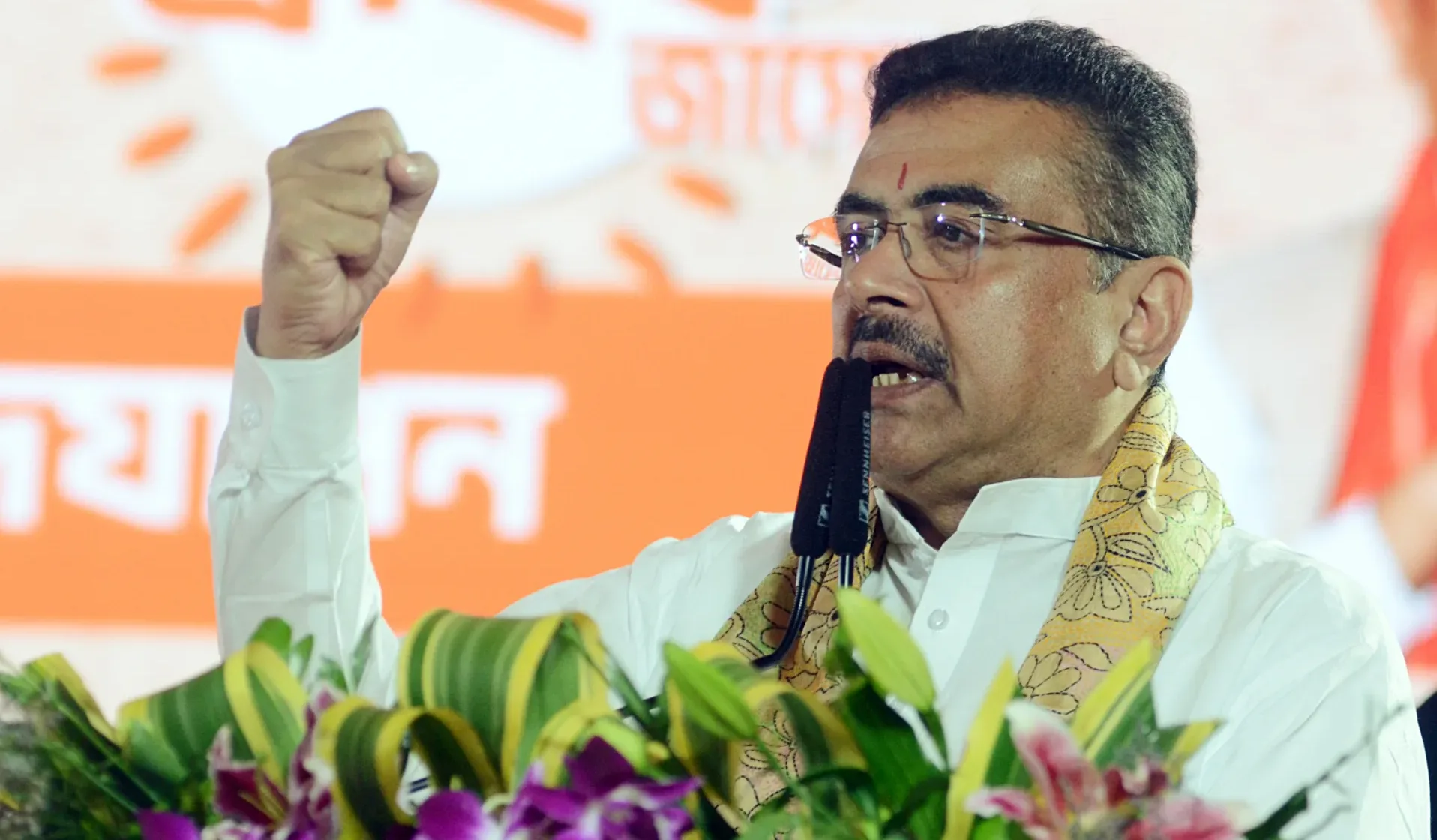
  • Chief Minister Suvendu Adhikari promises major investments in Bengal; Adani hospital project set to begin 

    Chief Minister Suvendu Adhikari promises major investments in Bengal; Adani hospital project set to begin 

    West Bengal Chief Minister Suvendu Adhikari on Tuesday said the state could see major investments from leading industrial groups, while indicating that the government was working to bring more big businesses to Bengal.

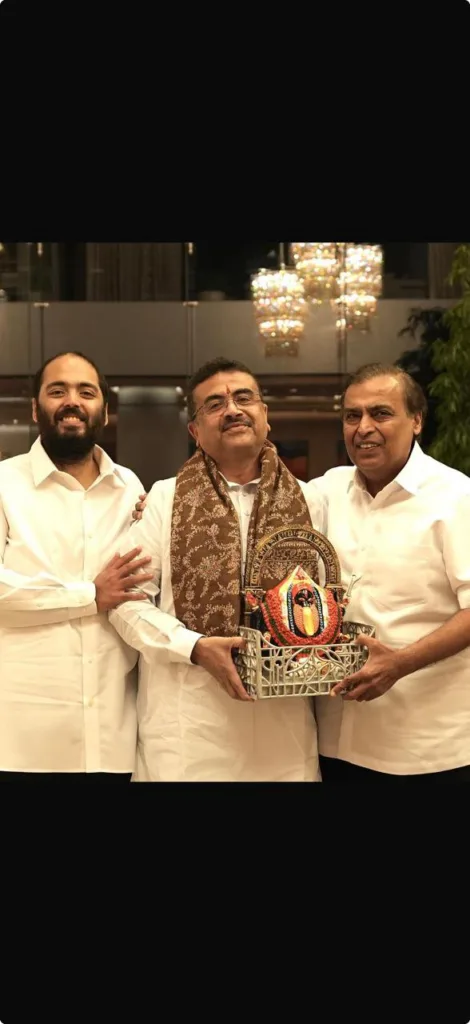
    Speaking to reporters in Cooch Behar, Adhikari referred to Prime Minister Narendra Modi’s message of “talk less and work more” while discussing his government’s efforts to attract investment. His remarks came a day after he met industrialist Mukesh Ambani and his son Anant Ambani in Mumbai. Recent reports said investment opportunities and the expansion of Reliance’s presence in West Bengal were discussed during the meeting. 

    Suvendu Adhikari hints at Ambani development

    Adhikari suggested that his meeting with the Ambanis could lead to a development in Bengal, although he did not disclose details.

    “I received an invitation from Anant Ambani to attend their Ganpati festival. I couldn’t make it last week, but yesterday I visited their home, performed Aarti at their temple, and had dinner with Mukesh ji and Anant ji. You will have to wait and watch what happens,” Adhikari told reporters in Cooch Behar.

    The meeting was part of the state government’s efforts to attract fresh industrial investment. Reports said discussions included opportunities for Reliance to expand its business activities in Bengal. 

    West Bengal Cm Suvendu Adhikari with Mukhesh and Anant Ambani
    West Bengal Cm Suvendu Adhikari with Mukhesh and Anant Ambani. Credit: X/Suvendu Adhikari

    ‘There will be huge investments in Bengal’

    Adhikari said major investors would be brought to the state and claimed that Bengal would receive substantial investment.

    “There will be huge investments in Bengal. All major investors will be here. The Communists and previous chief minister Mamata (Banerjee) have caused massive damage to the state. The entire country is ready to support the BJP government to get Bengal back on its feet. I have got this commitment from everybody,” Adhikari said.

    Also Read | Will West Bengal’s new land reforms make it easier to set up businesses? Exploring

    His comments form part of the state government’s broader push to attract large industrial projects and position West Bengal as an investment destination. The government has also announced plans to provide land to 33 industries before Durga Puja. 

    Adani hospital project in New Town

    Adhikari also said the groundbreaking ceremony for the Adani Group’s proposed hospital in Kolkata’s New Town would take place soon, with Gautam Adani expected to attend.

    The proposed facility is a 2,000-bed hospital, with the foundation stone ceremony scheduled for September 24, according to recent reports. 

    Also Read | West Bengal 933 schools with no students under government review; might hand buildings to other depts

    The developments involving the Ambani and Adani groups come as the Bengal government steps up its outreach to major corporate groups. The focus remains on attracting investment and expanding industrial activity across the state.

    This version targets Suvendu Adhikari, Bengal investment, Mukesh Ambani, Anant Ambani, Adani Group and New Town hospital as the main SEO keywords while keeping the political claims clearly attributed.

  • The Unfinished Awakening: Bengal, Freedom and India’s Tryst with Destiny at 80

    The Unfinished Awakening: Bengal, Freedom and India’s Tryst with Destiny at 80

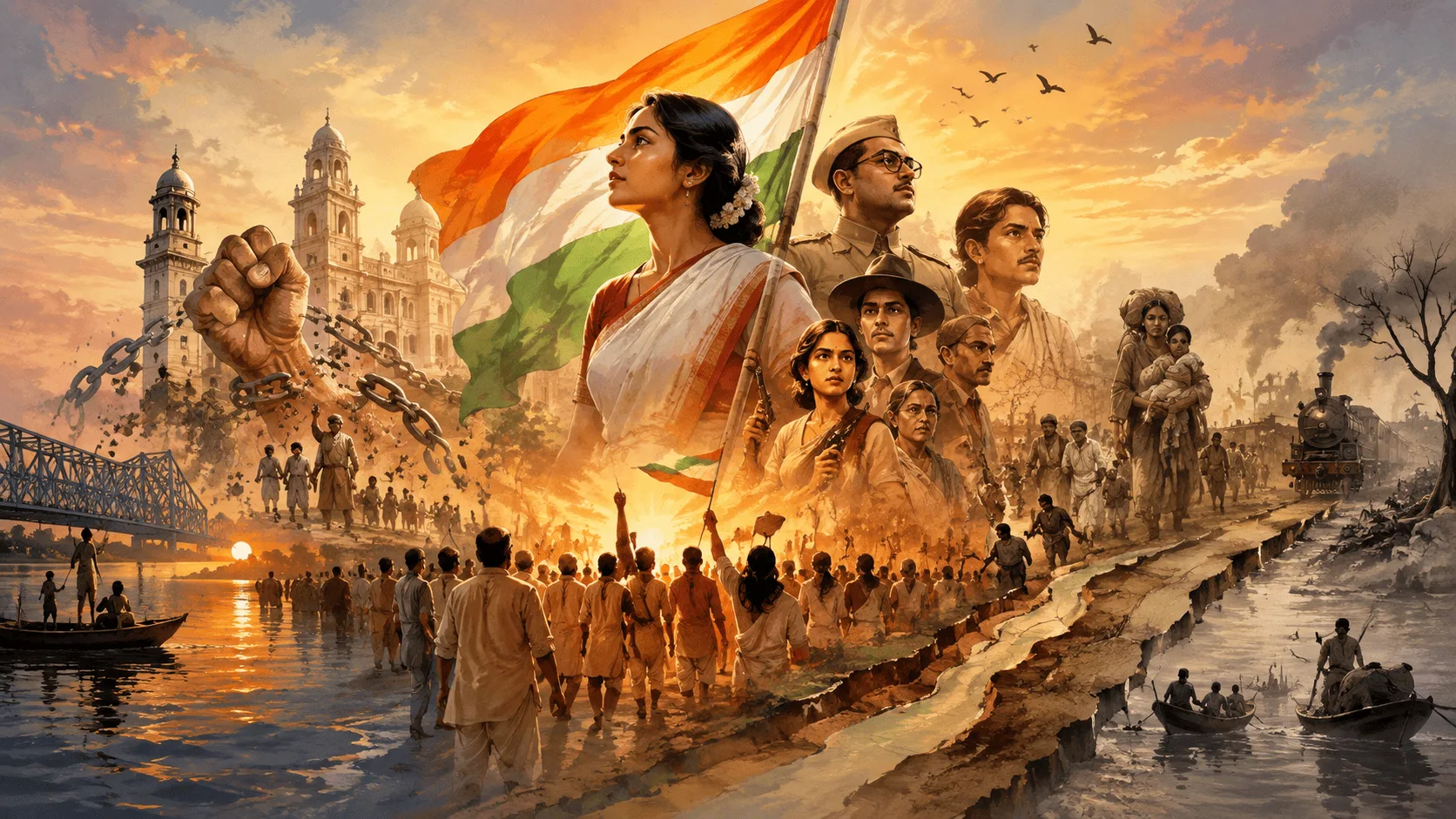
    On the night India crossed the threshold of freedom, Bengal occupied a peculiar and almost tragic position in the national imagination: it was at once one of the principal nurseries of Indian nationalism, the birthplace of movements that had challenged the moral authority of the Raj long before independence became an attainable political proposition, and the province that would experience the arrival of freedom through the violence of Partition, with Calcutta itself suspended between jubilation and apprehension. While New Delhi prepared for the ceremonies that would accompany the transfer of power, Bengal confronted a more complicated dawn, for the liberation of a country had arrived alongside the division of a homeland that had for generations been imagined, inhabited and remembered as a cultural whole. Eight decades later, as India marks its 80th Independence Day, that contradiction remains indispensable to any serious understanding of what freedom meant to Bengal and what Bengal, in turn, meant to the making of India.

    Long before 15 August became the ceremonial vocabulary through which an independent republic would annually remember itself, Bengal had already supplied much of the intellectual and emotional grammar of the freedom movement. The first Partition of Bengal in 1905, conceived by the colonial administration ostensibly for reasons of administrative convenience but widely perceived as an attempt to fracture an increasingly politically conscious population, produced the Swadeshi movement and transformed resistance from an abstract political sentiment into an everyday practice of boycott, indigenous enterprise, national education and cultural assertion. The streets, classrooms, printing presses and drawing rooms of Bengal became laboratories of nationalism, while literature, music and theatre acquired a political potency that the colonial state found increasingly difficult to contain. Rabindranath Tagore’s songs, Bankim Chandra Chattopadhyay’s Vande Mataram and the writings of a generation of intellectuals did something that political resolutions alone could not accomplish: they gave the idea of India an emotional vocabulary.

    Yet Bengal’s nationalism was never confined to the genteel world of intellectual debate. Beneath the public movement existed a subterranean republic of revolutionaries, whose names would eventually become inseparable from the mythology of India’s struggle for independence. Khudiram Bose, barely eighteen when he was executed in 1908, entered nationalist memory as the embodiment of a generation for whom colonial rule had ceased to appear merely unjust and had instead become intolerable; the organisations associated with Anushilan Samiti and Jugantar subsequently cultivated networks of young men who regarded armed resistance as an alternative to petitions, negotiations and constitutional gradualism. Their methods remain historically contentious, and their violence cannot responsibly be romanticised, but their importance lies in what they revealed about the changing psychology of colonial India: the British Empire, once presented as an almost permanent fact of political life, had begun to appear vulnerable to challenge.

    Also Read | Is the magic of Bengal’s music now lost, or is another story waiting to unfold?

    That transformation found one of its most formidable expressions in Subhas Chandra Bose, whose political imagination was perhaps too impatient to accommodate itself to the incrementalism of conventional nationalist politics. Netaji’s journey from Congress president to leader of the Indian National Army remains one of the most contested trajectories in the history of India’s freedom struggle, particularly because his wartime alliances with the Axis powers continue to invite legitimate historical scrutiny; yet reducing Bose either to a military romantic or to the controversies surrounding his wartime diplomacy would be to miss the larger significance of his politics. He understood freedom not merely as the legal transfer of sovereignty but as a psychological emancipation, requiring Indians to cease thinking of themselves as subjects awaiting political concessions and to imagine themselves instead as the authors of their own destiny. His famous call to sacrifice was consequently less a piece of rhetoric than an attempt to manufacture political agency among a colonised people.

    Bengal’s contribution to the freedom movement was, moreover, never exclusively male, nor was it confined to the celebrated names that populate school textbooks. Pritilata Waddedar, Kalpana Dutta and Bina Das belonged to a generation of women who entered political resistance at considerable personal risk, while Matangini Hazra, the elderly Gandhian revolutionary from Tamluk, became one of the most enduring symbols of the Quit India Movement when she continued advancing with the national flag after being shot by the colonial police in 1942. In the parallel nationalist administration established in Tamluk during the Quit India period, Bengal demonstrated another dimension of resistance: the capacity not merely to oppose colonial authority but to experiment, however imperfectly and briefly, with alternative forms of political organisation.

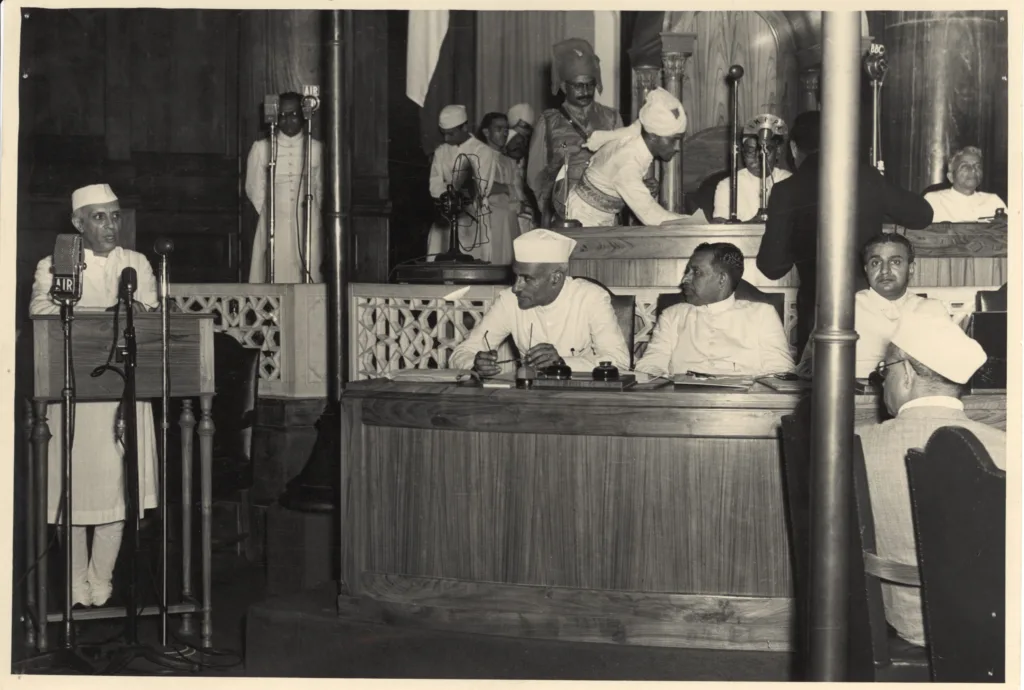
    And then came 1947, carrying with it the strange cruelty that history sometimes reserves for places that have contributed most passionately to its making. Nehru’s celebrated Tryst with Destiny speech, delivered on the eve of independence, imagined India awakening to life and freedom after a long night of subjugation; Bengal entered that same dawn with the knowledge that freedom had also redrawn the map beneath its feet. The partition of Bengal divided families, disrupted economies, displaced millions and transformed the meaning of home for communities on both sides of the new border. Calcutta, which had once stood at the centre of an undivided Bengal and had served as the capital of British India until 1911, became a city negotiating the enormous human consequences of Partition even as the new republic attempted to celebrate its arrival.

    Jawaharlal Nehru delivering his speech, Tryst with Destiny, on the eve of India’s first independence day | Wikipedia
    Jawaharlal Nehru delivering his speech, Tryst with Destiny, on the eve of India’s first independence day | Wikipedia

    This is why the Bengal story of Independence cannot be reduced to nostalgia, however seductive nostalgia may be. To remember Khudiram is to remember the ferocity of youthful conviction; to remember Surya Sen is to remember the audacity of organised rebellion; to remember Pritilata and Matangini is to recognise how extensively women participated in the making of freedom; to remember Netaji is to confront the complexity of nationalism itself; and to remember Partition is to understand that political liberation can coexist with profound human loss. The inheritance is therefore not a simple pantheon of heroes but a complicated archive of courage, disagreement, idealism, violence, sacrifice and grief.

    For India in 2026, that archive acquires renewed significance because the meaning of freedom has inevitably changed. The generation that fought the Raj sought sovereignty; the generation that inherited sovereignty has had to confront poverty, illiteracy, inequality, communal tension, institutional weakness and the enormous challenge of converting political independence into substantive opportunity. The India that now speaks of becoming a developed nation by 2047 is consequently engaged in a second, very different kind of freedom struggle: not against an external sovereign, but against the internal constraints that prevent citizens from exercising the full possibilities of independence.

    Also Read | Did you know Bengal once had its own airline? Here’s why it never took flight

    Bengal, which once supplied so much of the intellectual energy of India’s freedom movement, must find its place within that unfinished project. The challenge is no longer to overthrow an empire, but to build institutions capable of sustaining aspiration; no longer to demand Swaraj, but to translate political liberty into economic dynamism, educational excellence, technological confidence and social dignity. The Bengal that produced revolutionaries, poets, scientists, reformers and political thinkers cannot afford to treat its history as a museum of former greatness; its more demanding obligation is to convert that inheritance into a capacity for renewal.

    Perhaps, then, the most appropriate way to observe Independence Day in Bengal is neither through triumphalism nor through melancholy, but through a more demanding act of remembrance. Eighty years after Nehru spoke of India’s tryst with destiny, the tryst remains unfinished, because freedom, once achieved, does not become self-sustaining merely by virtue of being inherited. Every generation must decide what it will do with the political inheritance placed in its hands.

    The tricolour that rises over Bengal each August therefore carries within it more than the memory of 1947. It carries the unfinished arguments of 1905, the courage of the revolutionaries, the imagination of Tagore, the defiance of Netaji, the sacrifice of Matangini and Pritilata, the wounds of Partition and the aspirations of millions who inherited freedom without ever having witnessed its birth. The awakening of 1947 gave India its sovereignty; the responsibility of 2026 is to determine what that sovereignty can become.

    And perhaps that is the most enduring lesson Bengal can offer a country approaching its centenary: that freedom is not a destination reached at midnight, but a promise whose meaning must be renewed at every dawn.